
Reviewed by: Chief Operations Officer, Product Fulfillment Solutions
Last updated: December 19, 2025
Executive TLDR
Amazon Direct Fulfillment is a vendor program where Amazon owns the customer relationship and product listing, but you ship the order from your own warehouse on Amazon’s behalf.
For brands that ship small, light, non fragile products like supplements, vitamins, cosmetics, wellness items, snacks, and subscription kits, it can be a smart way to grow Amazon revenue without pushing all inventory into Amazon’s network.
It also comes with more operational responsibility. You are on the hook for storage, picking, packing, and shipping, while hitting strict service levels and label requirements.
In this guide, you will follow a fictional brand, Summit Grove Labs, as they evaluate Amazon Direct Fulfillment and decide how to pair it with a central 3PL partner like
Product Fulfillment Solutions in Cincinnati, Ohio.
You will see how to:
- Understand what Amazon Direct Fulfillment really is and how it differs from FBA and FBM
- Weigh the pros and cons for your specific product line
- Use a 3PL to handle the operational workload while you stay focused on product and brand
- Build a 90 day test plan so you learn fast without risking your entire channel
If you already know you want Amazon in your mix, but are unsure how to handle the logistics, you can start a conversation here,
Contact Product Fulfillment Solutions.
Table of Contents
- When Amazon opportunity outgrows your warehouse
- What Amazon Direct Fulfillment actually is
- Story, How Summit Grove Labs evaluated Direct Fulfillment
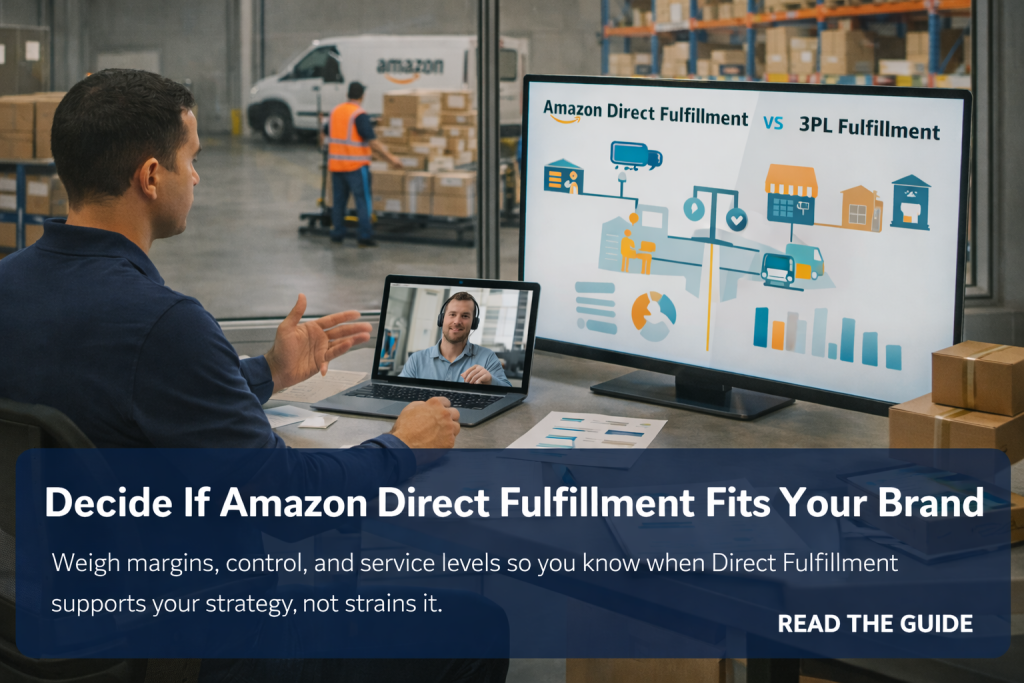
- Amazon Direct Fulfillment vs FBA vs FBM
- Pros and cons of Amazon Direct Fulfillment
- How a 3PL makes Amazon Direct Fulfillment manageable
- A 90 day roadmap to test Amazon Direct Fulfillment
- How Product Fulfillment Solutions supports Amazon vendors
- FAQs about Amazon Direct Fulfillment and 3PL partners
When Amazon opportunity outgrows your warehouse
Summit Grove Labs built a loyal following for their daily wellness packs. Most of their volume came from their own ecommerce store, but Amazon kept creeping up the revenue chart.
- Retailers were asking to buy wholesale so Amazon could list “Sold by Amazon”
- Customers searched on Amazon first, then found the brand site later
- Amazon promotions created unpredictable waves of demand
They liked the exposure and trusted Amazon’s marketing, but their small in house warehouse was starting to feel strained.
- Team members bounced between DTC orders, Amazon prep, and retail shipments
- Cutoffs for Amazon orders were tight and unforgiving
- Any delay in shipping risked chargebacks or unhappy customers
When Amazon suggested they explore Direct Fulfillment as a vendor, the question was not “Is Amazon important” anymore. It was “How do we participate without burning out our operations team.”
What Amazon Direct Fulfillment actually is
Amazon Direct Fulfillment is a vendor based dropship model.
In simple terms:
- Amazon buys your products at wholesale as a vendor
- Amazon lists and markets your products under its own name
- When an order is placed, Amazon sends you a purchase order for a single unit or small batch
- You ship that order directly to the end customer using specific labels and packing rules
You are not operating as a standard seller. You are acting as a vendor that ships on Amazon’s behalf.
That structure creates a clear line.
- Amazon owns the listing, pricing, and much of the customer relationship
- You own the physical fulfillment work and must hit strict service levels
Story, How Summit Grove Labs evaluated Direct Fulfillment
Instead of jumping in blindly, Summit Grove decided to treat Amazon Direct Fulfillment like any other channel test. They mapped the upside and the operational reality before flipping the switch.
The “before” picture, fragmented Amazon fulfillment
Before Direct Fulfillment was on the table, their Amazon picture looked like this:
- Some SKUs were in FBA, which worked well until storage limits kicked in
- Other SKUs were fulfilled from their own warehouse under FBM
- Retail partners occasionally bought wholesale and sold on Amazon independently
Every new Amazon opportunity meant another manual workflow and one more set of exceptions for the operations team to juggle.
Asking the hard questions before joining the program
When they received an invitation to explore Direct Fulfillment, they did not just ask, “What are the fees” They asked:
- Can we keep up with Amazon’s ship by dates from our current warehouse
- How will single unit vendor POs flow through our systems
- What happens to our DTC and retail orders when Amazon demand spikes
Those questions led them to look for a 3PL that could handle both their DTC orders and the new Amazon Direct Fulfillment workload from one central location.
Partnering with a central 3PL before scaling
Summit Grove moved their inventory into
Product Fulfillment Solutions’ Cincinnati, Ohio fulfillment center before expanding their Amazon program.
The goal was straightforward.
- Have one inventory pool for DTC, wholesale, and Amazon Direct Fulfillment
- Use a WMS driven operation to ingest and ship Amazon vendor orders reliably
- Free their internal team to focus on brand, product, and channel strategy
Amazon Direct Fulfillment vs FBA vs FBM
To decide whether Direct Fulfillment fits your strategy, it helps to compare it to the other common Amazon models.
Fulfilled by Amazon (FBA)
- You ship inventory in bulk to Amazon fulfillment centers
- Amazon picks, packs, and ships orders to customers
- You pay storage and fulfillment fees, and may face storage limits or surcharges
- You manage listings and pricing directly in most cases
Fulfilled by Merchant (FBM)
- You store inventory in your own facility or with a 3PL partner
- You pick, pack, and ship orders (or your 3PL does)
- You manage listings, pricing, and customer communications
- All operational responsibility sits on your side of the fence
Amazon Direct Fulfillment
- You operate as a vendor, selling wholesale to Amazon
- Amazon owns the listing and customer relationship
- You ship orders directly to customers using Amazon specific labels and requirements
- Amazon may cover shipping fees, while you cover labor and materials on your side
There is no “best” model for every brand. Many successful companies mix approaches, using Direct Fulfillment for certain product lines, FBA for others, and FBM or direct DTC for the rest.
Pros and cons of Amazon Direct Fulfillment
Direct Fulfillment can be attractive, but you need to go in with eyes open.
Potential benefits
- Access to Amazon’s reach, Amazon presents your products as “Sold by Amazon,” which can increase trust and visibility
- Less dependence on FBA capacity, you are not limited by Amazon’s warehouse space or inbound appointment schedules
- Catalog flexibility, you can offer a wider range of SKUs without sending all of them into FBA
- Operational control, you control packaging quality and can align branding across Amazon and other channels
Real world drawbacks
- More operational work, you must be set up to handle daily vendor POs and strict ship windows
- Complex compliance, labels, packing slips, and routing rules must be followed carefully to avoid chargebacks
- Less control over pricing, as a vendor, Amazon may set retail pricing in ways that impact other channels
- Concentration risk, heavy dependence on a single marketplace partner always deserves attention
How a 3PL makes Amazon Direct Fulfillment manageable
Most brands considering Direct Fulfillment are not excited about building a new internal warehouse team just for Amazon. This is where the right 3PL becomes a strategic partner instead of just a vendor.
Centralizing inventory for all channels
At Product Fulfillment Solutions, we help brands place inventory once and sell through multiple channels, including:
- DTC orders from your own ecommerce site
- Wholesale and retail accounts
- Amazon programs such as Direct Fulfillment and standard marketplace orders
Storing inventory in our Cincinnati fulfillment center means you can reach most US customers in one to three business days by ground while keeping a single, clear view of stock.
Handling Amazon rules inside a WMS driven operation
Amazon Direct Fulfillment is strict about:
- Ship by dates and pickup windows
- Label formats and packing slips
- Carton and shipment level data
We use warehouse management technology and scan based workflows to keep those requirements embedded in daily operations instead of relying on memory and sticky notes.
Protecting your other channels when Amazon spikes
One of the biggest risks with Direct Fulfillment is letting Amazon demand crowd out your DTC and retail customers.
- We work with brands to set priorities and capacity plans before peak periods
- Cutoffs and service level expectations are mapped for each channel
- Reporting shows how volume is shifting so you can adjust strategy, not just react
A 90 day roadmap to test Amazon Direct Fulfillment
You do not have to commit your entire catalog to Direct Fulfillment on day one. A structured 90 day test can tell you a lot.
Days 1 to 30, Model and prepare
- Identify a limited set of SKUs that are a good fit, small, light, and steady demand
- Map current Amazon volume, margins, and service levels
- Align with your 3PL on label formats, data flows, and capacity for vendor POs
Days 31 to 60, Launch a controlled pilot
- Go live with Direct Fulfillment for the selected SKUs
- Track on time ship, error rate, and operational workload closely
- Compare performance to your previous FBA or FBM setup for the same items
Days 61 to 90, Evaluate and decide
- Review financial results, including wholesale margins and fulfillment costs
- Look at channel health, did this model support or conflict with your other Amazon and DTC strategies
- Decide whether to expand, adjust, or pull back, based on data not assumptions
How Product Fulfillment Solutions supports Amazon vendors
Product Fulfillment Solutions is a Cincinnati based 3PL focused on brands that ship small, light, non fragile products such as supplements, vitamins, cosmetics, wellness items, snacks, and subscription boxes.
For brands working with Amazon, we help by:
- Storing inventory centrally and supporting multiple Amazon programs alongside your DTC and wholesale channels
- Coordinating with your systems and integration partners so Amazon orders flow directly into our WMS
- Running scan based receiving, picking, and packing to protect accuracy and brand standards
- Sharing clear reporting so you can see how Amazon performance fits into your wider supply chain picture
Amazon is a powerful growth lever. With the right logistics partner, you can pull that lever without putting your entire operation on edge.
Talk to an ExpertFAQs about Amazon Direct Fulfillment and 3PL partners
What is Amazon Direct Fulfillment in simple terms
Amazon Direct Fulfillment is a vendor program where Amazon buys your products at wholesale, lists them under its own name, and sends you individual purchase orders to ship directly to customers. You handle fulfillment from your facility or 3PL while following Amazon’s requirements.
How is Direct Fulfillment different from FBA
With FBA, you ship inventory in bulk to Amazon’s warehouses and Amazon fulfills orders. With Direct Fulfillment, you keep inventory in your own warehouse or 3PL and ship orders directly to customers when Amazon sends you vendor POs.
What kind of brands are a good fit for Direct Fulfillment
Brands with small, light, non fragile products and reliable operations are often a better fit. You should be confident in your ability, or your 3PL’s ability, to hit Amazon’s service levels and handle the additional order flow without hurting other channels.
Can I use a 3PL to handle Amazon Direct Fulfillment
Yes. Many brands work with a 3PL that integrates with Amazon vendor systems or with approved middleware so vendor POs flow directly into the warehouse. The 3PL then picks, packs, and ships on your behalf according to Amazon’s rules.
How does Product Fulfillment Solutions support Amazon Direct Fulfillment
Product Fulfillment Solutions supports Amazon related programs by centralizing inventory in our Cincinnati fulfillment center, integrating with your chosen Amazon connectors, and running WMS driven operations that respect label, packing, and service level requirements. We help you treat Amazon as one part of a healthy channel mix instead of an operational fire drill.
Talk to an Expert