
Reviewed by: Chief Operations Officer, Product Fulfillment Solutions
Last updated: January 16, 2026
Executive TLDR
Warehouse sorting can quietly make or break your fulfillment operation. When sorting is clean and intentional, orders flow smoothly, labor stays under control, and customers get what they ordered on time. When it is not, you see mis picks, frustrated staff, and “where is my order” tickets piling up.
For ecommerce brands shipping small, light, non fragile products, supplements, vitamins, cosmetics, wellness items, snacks, and subscription kits, sorting is where speed meets accuracy. You are often dealing with many small orders, lots of similar SKUs, and tight cutoffs. Sorting is what keeps that from turning into daily chaos.
This guide walks through how warehouse sorting really works, the methods that fit ecommerce brands best, and how a central 3PL partner like
Product Fulfillment Solutions and our
Cincinnati, Ohio fulfillment center can handle the heavy lifting so you can focus on growth instead of sorting bins.
If you already know your current sorting approach is straining under your volume, you can start the conversation here:
Contact Product Fulfillment Solutions.
Table of Contents
- When warehouse sorting starts to hurt or help
- Story, How Northline Naturals cleaned up their sorting
- What warehouse sorting really means
- Common warehouse sorting methods for ecommerce
- Signs your current sorting process is holding you back
- How to redesign warehouse sorting for ecommerce
- Using data to keep sorting smart
- Why a central Cincinnati 3PL helps sorting pay off
- How Product Fulfillment Solutions handles warehouse sorting
- Warehouse sorting FAQs
When warehouse sorting starts to hurt or help
In the early stages, your “sorting system” may just be a table near the dock, a few carts, and whoever is free to help. It is messy, but volumes are low enough that you can get away with it.
Sorting starts to really matter when:
- Your order volume grows to hundreds or thousands of orders per day
- You support multiple channels, DTC, marketplace, and wholesale, from the same building
- Carriers have tight pickup windows and you cannot miss them without paying for it
- Your team spends too much time searching for the right totes, pallets, or cartons
At that point, “we will figure it out as we go” sorting turns into lost time, lost product, and avoidable mistakes.
Story, How Northline Naturals cleaned up their sorting
Picture a fictional brand called Northline Naturals. They sell daily vitamin packs, powdered drink sticks, and small wellness add ons, all perfect for parcel shipping.
The “before” picture, sorting by instinct
In the beginning, their operation looked like many growing ecommerce brands:
- Orders printed in batches and piled near the packing tables
- Carts loaded with a mix of orders headed to different carriers and zones
- Completed orders stacked around the dock with handwritten notes for where they should go
Everyone was working hard, but the system relied on whoever “knew the drill” that day.
Pain points that kept showing up
- Orders occasionally missed the right carrier pickup because they were sorted late
- Mixed up pallets for wholesale shipments created chargebacks and frustration
- Support tickets spiked whenever daily volume spiked
The shift, structured sorting with a 3PL partner
Northline moved into a central 3PL environment similar to
Product Fulfillment Solutions’ Cincinnati fulfillment center and rebuilt sorting around clear rules.
- Orders were grouped by carrier and service level earlier in the process
- Dedicated sortation areas and lanes were set up for key carriers and wholesale partners
- Scan based checks confirmed that each order landed in the correct location before loading
The result was not glamorous, but it was powerful, fewer mistakes, smoother dock operations, and a team that was tired from productive work, not from chaos.
What warehouse sorting really means
Warehouse sorting is about getting items and orders into the right place at the right time, so the next step in the process is obvious and easy.
For ecommerce brands, sorting typically shows up in a few places.
Sorting inbound inventory
- Separating pallets by supplier, product family, or destination area in the warehouse
- Routing inventory to reserve storage, forward pick, kitting, or quality hold areas
- Organizing returns so they can be inspected and either restocked, written off, or reworked
Sorting during pick and pack
- Grouping orders into waves or clusters so pickers can work efficiently
- Separating completed orders by carrier, ship method, or cutoff time
- Directing fragile or special handling orders to specific packing stations
Sorting at the dock and before shipping
- Organizing parcels into gaylords, cages, or carts by carrier and service level
- Sorting pallets for LTL or truckload by destination and appointment time
- Staging shipments in sequence for clean loading and accurate manifests
Good sorting means every item and every order knows where it is going next without someone having to stop and think about it every time.
Common warehouse sorting methods for ecommerce
You do not need a huge automation budget to improve sorting, but you do need a clear method that fits your operation.
Manual sorting with clear lanes
This is the simplest approach, and it can work surprisingly well when it is intentional.
- Dedicated tables, racks, or floor-marked lanes for each carrier, ship method, or wholesale partner
- Color coded labels and carts that match those lanes
- Standard work, so everyone knows where each order or carton is supposed to land
Sortation with put walls and light guides
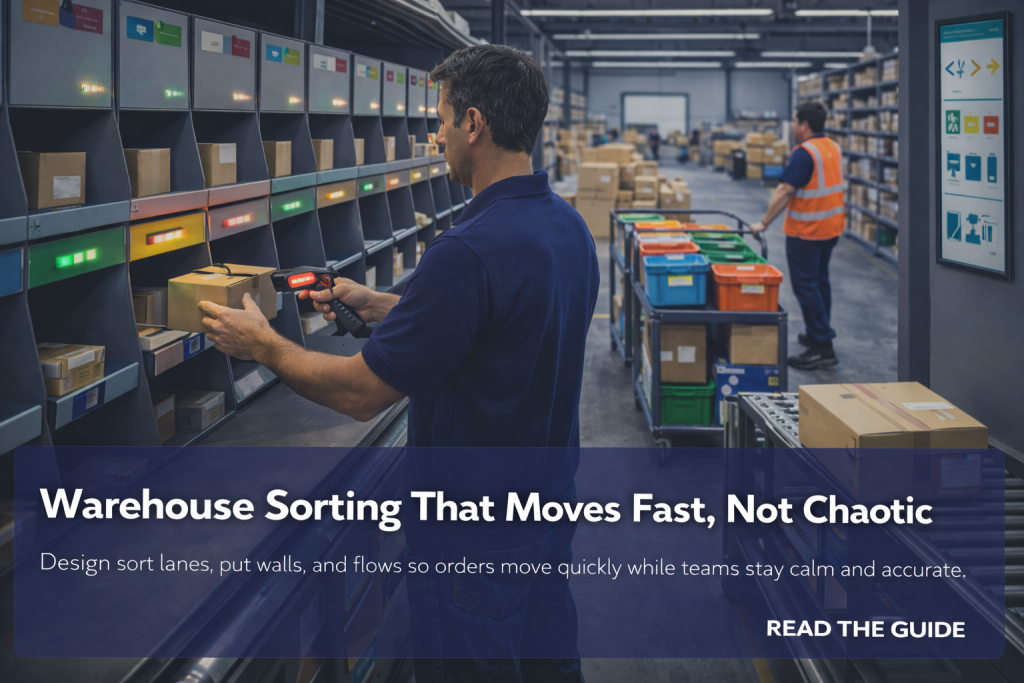
Put walls are racks or walls with cubbies representing orders, routes, or destinations. Pickers bring items to the wall, then scan and “put” them into the indicated slot.
- Great for high volume, small item operations with many partial orders in flight
- Helps separate picking from sorting and packing tasks
- Reduces walking and speeds up final sortation
Automated or semi automated sortation systems
These include belt sorters, sliding shoe sorters, and other conveyor based systems that can divert cartons automatically.
- Ideal for very high volume operations with consistent carton sizes
- Major capital investment, usually more appropriate once you have scaled significantly
- Requires tight coordination between WMS, hardware, and carrier schedules
Sorting by waves, routes, or cutoff times
Even without hardware, you can sort logically in time.
- Release orders in waves that match carrier cutoff times and dock schedules
- Group wholesale orders by route or destination region
- Use your WMS to prioritize and group work so sorting becomes easier downstream
Signs your current sorting process is holding you back
Sorting issues rarely announce themselves politely. They show up as symptoms elsewhere.
Recurring mis ships and misrouted orders
- Orders that end up on the wrong carrier or wrong service level
- Wholesale pallets with mixed SKUs in the wrong tiers or layers
- Frequent rework at the dock as someone double checks what is headed out
Missed or risky carrier pickups
- Teams rushing to sort and stage right before pickup times
- Carriers waiting while the warehouse “finishes a few more orders”
- Late handoffs that translate into late deliveries and higher costs
Confused teams and cluttered staging areas
- Piles of completed orders with no clear labeling or grouping
- Staff constantly asking where to put a given order or carton
- Staging areas that feel like a traffic jam instead of a smooth flow
Expensive fixes to simple problems
When sorting is weak, you end up paying for extra air shipments, rework, reships, and chargebacks that could have been prevented with a better system.
How to redesign warehouse sorting for ecommerce
You do not have to rebuild your entire warehouse to improve sorting. You do need to be intentional and honest about what is working and what is not.
Step 1, Map your current flow
- Follow a typical order from the moment it is released to the warehouse until it leaves the dock
- Note where it gets picked, packed, labeled, and staged
- Mark every point where someone has to stop and decide “where does this go”
Step 2, Define your sorting dimensions
Decide what you need to sort by most often. For ecommerce brands, this is usually a mix of:
- Carrier and service level, for example UPS Ground, USPS, regional carrier
- Order type, DTC, marketplace, wholesale, subscription
- Cutoff time or ship by commitment
Step 3, Create simple physical structures
- Dedicated tables, racks, or floor lanes labeled by carrier and ship method
- Color coded totes or carts that match those labels
- Clear signage so even a new team member can see where things belong
Step 4, Standardize the hand offs
- Define who is responsible for moving orders from pack out to staging
- Set timing rules, for example all orders for a given carrier must be staged 30 minutes before pickup
- Use scanning at key checkpoints so your system knows where orders are
Step 5, Start small, then layer in automation
- Run the new sorting rules manually first with a small subset of orders
- Fix obvious issues with lanes, labels, and responsibilities
- As volume grows, evaluate put walls, conveyors, or additional tech where the business case is clear
Using data to keep sorting smart
Sorting is not a set it and forget it project. Your order mix, carriers, and volume will change. Data helps you keep your process honest.
Track where errors actually happen
- Classify issues by root cause, picking, packing, sorting, or carrier
- Watch for patterns around specific carriers, zones, or order types
- Use that insight to improve training and layout in the highest risk areas
Watch dock and carrier performance
- Measure how often you are hitting internal staging deadlines
- Monitor on time dispatch for each carrier and service level
- Review any recurring exceptions or missed pickups and the causes
Use order data to refine sorting rules
- Group common order profiles together so pick and sort flows stay efficient
- Adjust waves and cutoffs based on real order arrival patterns during the day
- Revisit your sorting dimensions if your channel mix changes significantly
Why a central Cincinnati 3PL helps sorting pay off
Sorting is about internal efficiency, but its value shows up in your customer experience. Location turns that efficiency into faster, more reliable delivery.
From a central hub like
Cincinnati, Ohio, a large share of the United States is reachable within one to three business days by ground. For small, light ecommerce products, that matters because:
- Clean sorting into the right carrier lanes translates into consistent transit times
- You can build simple, honest shipping promises into your site that most customers will actually experience
- You rely less on expensive air shipments just to hit delivery expectations
Sorting gets orders to the right truck on time, a central location helps the truck get those orders to your customers on time.
How Product Fulfillment Solutions handles warehouse sorting
Product Fulfillment Solutions is a Cincinnati based 3PL focused on ecommerce brands that ship small, light, non fragile products that customers reorder often.
For sorting, our job is to make the movement from pick to pack to dock feel controlled, predictable, and scalable as your volume grows. In practice, that looks like:
- 1. We start with your reality, not a generic template, your carriers, your service levels, your channels, and your volume patterns
- 2. We define sorting rules and lanes around your business, by carrier, ship method, cutoff, or customer type as needed
- 3. We use scan based workflows, to confirm that orders are picked correctly and staged in the right place before they leave the building
- 4. We align sorting with dock and carrier schedules, so your orders are ready when trucks arrive instead of rushing at the last minute
- 5. We give you visibility, reporting on accuracy, on time shipment, and exceptions so you can see how sorting and overall fulfillment are performing
The goal is simple, your customers get the experience you promised, and your team gets a warehouse that feels organized rather than overwhelmed.
Talk to an ExpertWarehouse sorting FAQs
How do I know if I need to invest in better sorting
Look for recurring mis ships, late carrier handoffs, cluttered staging areas, and a team that constantly asks where orders should go next. If you feel nervous about hitting cutoffs on busy days or see the same avoidable mistakes show up on reports, your sorting process is probably due for an upgrade.
Do I need expensive automation to improve sorting
Not at first. Many brands see big gains with simple, disciplined approaches like clearly labeled lanes, color coded totes, standard work instructions, and better wave planning. Higher end automation is most useful once you have already outgrown what a well organized manual system can handle.
How does sorting impact my shipping costs
When sorting is tight, orders reach the right carriers on time and in the right configurations, which reduces last minute air upgrades, misrouted parcels, and chargebacks. It also helps you keep promises on ground services, which are usually more cost effective than rush options.
How often should we review or change our sorting process
You should review sorting whenever your volume, carrier mix, or channel mix changes significantly. At a minimum, plan a structured review at least once or twice a year to look at error patterns, dock performance, and staging congestion.
How does Product Fulfillment Solutions support warehouse sorting for ecommerce brands
Product Fulfillment Solutions supports sorting by combining scan based warehouse technology, clear physical lanes, and a central Cincinnati fulfillment center that aligns with major carrier networks. We work with you to define sorting rules and workflows that match your products and promises, then keep refining them as your brand grows.
Talk to an Expert