
Author: Jason Martin
Last updated: February 2, 2026
Executive TLDR
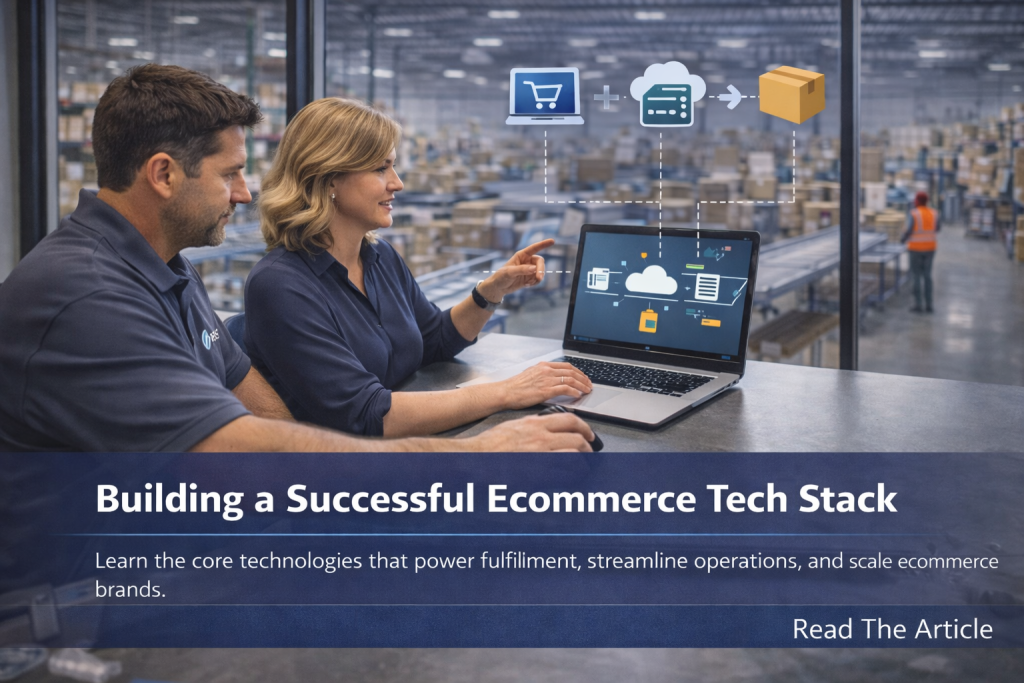
An ecommerce tech stack is the set of software your business uses to run online sales, manage inventory, and support fulfillment. The right stack not only drives conversion but also reduces fulfillment errors and operational costs.
This guide breaks down the essential components of an ecommerce tech stack, how they connect with fulfillment workflows, and what a 3PL partner like Product Fulfillment Solutions expects from your tech to hit SLAs consistently.
If your stack feels fragmented or fulfillment performance is lagging,
Contact Product Fulfillment Solutions
for alignment and advice.
Table of contents
- When Your Tech Stack Starts to Matter
- Story: How Vita Supplements Synced Tech and Fulfillment
- Core Components of an Ecommerce Tech Stack
- Inventory and Fulfillment Connections That Matter
- Choosing the Right Systems for Growth
- How a 3PL Partners With Your Tech Stack
- Ecommerce Tech Stack FAQs
When Your Tech Stack Starts to Matter
In the earliest stages of ecommerce, brands can get by with basic solutions — a marketplace listing, simple cart, and manual inventory tracking. But once order volume and SKU count increase, a disjointed tech stack leads to:
- Stockouts and oversells
- Manual data entry errors
- Delayed fulfillment and customer dissatisfaction
- Costly labor wasted on reconciliation instead of strategizing
At this point, tech stack decisions become fulfillment decisions.
Story: How Vita Supplements Synced Tech and Fulfillment
Before
Vita Supplements was an up-and-coming health brand selling on multiple channels. But orders were landing in different systems, inventory counts didn’t match reality, and fulfillment partners were chasing updates.
Pain points
- Manual inventory uploads causing discrepancies
- Multiple carts not syncing orders in real time
- Warehouse staff unaware of channel-specific SLAs
The Shift
Vita switched to a unified stack that connected their ecommerce platform, inventory system, and reporting dashboards. Through integration with their fulfillment partner’s systems — including real-time reads into SKU availability — orders flowed cleanly from checkout to pick pack to dispatch.
Accuracy improved, labor dropped, and delays became rare instead of daily.
Core Components of an Ecommerce Tech Stack
1. Ecommerce Platform
This is your storefront engine — Shopify, BigCommerce, Magento, or a custom platform. It must support:
- Multi-channel listings
- Promotions, bundling, and subscriptions
- Checkout flexibility and payment options
2. Inventory Management System (IMS)
A true IMS centralizes SKU counts, tracks quantities across warehouses, and supports safety stock logic. This is the critical bridge between sales and fulfillment accuracy.
3. Warehouse Management System (WMS)
The WMS controls what happens inside the fulfillment environment — picking strategies, staging, cycle counts, lot tracking, and scan logic. A synced WMS prevents oversells and improves pick/pack speed.
4. Order Management System (OMS)
The OMS routes orders, manages split or combined shipments, and balances channel priorities. For complex stack needs, OMS rules determine how orders interact with the fulfillment partner.
5. Shipping and Carrier Tools
Rate shopping, label generation, and carrier selection tools help brands choose the best balance of cost and delivery promise.
6. Analytics and BI Tools
Dashboards that combine sales trends, inventory age, returns, and fulfillment KPIs empower data-driven decisions.
Inventory and Fulfillment Connections That Matter
A strong tech stack shares data bi-directionally:
- Inventory available vs allocated
- Real-time updates to order status
- Returns and restocking events
- Carrier tracking shared back to customers
Brands with multi-warehouse fulfillment — especially those working with a 3PL — should prioritize real-time inventory visibility across channels and fulfillment locations.
This is where integration with a 3PL’s systems — like PFS’s real-time data feed and dashboard — turns your stack from reactive to reliable.
Choosing the Right Systems for Growth
Not all stacks are equal. As you evaluate tools, consider:
- Does it support real-time inventory updates?
(No lag means fewer stockouts.) - Can it manage multi-channel sales and split shipments?
- Does it integrate with your fulfillment partner or WMS?
- Is it modular and scalable as orders grow?
Investing early in the right components saves costs and headaches later.
Talk to an Expert
How a 3PL Partners With Your Tech Stack
A 3PL like PFS doesn’t just receive orders. It connects your tech with fulfillment execution:
- Real-time inventory syncs for accuracy
- Order status updates pushed back to your OMS
- Carrier selection aligned with inventory location
- Kitting, assembly, and returns logged back into your systems
When systems talk clearly, fulfillment errors fall and operations scale cleanly. PFS offers seamless integration so your stack drives growth, not trouble.
Talk to an Expert
Ecommerce Tech Stack FAQs
Do I need a WMS if my 3PL has one?
Yes. Your ecommerce platform and WMS should be integrated so inventory counts and fulfillment assignments stay aligned in real time.
What is the difference between OMS and IMS?
IMS tracks quantities and availability. OMS routes orders, assigns fulfillment logic, and manages split shipments.
How do I prevent oversells?
Real-time inventory sync across all channels and fulfillment locations is the best defense against oversells.
Can a 3PL integrate with custom ecommerce stacks?
Yes. Modern 3PLs support APIs, EDI, and data feeds that connect with both off-the-shelf and custom systems.