
Reviewed by: Chief Operations Officer, Product Fulfillment Solutions
Last updated: February 23, 2026
Executive TLDR
Warehouse 5S is a simple but powerful set of practices for organizing workspace, reducing waste, and creating predictable fulfillment flow. When ecommerce operations scale, disorganized inventory and cluttered workstations increase picking errors, slow throughput, and frustrate teams.
In this article, we break down the five steps of 5S, show practical ways to apply them in ecommerce fulfillment, and explain how a disciplined environment reduces cycle times, improves accuracy, and supports growth without chaos.
If you already know you need a more reliable fulfillment environment, you can start the conversation here, Contact Product Fulfillment Solutions.
Table of contents
- When Warehouse 5S Starts to Matter
- Story: How 5S Improved Sunnyside Snacks Fulfillment
- The Five Steps of Warehouse 5S
- Measuring Success With 5S
- 5S and Warehouse Technology
- 5S Mistakes to Avoid
- Warehouse 5S FAQs
When Warehouse 5S Starts to Matter
Warehouse 5S usually becomes relevant as operations grow beyond manual control. Early on, teams can find stock quickly and process orders with informal systems. But as SKUs multiply, orders increase, and peak demand cycles begin, disorganization costs time and money.
Ecommerce fulfillment workflows suffer when clutter slows picking, misplaced items require retracing steps, and tools or supplies are hard to find. Warehouse 5S introduces a structured approach to eliminate these inefficiencies before they become chronic problems.
Story: How 5S Improved Sunnyside Snacks Fulfillment
Before
Sunnyside Snacks, a fast growing snack subscription brand, had rapid growth in orders but limited warehouse discipline. Pick faces were crowded, obsolete cartons piled up, and fulfillment teams spent excessive time searching for tools and inventory locations.
Pain points
- High picking errors
- Slow packing throughput
- Frustrated new staff due to lack of standards
- Cluttered aisles creating safety hazards
The shift
After adopting a warehouse 5S program, Sunnyside reorganized storage areas, labeled all zones, standardized cart locations, and trained the team on upkeep. Errors dropped, cycle times improved, and onboarding new staff became faster and less stressful.
The Five Steps of Warehouse 5S
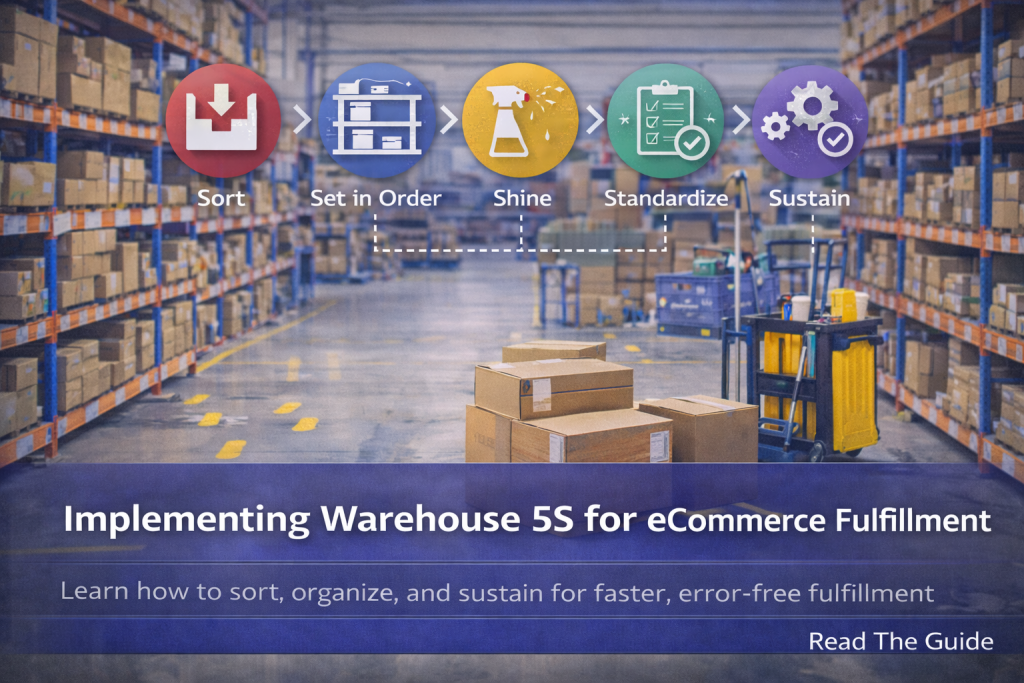
1. Sort
Remove unnecessary items from the work area. In a fulfillment environment, that means clearing obsolete packaging, empty bins, and unused tools from picking and packing zones. Keep only what is needed for the current workflow.
2. Set in Order
Create logical places for everything. Assign locations for each SKU, pallet size, carton type, and fulfillment tool. Label shelves, racks, and bins so anyone can find the right item quickly and return it correctly.
3. Shine
Clean and inspect regularly. Sweep aisles, wipe down surfaces, and verify that storage areas are free of debris. A clean environment helps reveal abnormalities like leaks, damage, or miscounts before they cause bigger problems.
4. Standardize
Document consistent workflows. Create checklists for picking and packing stations, establish procedures for restocking, and post visual standards so everyone understands what a correct work area looks like.
5. Sustain
Make 5S a habit, not a project. Conduct daily or weekly audits, assign ownership, and build accountability into routine operations. Reward teams for compliance and continuous improvement.
Talk to an Expert
Measuring Success With 5S
Track simple operational metrics to gauge effectiveness:
- Order processing time before and after implementation
- Picking and packing error rates
- Time spent searching for misplaced stock
- Cycle count adjustments due to misplacement
Improvements in these metrics indicate that your 5S program is delivering real value and reducing hidden operational costs.
5S and Warehouse Technology
Warehouse technology enhances 5S by providing visibility and automation. Real-time inventory systems ensure accuracy, barcode scanning reduces manual mislocation errors, and batch tracking helps confirm that items are stored and picked according to standards.
Integrating technology with 5S practices creates a disciplined fulfillment environment where everything has a place, and that place is accurately tracked and maintained.
5S Mistakes to Avoid
- Starting 5S without team buy-in or training
- Failing to maintain updated labels or zone maps
- Ignoring periodic audits and allowing drift back into chaos
- Not linking 5S to operational metrics and accountability
Warehouse 5S FAQs
What is warehouse 5S?
Warehouse 5S is a structured approach to organizing and maintaining your workspace so it operates efficiently and consistently, reducing waste and errors in fulfillment workflows.
Does 5S work for ecommerce fulfillment?
Yes. Ecommerce fulfillment often involves high SKU counts and rapid movements. 5S helps structure that activity to reduce picking errors and speed throughput.
How long does it take to implement 5S?
Initial organization can take a few days to a few weeks, depending on warehouse size. Sustaining the practice is an ongoing effort integrated into daily operations.
Can technology help with 5S?
Yes. Inventory systems, barcode scanning, and real-time reporting reinforce 5S by making stock locations and workflows visible and verifiable.
Who should lead a 5S program?
Operations leaders with support from fulfillment teams should champion 5S and regularly audit compliance to maintain standards.
Talk to an Expert