
Author:Jason Martin
Last updated: February 3, 2026
Executive TLDR
A loading dock is more than a place where trucks park — it’s the gateway between transportation and fulfillment.
Well-designed loading dock operations improve inbound accuracy, outbound speed, labor efficiency, and inventory flow. Poorly managed docks create bottlenecks that ripple through receiving, picking, packing, and shipping.
If dock congestion or slow receiving is impacting your fulfillment,
contact Product Fulfillment Solutions
to evaluate your inbound and outbound workflows.
Table of contents
- What Is a Loading Dock?
- Why Loading Docks Matter in Fulfillment
- Types of Loading Docks
- Key Loading Dock Components
- How Loading Docks Affect Warehouse Performance
- How 3PLs Optimize Loading Dock Operations
- Loading Dock FAQs
What Is a Loading Dock?
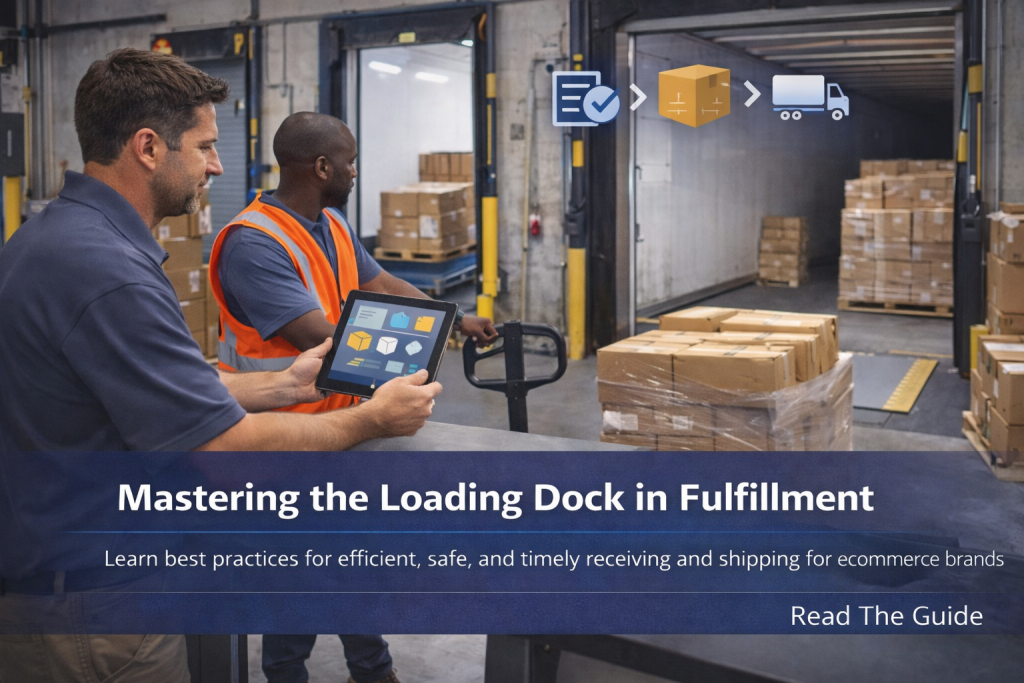
A loading dock is a designated area of a warehouse or fulfillment center where inbound freight is received and outbound shipments are dispatched.
It serves as the transition point between transportation providers (trucks, trailers, containers) and internal warehouse operations.
In ecommerce fulfillment, loading docks support:
- Inbound receiving and inspection
- Outbound order staging
- Carrier handoff and documentation
- Inventory flow into storage or picking locations
Why Loading Docks Matter in Fulfillment
Loading docks are one of the most common sources of warehouse congestion.
If dock operations are inefficient, the impact spreads quickly:
- Inbound freight waits longer to be received
- Inventory updates are delayed
- Pickers lack available stock
- Outbound orders miss carrier cutoffs
Efficient dock operations keep inventory moving and protect downstream fulfillment performance.
Types of Loading Docks
1. Flush Docks
Flush docks are built level with the warehouse exterior wall. They require dock levelers to bridge the gap between trailer and floor.
2. Open Docks
Open docks lack overhead doors and are typically used in mild climates or for high-volume operations where speed matters more than environmental control.
3. Sawtooth Docks
Sawtooth docks angle trailers away from the building, allowing tighter yard spacing and improved maneuverability.
4. Enclosed or Climate-Controlled Docks
Used for temperature-sensitive goods, enclosed docks protect inventory during loading and unloading.
Key Loading Dock Components
- Dock doors: Control access and security
- Dock levelers: Bridge height differences between trailers and warehouse floors
- Dock seals and shelters: Reduce air loss and protect goods
- Yard management systems: Track trailer locations and dock assignments
- Material handling equipment: Forklifts, pallet jacks, conveyors
Each component plays a role in maintaining safe, efficient freight movement.
How Loading Docks Affect Warehouse Performance
Dock efficiency directly impacts:
- Receiving speed: Faster unloading means inventory becomes available sooner
- Labor utilization: Reduced waiting time improves productivity
- Inventory accuracy: Timely receiving updates prevent overselling
- Outbound velocity: Orders stage and ship on schedule
In peak season, dock performance often determines whether fulfillment keeps up — or falls behind.
How 3PLs Optimize Loading Dock Operations
A 3PL like Product Fulfillment Solutions treats the dock as a strategic control point:
- Scheduled inbound appointments
- Dedicated receiving teams
- Pre-allocation of storage locations
- Carrier coordination and cutoff management
- Real-time inventory updates upon receipt
Optimized dock workflows reduce dwell time, prevent congestion, and keep fulfillment flowing.
Talk to an Expert
Loading Dock FAQs
What is the main purpose of a loading dock?
To safely and efficiently transfer goods between transportation vehicles and warehouse operations.
How many loading docks does a warehouse need?
It depends on order volume, freight frequency, and dock turnaround time.
Do loading docks affect inventory accuracy?
Yes. Delayed receiving at the dock leads to inaccurate inventory availability.
Can a 3PL improve loading dock efficiency?
Yes. A 3PL standardizes dock processes, staffing, scheduling, and technology.