Reviewed by: Chief Operations Officer, Product Fulfillment Solutions
Last updated: November 26, 2025
Executive TLDR
Supply chain automation is not about replacing people with robots. It is about taking the boring, repetitive work out of your day so your team can focus on what actually grows the brand.
For ecommerce brands shipping small, light, non fragile products like supplements, cosmetics, wellness items, snacks, and subscription kits, smart automation looks like this:
- Orders flow from your sales channels to the warehouse without manual uploads
- Scanners, barcodes, and a WMS guide pick and pack so accuracy stays high
- Labels, documents, and shipping choices are generated automatically based on rules you set
- Simple dashboards show whether you are hitting service levels in real time
This article follows a fictional brand, FlowWell Naturals, as they move from a mostly manual operation to a practical level of automation with a third party logistics partner. Under the story, you will see:
- What supply chain automation really means for growing ecommerce brands
- Where automation delivers the biggest payoff inside a fulfillment center
- How to choose a level of automation that fits your size and budget
- How Product Fulfillment Solutions uses operator friendly automation in our Cincinnati warehouse
If you want to talk through what a more automated, less stressful operation could look like for your brand, you can start here:
Contact Product Fulfillment Solutions.
When manual work starts to hold you back
FlowWell Naturals had the kind of problem most founders secretly want.
Sales were growing fast. A few influencer hits, a strong subscription base, and a couple of key retail accounts had the brand humming.
Operations told a different story:
- Orders were exported from the storefront and imported into the shipping system by hand
- Pick tickets printed on paper, highlighted with markers, and walked out to the floor
- Packers memorized which SKUs needed inserts, insulated mailers, or special tape
- Every small change in a promotion meant a new round of instructions
On a normal Tuesday, it was fine. On big days, the cracks showed up as mis ships, overtime, and a lot of “just this once” manual fixes.
One afternoon, after a last minute promotion pushed orders far past forecast, the operations manager looked at the stack of paper on the shipping desk and said what everyone was thinking.
“We do not need more heroes. We need better systems.”
Table of Contents
- What supply chain automation means for ecommerce brands
- Story: How FlowWell Naturals automated without losing the human touch
- Where automation delivers the biggest payoff in fulfillment
- Choosing the right level of automation for your brand
- Data and KPIs that should drive your automation decisions
- How to get started with supply chain automation in 90 days
- How Product Fulfillment Solutions thinks about automation
- FAQs about supply chain automation and 3PLs
What supply chain automation means for ecommerce brands
Supply chain automation is a broad phrase. For ecommerce brands, it gets real in a few specific ways.
At a practical level, automation usually means:
- Order automation. Orders flow from your ecommerce platforms and marketplaces straight into a WMS without manual file work.
- Guided warehouse work. Pickers follow scanner directed paths, not guesswork. Packers see pack instructions on screen, not in email threads.
- Rule based shipping. Service levels, carrier choices, and label generation follow rules, not individual judgment on every order.
- Automated reporting. Key metrics update in near real time so you do not need a weekly spreadsheet marathon to know what is happening.
Good automation does not remove the human element. It gives your people fewer opportunities to make avoidable mistakes and more time to solve real problems.
Story: How FlowWell Naturals automated without losing the human touch
FlowWell Naturals had a strong brand and a loyal customer base. Their products were small, light, and easy to ship. Their operations, on the other hand, still felt like a startup garage, only with taller racks.
Before automation: busy hands, tired brains
Their “before” picture looked like this:
- Orders downloaded and cleaned in spreadsheets every morning and afternoon
- Pickers using printed lists with handwritten notes for rush orders and special packs
- Packers checking a laminated sheet to remember which SKUs needed which insert or mailer
- Customer service sending individual emails to the warehouse for VIP orders or last minute address changes
The team cared, which helped. But caring does not scale. Systems do.
Deciding to partner with a 3PL
FlowWell’s leadership compared two options:
- Invest heavily in their own automation equipment and software, then learn how to run it
- Partner with a third party logistics provider that already had the right level of automation and a central location
They chose the second path and partnered with
Product Fulfillment Solutions to move fulfillment into our Cincinnati, Ohio facility.
The move to an operator friendly automated warehouse
FlowWell was not looking for a fully robotic showpiece. They wanted a warehouse where technology made every shift smoother.
Inside our Cincinnati fulfillment center, they saw:
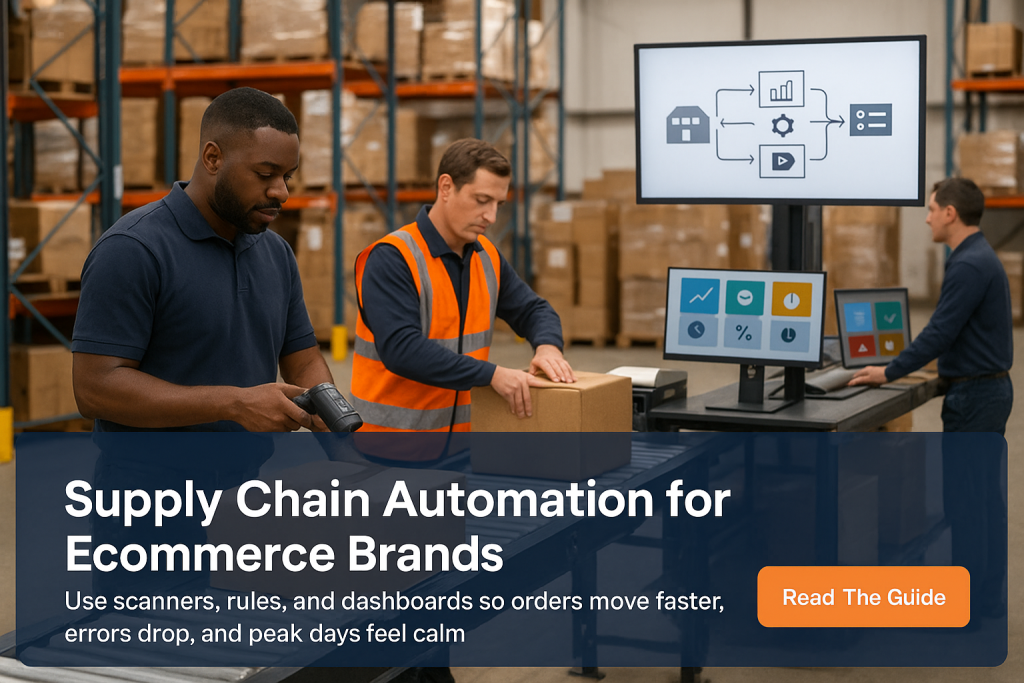
- Scanner directed picking so associates followed efficient routes instead of zig zagging
- Pack stations with on screen instructions that updated automatically when promotions changed
- Shipping software that selected services based on rules about weight, destination, and promise date
- Simple dashboards for backlog, on time ship, and exceptions, visible to both teams
In other words, the people still did the work. Automation removed the friction.
What changed after automation
Within a few months of the move:
- Manual order imports disappeared, freeing hours of admin time each week
- Order accuracy improved because scanners and checks caught mismatches earlier
- Rush orders flowed through the same system with priority rules instead of panicked emails
- Customer service could see order status without chasing updates on the floor
FlowWell did not lose their personal touch. They lost their avoidable chaos.
Where automation delivers the biggest payoff in fulfillment
It is easy to picture automation as robots and conveyors. In reality, some of the highest return moves are simple and software driven.
1. Order orchestration and routing
Automation starts before anyone touches a box.
With the right setup, orders:
- Flow automatically from your ecommerce platforms into the WMS
- Are batched and prioritized based on rules you define, such as cutoffs or channel
- Trigger alerts when something looks off, like an invalid address or missing SKU
2. Scanner directed pick and pack
Handwriting and memory are not control systems. Scanners and barcodes are.
Scanner directed work means:
- Pickers confirm each location and SKU with a scan, which reduces mis picks
- Pick paths are optimized so associates walk less and ship more
- Packers scan items into the box, confirming the order is complete before sealing
3. Shipping rules and label automation
Instead of deciding service levels order by order, you can set rules based on:
- Destination zones and promised delivery dates
- Order weight and carton size
- Channel commitments for premium customers or retailers
Labels, documents, and tracking updates follow those rules automatically. Humans step in only when there is a true exception.
4. Exception handling and alerts
Not every order will flow perfectly. Good automation does not pretend otherwise. It flags exceptions early so someone can step in while there is still time to fix them.
Talk to an Expert
Choosing the right level of automation for your brand
More automation is not always better. The goal is the right automation for your volume, product mix, and growth plan.
Questions to ask before you invest
- What is actually holding us back today, speed, accuracy, visibility, or labor cost
- Are our current processes stable enough to automate, or are we still reinventing them every quarter
- Do we want to own and operate hardware, or would we rather plug into a 3PL that already has what we need
Lightweight automation vs heavy infrastructure
Most small to mid sized ecommerce brands see strong returns from:
- Scanner and WMS driven workflows
- Rule based shipping automation
- Simple conveyors and pack station setups
High density storage systems or fully robotic picking may only make sense at very high volume or when labor markets are especially tight. A partner like Product Fulfillment Solutions can help you decide what level is realistic and helpful, not just impressive in a tour.
Data and KPIs that should drive your automation decisions
Automation decisions should be driven by numbers, not envy of someone else’s warehouse video.
Core KPIs to evaluate before and after automation
- Pick and pack productivity. Lines or orders per labor hour by shift and by day.
- Order accuracy. Percentage of orders shipped without error or rework.
- On time ship rate. Orders shipped on or before the promised cutoff.
- Labor cost per order. All in warehouse labor divided by orders shipped.
- Dock to stock time. Hours or days from receipt to available inventory.
When you automate wisely, these numbers should move in the right direction over time.
Using data to avoid over automation
Sometimes the data will tell you that you do not need more equipment. You may need clearer processes, better training, or a central location that reduces transit time.
Automation should be a tool that supports your strategy, not a replacement for one.
How to get started with supply chain automation in 90 days
You do not need a five year roadmap to start. You can make meaningful progress in a few months with a staged approach.
Step 1, Clean up your data and SKUs
Automation magnifies whatever you feed it.
Spend time cleaning:
- SKU naming and unit of measure standards
- Bundle and kit definitions
- Address validation rules and channel mappings
Step 2, Automate order flow
Connect your ecommerce platforms and marketplaces to a central system so orders stop living in spreadsheets. This single step reduces error risk immediately.
Step 3, Add scanner directed picking and pack rules
Introduce barcodes and scanners, then use them to:
- Confirm locations and SKUs at pick
- Confirm complete orders at pack
- Apply consistent pack instructions for fragile, liquid, or bundled items
Step 4, Review results and plan your next phase
After a few cycles, review your KPIs with your operations team and your 3PL. Double down on what worked, and decide if hardware investments or further software automation make sense.
How Product Fulfillment Solutions thinks about automation
Product Fulfillment Solutions uses automation as a way to deliver consistent, scalable service to brands like yours, not as a buzzword.
In our Cincinnati facility, we focus on:
- Scanner and WMS driven workflows for receiving, storage, pick, pack, and ship
- Rule based shipping logic that matches carriers and services to your promises
- Simple, effective material handling that keeps the floor moving without clutter
- Reporting that shows you how automation is affecting speed, cost, and accuracy
For brands shipping small, light, non fragile products, this balance of smart automation and experienced people creates a calm, predictable fulfillment experience, even when orders spike.
Talk to an ExpertFAQs about supply chain automation and 3PLs
What is supply chain automation for ecommerce brands
Supply chain automation for ecommerce brands means using connected systems, scanners, and rule based workflows to move orders, inventory, and shipments with less manual work and fewer errors. It covers everything from order import to picking, packing, and shipping.
Does automation mean we need a fully robotic warehouse
No. Most growing brands see the biggest gains from software driven automation and scanner workflows, not full robotics. A strong 3PL can provide the right level of automation without requiring you to own a warehouse full of equipment.
Will we lose the human touch if we automate more
Done correctly, automation supports your team instead of replacing them. It removes repetitive tasks and reduces errors so your people can focus on service, problem solving, and growth oriented work.
How do we know if we are ready for more automation
You are likely ready when manual processes are causing recurring errors, delays, or overtime, and when you have stable products and processes that can be translated into rules. Reviewing your KPIs and pain points with a 3PL partner is a good way to decide.
How does Product Fulfillment Solutions use automation
Product Fulfillment Solutions uses automation through WMS driven workflows, scanner based picking and packing, and rule based shipping logic in a central Cincinnati facility. This combination helps keep orders accurate, on time, and cost effective for brands that ship small, light, non fragile products.
Talk to an Expert