
Reviewed by: Chief Operations Officer, Product Fulfillment Solutions
Last updated: January 19, 2026
Executive TLDR
If your team is still walking the floor with printed pick slips and highlighters, you are paying for it in speed, accuracy, and sanity.
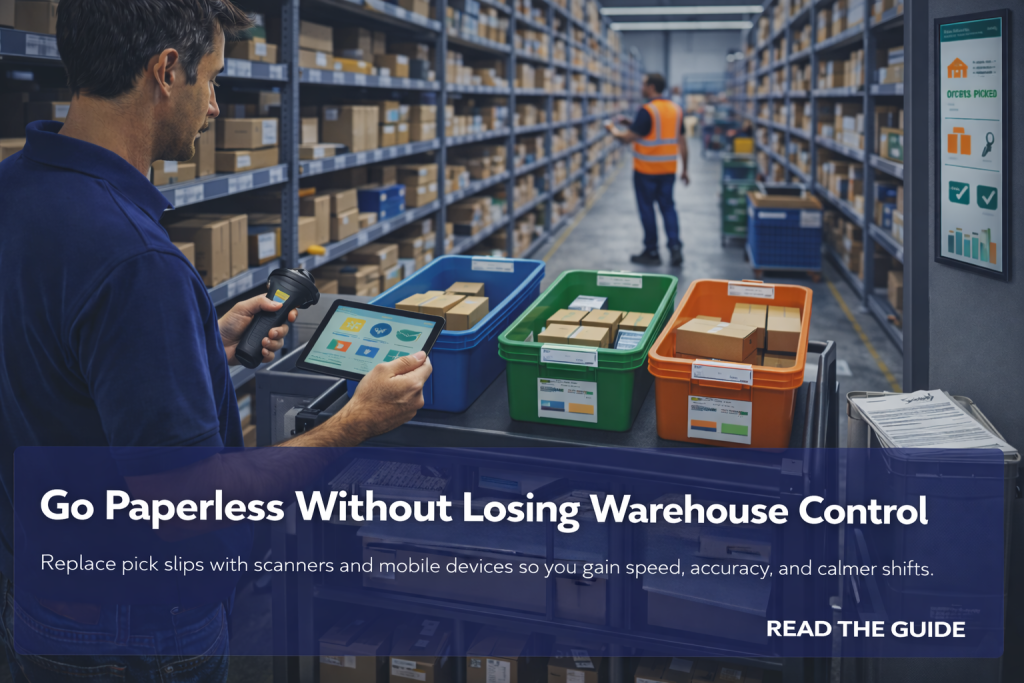
Paperless picking replaces paper with scanners, mobile devices, and real time data. For ecommerce brands shipping small, light, non fragile products like supplements, vitamins, cosmetics, wellness items, snacks, and subscription boxes, it is one of the fastest ways to get more orders out the door without burning out your team.
In this guide, you will learn how to:
- Understand what paperless picking really is and how it works in a modern warehouse
- Reduce mis picks and returns with scan based workflows
- Use handhelds, mobile apps, and simple tech instead of jumping straight to expensive automation
- Roll out paperless picking in five practical steps, even if your team is change resistant
- Turn “no more paper” into better inventory accuracy, happier customers, and lower cost per order with a 3PL partner like
Product Fulfillment Solutions and our
Cincinnati, Ohio fulfillment center
If you already know you cannot scale paper any further and want to see what a paperless operation could look like for your brand, you can start that conversation right away here:
Contact Product Fulfillment Solutions.
Table of contents
- When paper starts to hold your warehouse back
- Story, How BrightLeaf Wellness went paperless
- What is paperless picking
- Why paperless picking fits ecommerce brands
- Paperless picking technologies and methods
- How to implement paperless picking in 5 steps
- Strategic advantages beyond efficiency
- How Product Fulfillment Solutions runs paperless picking
- Paperless picking FAQs
When paper starts to hold your warehouse back
Paper works fine when you are shipping a few dozen orders per day. You print a stack of pick slips, clip them to a cart, and go.
The cracks start to show when:
- Order volume jumps into the hundreds or thousands per day
- Your catalog grows into hundreds of similar looking SKUs and variants
- You add more channels, your own site, marketplaces, subscriptions, and wholesale
- Cutoff times get tighter and you have no room for rework
Suddenly, paper is not helping you stay organized. It is slowing you down and hiding mistakes until they reach your customers.
Story, How BrightLeaf Wellness went paperless
To make this concrete, imagine a fictional brand called BrightLeaf Wellness. They sell daily vitamin packs, powdered drink sticks, and sleep support chews. All small, all light, all perfect on paper for fast ecommerce fulfillment.
The “before” picture, highlighters and heroics
Here is how their operation worked before they went paperless:
- Pick slips printed in batches and sorted into clipboards by zone
- Pickers crossing each other on the floor, each following their own path
- Lines through SKUs on paper to mark picks, followed by manual checks at pack out
- Returns driven by simple swaps, wrong flavors, wrong counts, or missing items
Nothing was completely broken, but the operation relied on memory, habit, and a few experienced people to keep everything on track.
The breaking point, spikes and errors
During a promotion, order volume doubled for a week. The team kept printing more paper and working longer hours, but:
- Picking errors jumped and returns followed a week later
- Orders took longer to pick because staff spent time hunting SKUs on crowded pages
- Supervisors had no clean way to see where picks were stuck or which orders were at risk
By the time the dust settled, they knew the problem. They were trying to run a digital business on a paper process.
The shift, from paper slips to scans and screens
BrightLeaf partnered with a 3PL similar to
Product Fulfillment Solutions’ Cincinnati fulfillment center and made one core decision. Every pick would be driven by real time data instead of paper and memory.
In practice, that meant:
- Releasing digital pick waves to handheld devices instead of printing lists
- Requiring a barcode scan at each pick location and again at pack out
- Updating inventory on each scan so counts stayed accurate throughout the day
Within weeks, mis picks dropped sharply, returns slowed, and the floor felt calmer, even as volume stayed higher than before.
Talk to an Expert
What is paperless picking
Paperless picking is a way of running your warehouse where pickers follow digital instructions on devices instead of printed pick slips.
At a basic level, it includes:
- Digital pick lists sent from your order system or WMS to handhelds, tablets, or wearable devices
- Barcode scans that confirm the right item and quantity at each pick
- Real time updates back to your systems for inventory, order status, and performance metrics
More advanced setups layer in voice direction, light systems, or smart wearables, but the goal is always the same. Give every picker clear, simple directions and verify each step with a scan instead of a pen stroke.
Why paperless picking fits ecommerce brands
If you sell small, light products that customers reorder regularly, paperless picking lines up almost perfectly with how your business works.
More orders without more chaos
- Digital routes keep pickers moving logically instead of wandering between aisles
- New hires can follow device prompts instead of memorizing the layout
- Supervisors can see progress and bottlenecks in real time
Fewer mis picks and fewer returns
- Barcode scans catch “wrong flavor, wrong shade, wrong size” errors before the box is sealed
- Look alike SKUs are verified by code, not by guesswork
- Returns driven by simple picking mistakes drop as scan compliance rises
Better inventory accuracy
- Each pick updates inventory instead of waiting for end of day reconciliation
- Overselling drops when counts stay close to reality
- Replenishment decisions improve because the data is trustworthy
For brands working with a 3PL like Product Fulfillment Solutions, paperless picking also makes it easier to align your promises with our
ecommerce fulfillment services and
3PL fulfillment.
Paperless picking technologies and methods
You do not have to deploy every technology to get the benefits of paperless picking. You can start small and layer capabilities over time.
Handheld devices and mobile apps
This is the most common starting point:
- Pickers carry a handheld scanner, smartphone, or small tablet
- The device shows the next location, SKU, and quantity to pick
- Pickers scan the location and item to confirm accuracy
Handhelds pair nicely with the type of small parcels common in
pick and pack services for supplements, cosmetics, and other consumer products.
Pick to light and put walls
Lights and put walls can sit on top of a paperless system when volume is high enough.
- Pick to light uses lights and displays on shelves to show where to pick and how many units
- Put walls use cubbies for orders, with visual prompts for where items should be placed
- Both approaches reduce walking and help split large waves into clean, sorted orders
Voice and wearables
Voice headsets and smart wearables give even more freedom to move without looking at a screen.
- Voice systems read out instructions and accept spoken confirmations
- Wearables like ring scanners and wrist screens keep hands mostly free
These tools can help in more complex layouts, but they still rely on the same core idea, digital instructions plus verification.
WMS and system integration
All of this only works if your systems talk to each other.
- Your ecommerce platform sends orders into a warehouse management system
- The WMS turns those orders into optimized pick tasks on devices
- Every scan updates inventory, order status, and performance metrics in real time
At Product Fulfillment Solutions, our
real time information tools are built to support this loop across all the brands we serve.
How to implement paperless picking in 5 steps
Going paperless is more about clarity and change management than it is about gadgets. Here is a practical path.
Step 1, Map your current picking process
- Follow a few orders from release to ship from the picker’s point of view
- Note where paper is created, carried, and updated
- Capture how often people stop to ask questions or correct mistakes
Step 2, Choose your first device and workflow
- Start with handhelds or mobile devices tied into your WMS or 3PL system
- Decide whether you will pick single orders, batches, or clusters first
- Limit the first wave of users so you can support them closely
Step 3, Build and test your digital pick paths
- Set logical routes that minimize walking and backtracking
- Configure the device screen to show only what pickers really need to see
- Test the flow on real orders and adjust before rolling it wider
Step 4, Train with real orders, not just slides
- Use live or realistic sample orders for training shifts
- Pair early adopters with newer team members as “floor coaches”
- Collect feedback on what is confusing or slowing people down
Step 5, Roll out in phases and measure
- Start in one zone, for example small parcels, then expand to others
- Track mis picks, returns, pick rates, and overtime before and after
- Use the data to refine settings and training over the first 60 to 90 days
When you work with a 3PL like Product Fulfillment Solutions, much of this is already baked into our operation, so your brand can benefit from paperless picking without having to design the entire system alone.
Strategic advantages beyond efficiency
Paperless picking is not only about today’s shift. It also changes the kind of information you have about your operation and how you use it to grow.
Better data for better decisions
- Scan data shows which SKUs are really moving and where
- You can see which slots, zones, or routes are slowing people down
- Inventory accuracy improves, which makes demand planning less guesswork
Faster onboarding during peak
- Digital instructions make it easier to train seasonal staff quickly
- Pickers do not have to learn how to read complex pick slips
- Supervisors can monitor productivity and support new hires in real time
Sustainability and brand story
- Less paper wasted on pick slips and reprints
- Fewer reships from errors means less transport and packaging waste
- You can honestly say you are taking waste out of your operation
For brands that care about long term trust, these details matter. Customers feel the difference when orders arrive quickly, accurately, and consistently.
Talk to an Expert
How Product Fulfillment Solutions runs paperless picking
Product Fulfillment Solutions is a Cincinnati based 3PL that focuses on ecommerce brands shipping small, light, non fragile products that customers reorder often.
Paperless picking is part of how we keep that promise. In practical terms, we:
- 1. Start with your reality, not a generic template, your products, your channels, your order profiles, and your pain points
- 2. Configure scan based workflows in our WMS, so each pick and pack step is verified, not assumed
- 3. Combine paperless picking with smart slotting, putting fast movers close and building routes that match your order mix
- 4. Tie paperless picking into our broader services, including
pick and pack services,
kitting and assembly solutions, and
discounted shipping rates - 5. Share meaningful reporting, accuracy, throughput, and service levels you can actually act on
Because our fulfillment center sits in Cincinnati, we can combine paperless efficiency with a central location that reaches a large share of the United States within one to three business days by ground. That combination supports both your margins and your promises.
Talk to an ExpertPaperless picking FAQs
How do I know if we are ready to go paperless
You are usually ready when paper feels like a bottleneck. If you see recurring mis picks, heavy use of overtime during spikes, and a lot of “where is this order” questions on the floor, your current paper based approach is likely holding you back.
Is paperless picking only for large warehouses
No. Smaller brands often get some of the biggest gains because they move from very manual processes to structured, scan based workflows. Cloud based systems and handheld devices have made paperless picking accessible without a massive upfront spend.
How long does it take to implement paperless picking
For a focused operation, you can usually pilot paperless picking in a specific area within a few weeks, then expand over a couple of months. The exact time depends on your systems, your layout, and how much process change is needed, which is why a phased rollout is usually best.
Will paperless picking disrupt our current operations
Any change in core workflow needs planning, but a well run rollout should reduce disruption, not increase it. Start with one zone or one product family, support the team closely, and only expand once the process is stable. The goal is to reduce chaos, not move it into a new format.
How does Product Fulfillment Solutions support paperless picking for brands
Product Fulfillment Solutions runs paperless picking as part of our standard operation. We tie scan based workflows into our WMS, design pick paths around your order mix, and give you clear reporting on accuracy and performance. When you work with us, you get the benefits of paperless picking without having to design or manage the system on your own.
Talk to an Expert