
Author: Jason Martin
Reviewed by: Chief Operations Officer, Product Fulfillment Solutions
Executive TLDR
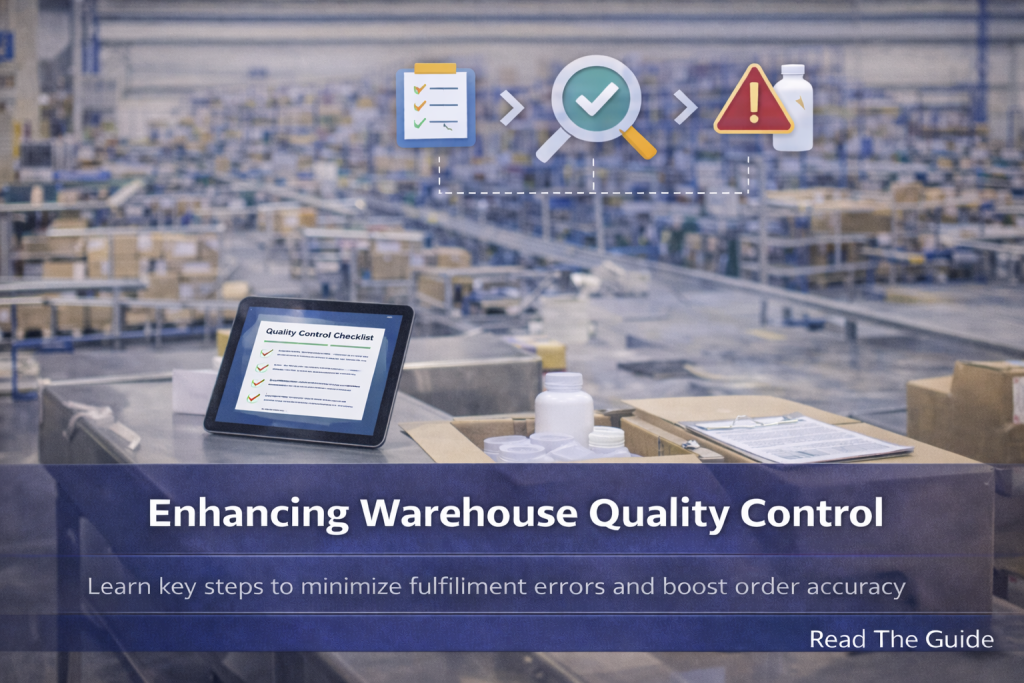
Warehouse quality control (QC) ensures inventory accuracy and order fulfillment precision.
Strong QC processes reduce mis-picks, damaged shipments, and costly returns.
Barcode scanning, standardized inspections, and WMS technology are essential for high accuracy rates.
If fulfillment errors are hurting your customer experience,
contact Product Fulfillment Solutions to strengthen your warehouse quality control systems.
Table of contents
- What Is Warehouse Quality Control?
- Why Warehouse Quality Control Matters
- Common Quality Control Checkpoints
- Best Practices for Warehouse QC
- Technology’s Role in Quality Control
- How a 3PL Improves Warehouse Quality
- Warehouse Quality Control FAQs
What Is Warehouse Quality Control?
Warehouse quality control refers to the processes and procedures used to ensure inventory accuracy and order fulfillment correctness. It includes inspections during receiving, storage, picking, packing, and shipping.
The objective is simple: ship the right product, in the right condition, to the right customer — every time.
Why Warehouse Quality Control Matters
- Reduces costly returns and reshipments
- Improves customer satisfaction
- Protects brand reputation
- Minimizes inventory discrepancies
- Supports retail compliance standards
Even small error rates can create significant operational costs as order volume increases.
Common Quality Control Checkpoints
1. Receiving Inspections
Incoming shipments are verified against purchase orders to confirm SKU counts, condition, and accuracy.
2. Inventory Audits
Cycle counts and periodic audits ensure system inventory matches physical stock.
3. Picking Verification
Barcode scanning confirms the correct SKU is selected for each order.
4. Packing Inspections
Orders are reviewed before sealing to verify correct items and packaging integrity.
5. Pre-Shipping Checks
Shipping labels, addresses, and documentation are validated to prevent carrier errors.
Best Practices for Warehouse QC
Standardized Procedures
Create documented SOPs for receiving, picking, packing, and shipping.
Barcode Scanning Systems
Scanning reduces human error and provides real-time tracking of each SKU.
Cycle Counting
Frequent inventory counts catch discrepancies before they become major issues.
Employee Training
Consistent training ensures teams understand quality standards and accountability.
Technology’s Role in Quality Control
Warehouse Management Systems (WMS) provide real-time visibility into inventory levels, SKU movement, and order status. Automated alerts flag discrepancies immediately.
At Product Fulfillment Solutions, our
real-time reporting systems
deliver SKU-level transparency to maintain high fulfillment accuracy.
How a 3PL Improves Warehouse Quality
A professional 3PL invests in systems and processes that many growing brands cannot implement internally.
- Advanced barcode scanning workflows
- Structured QC checkpoints at every stage
- Inventory reconciliation processes
- Retail compliance support
- Continuous performance monitoring
From our
Cincinnati, Ohio fulfillment center,
we maintain strict quality standards to minimize errors and maximize customer satisfaction.
If accuracy rates below 99% are costing you money, it’s time to strengthen your QC systems.
Talk to an ExpertWarehouse Quality Control FAQs
What is warehouse quality control?
Warehouse quality control includes the processes used to ensure accurate inventory tracking and correct order fulfillment.
How do warehouses prevent picking errors?
By using barcode scanning systems, standardized procedures, and multiple verification checkpoints.
Why is inventory accuracy important?
Accurate inventory prevents stockouts, overselling, and customer dissatisfaction.
Can a 3PL improve fulfillment accuracy?
Yes. A 3PL implements advanced systems and strict quality processes to maintain high order accuracy rates.
Talk to an Expert