
Reviewed by: Chief Operations Officer, Product Fulfillment Solutions
Last updated: March 8, 2026
Executive TLDR
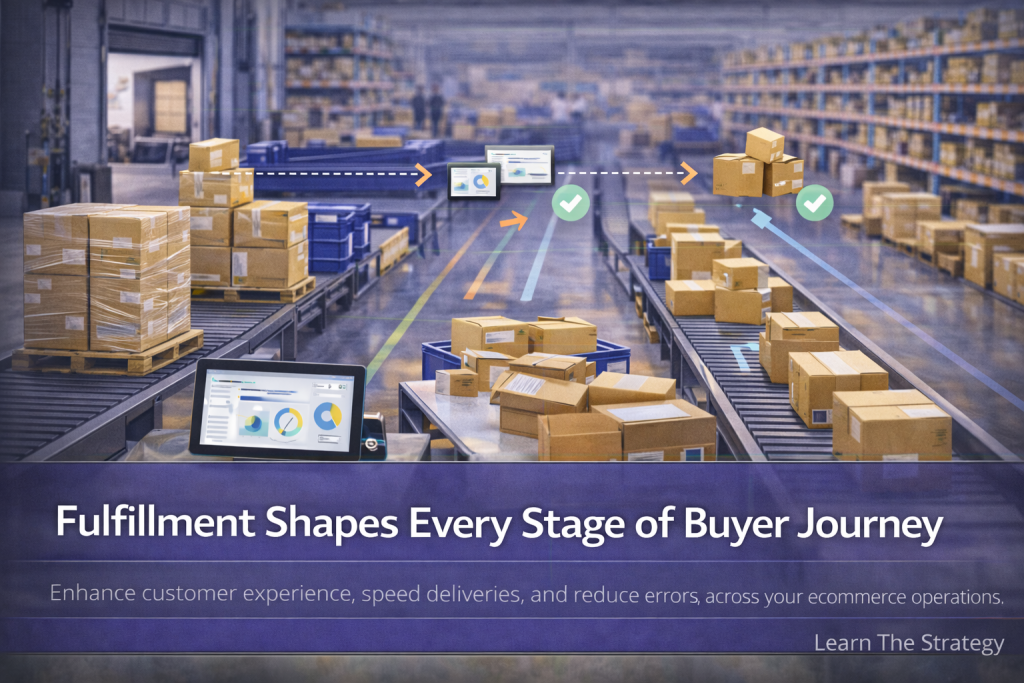
The ecommerce buyer’s journey does not end when a customer clicks “buy.” In reality, fulfillment plays a critical role in the entire experience, from initial trust signals to repeat purchases. Shipping speed, delivery reliability, and order accuracy shape how customers perceive your brand long after checkout.
Many ecommerce companies focus heavily on marketing and acquisition but underestimate how fulfillment performance influences customer retention. Late deliveries, stockouts, or damaged orders can quickly erode trust and reduce lifetime value.
Strong fulfillment infrastructure helps brands support the entire buyer journey, from product availability and transparent shipping expectations to consistent delivery performance and reliable inventory visibility.
Product Fulfillment Solutions supports brands through scalable systems, experienced warehouse teams, and centralized operations inside our Cincinnati, Ohio fulfillment center, helping ensure every order strengthens customer loyalty.
If you already know you need a steadier fulfillment program, you can start the conversation here,
Contact Product Fulfillment Solutions.
Table of contents
- When the buyer’s journey starts impacting operations
- Story: how VitalBar Nutrition improved customer retention
- Understanding the three stages of the buyer’s journey
- Why fulfillment affects the decision stage
- Post purchase experience drives repeat customers
- Inventory visibility and customer confidence
- How 3PL partnerships support the full buyer lifecycle
- Building a fulfillment system that supports growth
- Buyer’s journey FAQs
When the buyer’s journey starts impacting operations
For early stage ecommerce brands, the buyer’s journey is often viewed primarily through a marketing lens. Teams focus on traffic generation, product positioning, and conversion rates. Fulfillment may feel like a back office function that simply processes orders after the sale.
As brands grow, that assumption changes quickly. Customer expectations around shipping speed, order accuracy, and delivery transparency become major factors in the overall brand experience. The fulfillment operation becomes directly tied to customer satisfaction.
This shift usually appears when brands start experiencing:
- Higher daily order volumes
- Customers expecting two to four day delivery windows
- More frequent repeat purchases
- Subscription programs or replenishment products
- Customer support inquiries about shipping delays
At this point, fulfillment is no longer just logistics. It becomes part of the customer experience. Brands using reliable ecommerce fulfillment services often see stronger retention because operational consistency supports the full buying cycle.
Story: how VitalBar Nutrition improved customer retention
Before
VitalBar Nutrition launched a line of protein snack bars designed for athletes and busy professionals. Early marketing campaigns performed well, and orders increased steadily through online channels.
Pain points
As order volume grew, operational issues began to affect customer satisfaction. Some orders shipped late during promotions, while inventory counts occasionally caused stockouts. Customers who enjoyed the product sometimes hesitated to reorder due to inconsistent delivery experiences.
The shift
After restructuring their fulfillment workflow, VitalBar moved inventory into a facility designed for high volume ecommerce operations. Improved pick workflows and structured storage reduced delays and improved reliability.
With more efficient pick and pack services, the brand stabilized delivery times and customer confidence improved. Repeat purchase rates increased as customers experienced consistent order fulfillment.
Understanding the three stages of the buyer’s journey
The ecommerce buyer’s journey typically unfolds in three stages. Each stage carries operational implications that influence fulfillment planning.
Awareness stage
Customers first discover the brand through marketing, social media, search, or recommendations. At this point they are evaluating whether the brand appears trustworthy and reliable.
Operational details like shipping policies, delivery speed, and product availability contribute to this early trust.
Consideration stage
Shoppers compare options between brands. Transparent shipping timelines, clear return policies, and reliable inventory availability help remove hesitation.
Decision stage
Customers complete their purchase and move into the fulfillment phase. This stage is where operational performance either confirms the brand promise or undermines it.
Reliable fulfillment partners offering strong warehousing and storage solutions help brands maintain the consistency customers expect.
Why fulfillment affects the decision stage
Shipping expectations often determine whether a shopper completes a purchase. When delivery estimates appear too slow or unreliable, customers may abandon their cart and look elsewhere.
Operational infrastructure directly influences these expectations.
Efficient fulfillment centers allow brands to offer:
- Accurate delivery estimates
- Faster shipping transit times
- Consistent order processing
- Reduced fulfillment errors
Location also plays a role. A centrally located facility like the Cincinnati, Ohio fulfillment center allows brands to reach much of the United States within two to four days using standard ground shipping.
Talk to an Expert
Post purchase experience drives repeat customers
The most overlooked stage of the buyer’s journey happens after the order ships. Customers evaluate the experience based on how smoothly fulfillment occurs.
Several operational factors influence post purchase satisfaction:
- Accurate order picking and packing
- On time shipment processing
- Reliable delivery timelines
- Clear tracking updates
- Proper packaging that protects products
Brands that consistently deliver smooth post purchase experiences often see stronger repeat purchase behavior. Reliable fulfillment creates confidence that encourages customers to reorder.
Access to real time information also allows brands to track inventory levels, shipping performance, and order status across all sales channels.
Inventory visibility and customer confidence
Stockouts can disrupt the buyer’s journey at multiple points. When customers discover a product is unavailable after they have already decided to purchase, the experience creates friction and frustration.
Reliable inventory systems help prevent this problem by ensuring accurate availability across ecommerce platforms.
Effective inventory visibility allows brands to:
- Avoid overselling products during promotions
- Maintain accurate stock counts
- Plan replenishment cycles effectively
- Provide transparent availability information to customers
Operational accuracy improves trust, which directly supports long term customer relationships.
How 3PL partnerships support the full buyer lifecycle
As ecommerce brands grow, managing fulfillment internally becomes increasingly complex. Inventory management, picking workflows, shipping coordination, and returns processing all require dedicated systems and staff.
A specialized 3PL partner provides infrastructure designed specifically for these operational demands.
Brands working with experienced providers gain access to:
- Scalable fulfillment facilities
- Established operational workflows
- Integrated shipping carrier networks
- Inventory tracking systems
- Operational expertise for ecommerce logistics
These capabilities allow brands to focus on product development and marketing while fulfillment operations remain stable and predictable.
Building a fulfillment system that supports growth
Customer acquisition is only the beginning of the ecommerce buyer’s journey. Long term success depends on maintaining consistent operational performance across every order.
Brands preparing for sustained growth should focus on several operational priorities:
- Accurate inventory tracking
- Efficient picking and packing workflows
- Reliable shipping carrier partnerships
- Centralized fulfillment infrastructure
- Systems that scale with increasing order volume
When fulfillment operations run smoothly, the buyer’s journey becomes a cycle rather than a one time transaction. Customers return because they trust the entire experience, not just the product.
Talk to an Expert
Buyer’s journey FAQs
What is the ecommerce buyer’s journey?
The ecommerce buyer’s journey describes the process customers follow from discovering a product to completing a purchase and evaluating the experience afterward. It typically includes awareness, consideration, decision, and post purchase stages.
Why does fulfillment affect the buyer’s journey?
Fulfillment impacts delivery speed, order accuracy, and shipping reliability. These factors shape how customers perceive a brand and influence whether they return to make additional purchases.
How does shipping speed influence conversion rates?
Customers often compare delivery timelines before completing a purchase. Faster or more predictable shipping estimates can reduce cart abandonment and encourage customers to finalize their orders.
What role does inventory management play in the buyer’s journey?
Accurate inventory systems prevent stockouts and overselling. Reliable product availability ensures customers can purchase items when they are ready and avoids disruptions during the decision stage.
How can ecommerce brands improve post purchase experiences?
Brands can improve post purchase experiences by ensuring accurate order fulfillment, providing tracking updates, packaging products securely, and maintaining consistent delivery timelines.
Why do growing ecommerce brands work with 3PL providers?
3PL providers offer infrastructure and expertise that allow brands to scale fulfillment operations efficiently. This helps maintain reliable shipping performance as order volume increases.