
Reviewed by: Chief Operations Officer, Product Fulfillment Solutions
Last updated: April 1, 2026
Executive TLDR
As ecommerce brands grow, warehouse organization becomes one of the biggest hidden constraints to fulfillment speed. Many operations still rely on fixed bin locations, which work early on but quickly create congestion, wasted space, and slower picking as SKU counts increase.
Dynamic storage solves this problem by allowing inventory to be stored wherever space is available while warehouse systems track exact locations in real time. Instead of forcing products into permanent slots, inventory flows through the warehouse based on demand, velocity, and operational efficiency.
This guide explains how dynamic storage works, why growing ecommerce brands adopt it, and how modern fulfillment operations use it to increase accuracy, improve throughput, and scale without constant warehouse expansion.
- Understand dynamic vs fixed storage systems
- Learn why static slotting slows growing brands
- See how WMS-driven storage improves picking efficiency
- Discover how flexible warehousing supports scalable fulfillment
If your inventory growth is starting to strain operations, you can speak with a fulfillment strategist here:
Contact Product Fulfillment Solutions.
Table of contents
- Why warehouse space becomes a growth problem
- Story: How Veloura Skin scaled without moving warehouses
- What is dynamic storage?
- Dynamic storage vs fixed storage
- How dynamic storage improves fulfillment speed
- Technology required for dynamic storage
- When brands should switch to dynamic storage
- Dynamic storage FAQs
Why warehouse space becomes a growth problem
Early-stage ecommerce warehouses often assign fixed locations to every SKU. Each product receives a permanent shelf or bin, making inventory easy to remember manually.
This works when brands carry 20 products. It breaks when they carry 500.
As catalogs expand, fixed storage creates several operational issues:
- Empty space reserved for slow-moving SKUs
- Fast sellers running out of accessible pick locations
- Longer walking distances for warehouse teams
- Frequent re-slotting projects
- Reduced picking efficiency during peak seasons
Brands often assume they need a bigger warehouse, when the real issue is inefficient storage strategy. Modern warehousing and storage solutions solve this through flexibility rather than expansion.
Story: How Veloura Skin scaled without moving warehouses
Before
Veloura Skin, a fast-growing cosmetics brand, expanded from 40 SKUs to over 300 within one year. Their warehouse used fixed shelving assignments created during startup operations.
The problems
- Pickers walking excessive distances
- Best-selling products constantly relocated manually
- Overflow inventory stored inconsistently
- Rising fulfillment times despite hiring more staff
The change
After transitioning to a WMS-driven dynamic storage model inside a centralized Cincinnati, Ohio fulfillment center, inventory locations became system-controlled instead of manually assigned.
High-velocity SKUs automatically moved closer to picking zones, while slower items occupied flexible storage areas.
The results
- Faster pick paths
- Improved inventory accuracy
- Better space utilization
- No warehouse relocation required
What is dynamic storage?
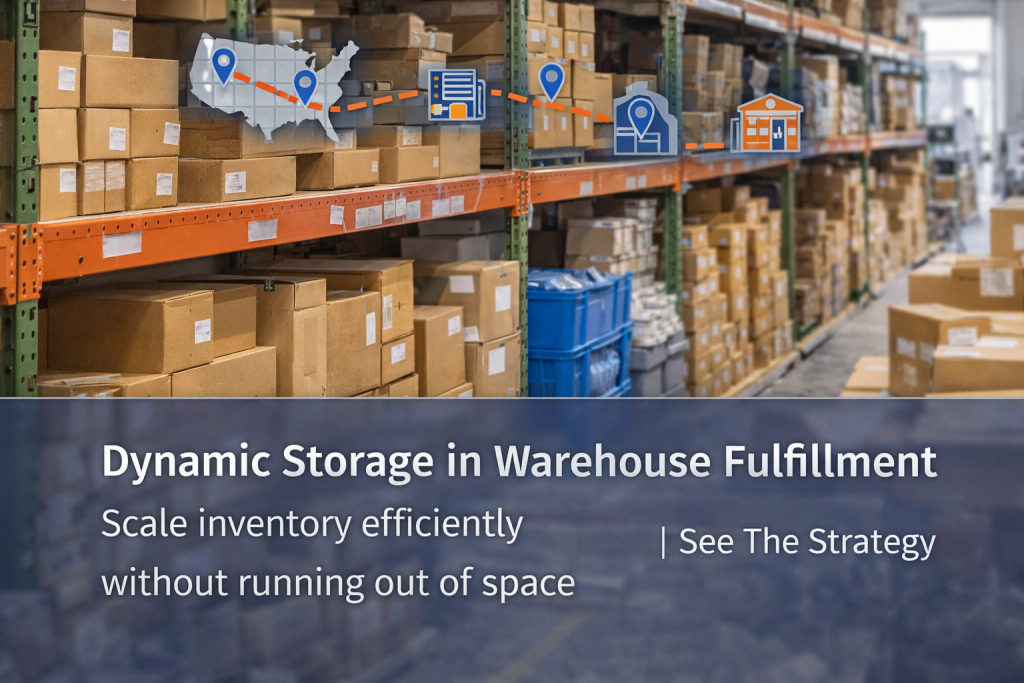
Dynamic storage is a warehouse management strategy where inventory does not have permanent locations. Instead, products are stored wherever space is available, and a warehouse management system tracks exact placement digitally.
Warehouse staff rely on barcode scanning and system instructions rather than memory or printed maps.
When inventory arrives:
- The system assigns an optimal storage location.
- Items are scanned into that location.
- Pickers receive directions from the system during order fulfillment.
This approach allows warehouses to continuously optimize layout without physically reorganizing entire sections.
Efficient execution pairs closely with structured pick and pack services, ensuring products remain easy to locate even as inventory moves dynamically.
Dynamic storage vs fixed storage
| Fixed Storage | Dynamic Storage |
|---|---|
| Permanent SKU locations | Flexible system-assigned locations |
| Easy early setup | Optimized for scale |
| Wasted unused space | Maximized space utilization |
| Manual organization | System-driven organization |
| Slower at high SKU counts | Faster as complexity grows |
Dynamic storage becomes increasingly valuable as brands expand channels, introduce bundles, or launch seasonal products.
How dynamic storage improves fulfillment speed
Dynamic storage improves performance because warehouses adapt continuously instead of periodically reorganizing.
Key operational advantages include:
- Shorter picker travel distances
- Improved inventory density
- Faster receiving workflows
- Reduced congestion during peak periods
- Better scalability for promotions and launches
When inventory placement aligns with real demand patterns, fulfillment becomes faster without increasing labor costs.
Access to real time information allows operations teams to monitor inventory flow and adjust strategies proactively.
Talk to an Expert
Technology required for dynamic storage
Dynamic storage depends on technology coordination rather than manual processes. Core components include:
- Warehouse Management System (WMS)
- Barcode scanning workflows
- Real-time inventory tracking
- Directed putaway instructions
- System-guided picking routes
Without strong system integration, dynamic storage becomes chaotic. With the right infrastructure, it becomes one of the most powerful efficiency drivers in modern fulfillment.
When brands should switch to dynamic storage
Brands typically benefit from dynamic storage when they experience:
- Rapid SKU expansion
- Seasonal inventory fluctuations
- Subscription or bundle programs
- Increasing order volumes
- Warehouse congestion despite available space
Partnering with a scalable ecommerce fulfillment services provider allows brands to adopt advanced storage strategies without building complex infrastructure internally.
Dynamic storage turns warehouse space into a flexible asset rather than a fixed limitation.
Talk to an Expert
Dynamic storage FAQs
What is dynamic storage in warehousing?
Dynamic storage is a system where inventory locations change based on availability and efficiency, with a warehouse management system tracking exact placement in real time.
Is dynamic storage better than fixed storage?
For growing ecommerce brands, yes. Dynamic storage improves space utilization and picking efficiency as SKU counts and order volume increase.
Does dynamic storage reduce warehouse space needs?
Often it does. By eliminating unused reserved locations, warehouses can store more inventory within the same footprint.
Do workers need to memorize locations?
No. Warehouse staff follow system-directed instructions using scanners and digital workflows.
Can small ecommerce brands use dynamic storage?
Yes, especially when working with a 3PL that already operates advanced warehouse systems.
How does dynamic storage improve fulfillment accuracy?
Barcode verification and system tracking reduce human error, ensuring products are stored and picked from verified locations.