
Reviewed by: Chief Operations Officer, Product Fulfillment Solutions
Last updated: April 03, 2026
Executive TLDR
Foreign Trade Zone, or FTZ, warehouses can reduce duties, improve cash flow, and simplify imports, but they are not the right fit for every ecommerce brand. The benefits depend on your product mix, volume, and how your supply chain is structured.
Many brands explore FTZs when import costs start eating into margins or when they scale internationally. But the reality is that FTZs add operational complexity, compliance requirements, and overhead that only make sense at certain levels of volume.
In this guide, you will learn what an FTZ warehouse is, how it works, when it makes sense, and when a simpler fulfillment setup will actually perform better.
If you already know you need a steadier fulfillment program, you can start the conversation here,
Contact Product Fulfillment Solutions.
Table of contents
- When FTZ warehouses become relevant
- Story, how a brand evaluated FTZ vs standard fulfillment
- What is an FTZ warehouse
- How FTZ warehouses work in practice
- Key benefits and tradeoffs
- When FTZ makes sense for ecommerce brands
- When a standard 3PL is the better option
- Practical evaluation checklist
- FTZ warehouse FAQs
When FTZ warehouses become relevant
Most ecommerce brands do not think about FTZ warehouses early on. In the beginning, the focus is on getting products in, shipping orders out, and keeping customers happy.
FTZ becomes relevant when import volume increases and duty costs start adding up. This usually happens when brands are sourcing internationally at scale or managing multiple SKUs with varying duty rates.
At this point, leaders start asking deeper questions. Can we delay duties. Can we reduce them. Can we improve cash flow. That is where FTZ enters the conversation.
However, FTZ is not just a cost lever. It is an operational decision that affects compliance, reporting, and fulfillment workflows.
Story, how a brand evaluated FTZ vs standard fulfillment
Before
A fast-growing health and wellness brand was importing large volumes of product from overseas. Duty payments were immediate, and cash flow was getting tight.
Pain points
- High upfront duty payments on all inventory
- Limited flexibility when demand fluctuated
- Difficulty forecasting landed costs accurately
The shift
The team explored FTZ as a solution but quickly realized it added complexity. Instead, they improved inventory flow and leveraged a centralized Cincinnati, Ohio fulfillment center to optimize shipping and reduce operational inefficiencies.
By improving processes and gaining better visibility through real time information, they achieved cost control without introducing unnecessary complexity.
What is an FTZ warehouse
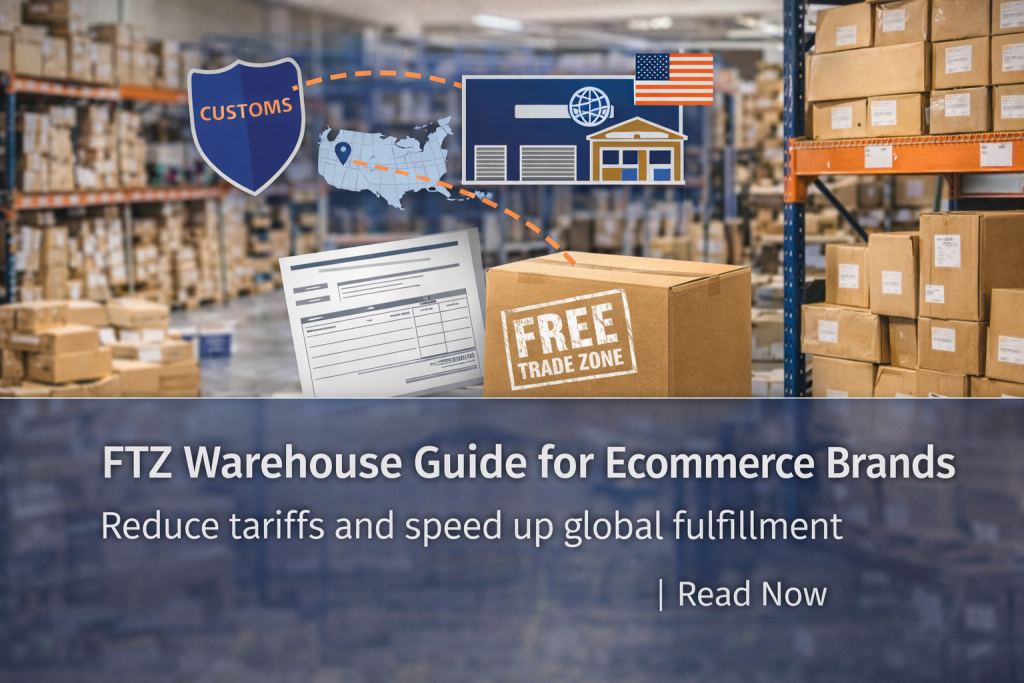
An FTZ warehouse is a designated area where imported goods can be stored, processed, or assembled without immediately paying duties. Duties are only paid when goods leave the zone and enter the domestic market.
This creates flexibility for businesses importing goods in bulk. Instead of paying duties upfront, companies can defer or potentially reduce those costs depending on how products are handled.
For ecommerce brands, this can be useful when managing high import volumes or products with varying duty classifications.
How FTZ warehouses work in practice
In an FTZ setup, imported goods are received into the zone and tracked under strict compliance rules. Inventory can be stored, repackaged, or even assembled before being released.
Key operational steps include:
- Receiving goods into the FTZ under customs supervision
- Tracking inventory movements with detailed reporting
- Paying duties only when goods enter the domestic market
- Managing compliance and documentation requirements
These processes require strong systems and disciplined workflows, often supported by structured EDI solutions and connections.
Key benefits and tradeoffs
FTZ warehouses offer several advantages, but they also come with tradeoffs that must be considered carefully.
Benefits
- Deferred duty payments improve cash flow
- Potential duty reduction depending on product processing
- Better control over imported inventory
Tradeoffs
- Increased operational complexity
- Strict compliance and reporting requirements
- Higher administrative overhead
For many ecommerce brands, the added complexity outweighs the financial benefit unless volume is high and consistent.
Talk to an Expert
When FTZ makes sense for ecommerce brands
FTZ is most valuable in specific situations. It is not a general solution for all brands.
- High import volume with significant duty exposure
- Products with varying duty classifications
- Long inventory holding periods
- Complex supply chains with multiple destinations
In these cases, the financial benefits can justify the added operational requirements.
When a standard 3PL is the better option
For most ecommerce brands, a well-run 3PL provides better results with less complexity.
Using structured ecommerce fulfillment services and efficient pick and pack services, brands can reduce costs and improve delivery performance without managing FTZ compliance.
Additional benefits include:
- Faster implementation and onboarding
- Lower administrative burden
- Scalable operations during growth
In many cases, optimizing fulfillment processes delivers more value than introducing a complex FTZ structure.
Talk to an Expert
Practical evaluation checklist
If you are considering FTZ, use this checklist to evaluate whether it fits your business:
- Are duty costs a major percentage of your landed cost
- Do you have consistent high-volume imports
- Can your team handle compliance and reporting requirements
- Will the financial benefit outweigh operational complexity
If the answer is no to most of these, focusing on better fulfillment strategy and warehouse efficiency will likely deliver stronger results.
FTZ warehouse FAQs
What is an FTZ warehouse in simple terms?
An FTZ warehouse is a location where imported goods can be stored without paying duties until they are sold or moved into the domestic market.
Do all ecommerce brands benefit from FTZ?
No, FTZ mainly benefits high-volume importers. Smaller brands often gain more from optimizing fulfillment operations instead.
Does FTZ reduce shipping costs?
No, FTZ primarily impacts duties and import costs. Shipping costs depend on fulfillment strategy and inventory placement.
Is FTZ difficult to manage?
Yes, it requires strict compliance, reporting, and operational discipline, which adds complexity to your workflow.
Can a 3PL help without using FTZ?
Yes, a 3PL can reduce costs through better processes, shipping rates, and operational efficiency without FTZ complexity.
When should I consider FTZ?
When import duties significantly impact margins and you have consistent high-volume international sourcing.