
Author:Jason Martin
Reviewed by:Chief Operations Officer, Product Fulfillment Solutions
Executive TLDR
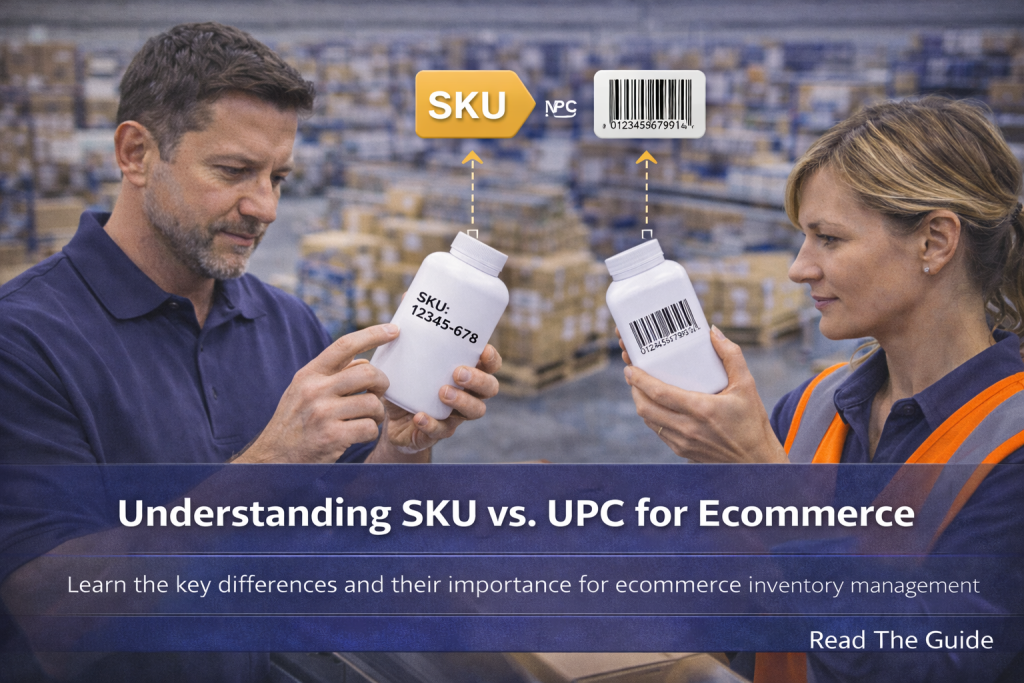
SKUs and UPCs are both product identifiers, but they serve different purposes.
A SKU (Stock Keeping Unit) is an internal code used by businesses to manage inventory.
A UPC (Universal Product Code) is a standardized barcode used for retail scanning and external sales channels.
Using both correctly improves inventory accuracy, order fulfillment, and reporting.
Talk to Product Fulfillment Solutions to streamline your inventory operations.
Table of contents
- What Is a SKU?
- What Is a UPC?
- SKU vs. UPC: Key Differences
- When to Use a SKU vs. a UPC
- How a 3PL Manages SKUs and UPCs
- SKU vs. UPC FAQs
What Is a SKU?
A SKU (Stock Keeping Unit) is a unique alphanumeric code that a business creates to track inventory internally. Each variation of a product — such as size, color, or style — receives its own SKU.
SKUs are customizable and structured to match a company’s internal inventory system. For example, a black t-shirt in size medium might have a SKU like TSH-BLK-M.
SKUs help businesses:
- Track inventory levels
- Analyze sales performance by product variation
- Reduce picking and packing errors
- Improve warehouse organization
What Is a UPC?
A UPC (Universal Product Code) is a standardized 12-digit barcode used primarily for retail scanning. UPCs are issued by GS1 and are recognized globally.
Unlike SKUs, UPCs are not customizable. They are universal identifiers used across marketplaces, retail stores, and point-of-sale systems.
UPCs are required when selling through many major retailers and online marketplaces.
SKU vs. UPC: Key Differences
| Feature | SKU | UPC |
|---|---|---|
| Purpose | Internal inventory tracking | External retail scanning |
| Format | Custom alphanumeric | 12-digit numeric barcode |
| Who creates it? | The business | GS1 |
| Where used? | Warehouse and internal systems | Retail stores & marketplaces |
When to Use a SKU vs. a UPC
Use SKUs When:
- Managing warehouse inventory
- Organizing product variations
- Tracking internal performance metrics
Use UPCs When:
- Selling in retail stores
- Listing products on marketplaces like Amazon
- Scanning products at checkout
Most ecommerce brands use both. SKUs drive backend inventory control, while UPCs ensure marketplace compliance and retail compatibility.
How a 3PL Manages SKUs and UPCs
Inventory complexity increases as your SKU count grows. A professional 3PL ensures accurate tracking and fulfillment by:
- Implementing barcode scanning technology
- Maintaining real-time SKU-level inventory visibility
- Preventing mis-picks and shipping errors
- Integrating with ecommerce platforms and retail systems
At Product Fulfillment Solutions, our
real-time reporting systems
ensure every SKU is tracked accurately from receiving to shipment.
Operating from our
Cincinnati, Ohio fulfillment center,
we help brands manage growing SKU catalogs without sacrificing speed or accuracy.
If SKU complexity is slowing down your operation, it’s time to tighten your inventory systems.
Talk to an ExpertSKU vs. UPC FAQs
Is a SKU the same as a UPC?
No. A SKU is an internal inventory code created by a business, while a UPC is a standardized barcode used for retail sales.
Do I need both SKUs and UPCs?
Most ecommerce businesses use both. SKUs manage internal inventory, while UPCs are required for retail and marketplace sales.
Who issues UPC codes?
UPCs are issued by GS1, the global standards organization responsible for barcode systems.
Can two products share the same SKU?
No. Each product variation should have its own unique SKU to prevent inventory errors.
Talk to an Expert