
Reviewed by: Chief Operations Officer, Product Fulfillment Solutions
Last updated: April 15, 2026
Executive TLDR
Many ecommerce brands use “shipping” and “delivery” interchangeably, but in fulfillment operations they represent two very different parts of the customer journey. Confusing the two leads to missed expectations, support tickets, and SLA frustration.
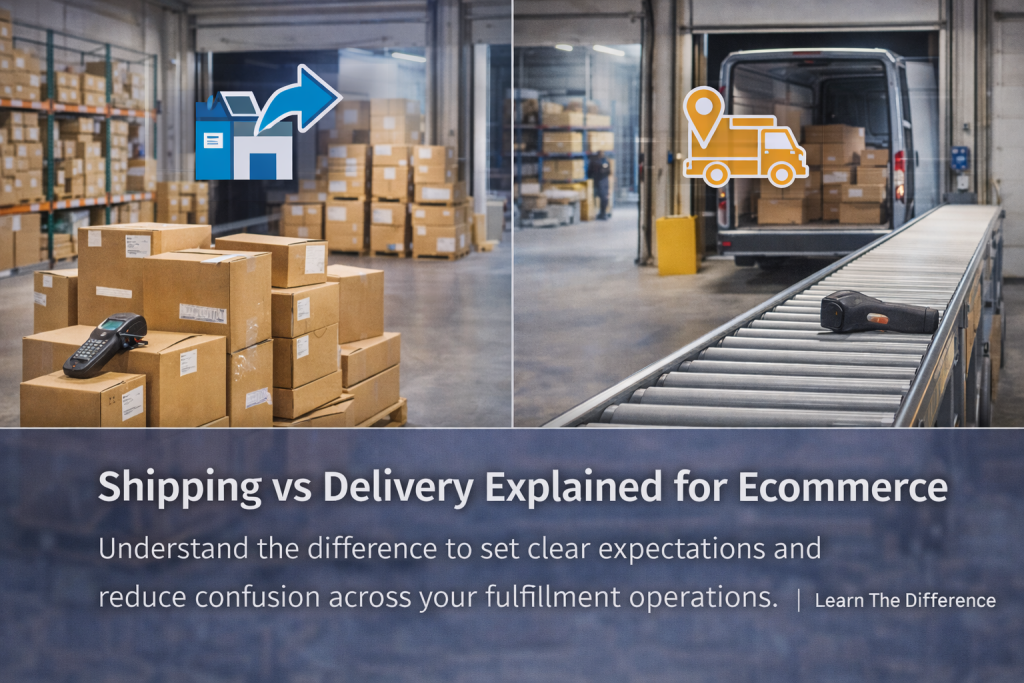
Shipping refers to the process of moving an order from a warehouse to a carrier. Delivery refers to the final stage when the package reaches the customer’s door. The gap between them is where most customer experience issues happen.
In this guide, you will learn how to clearly separate shipping vs delivery in your operations, how carriers impact each stage, and how a strong fulfillment partner like Product Fulfillment Solutions (PFS) reduces friction between both.
If you already know you need a steadier fulfillment program, you can start the conversation here,
Contact Product Fulfillment Solutions.
Table of contents
- When shipping vs delivery becomes confusing
- Story: how NorthBay Supplements fixed delivery confusion
- What shipping really means in fulfillment
- What delivery really means for customer experience
- Where most brands lose visibility
- How 3PL operations reduce the gap
- Aligning SLAs with real world transit
- Operational playbook for ops teams
- Shipping vs delivery FAQs
When shipping vs delivery starts to hurt operations
Confusion between shipping and delivery usually shows up when ecommerce brands start scaling past early-stage order volume. At low volume, delays are easy to manage manually. At higher volume, every misunderstanding turns into customer support pressure.
Shipping is the internal handoff from warehouse to carrier. Delivery is the external experience controlled by carrier networks. When brands treat both as the same milestone, expectations break quickly.
This becomes critical when customers start demanding precise delivery windows. A “shipped today” promise does not guarantee a “delivered tomorrow” outcome, even with fast carriers.
Story: how NorthBay Supplements fixed delivery confusion
Before
NorthBay Supplements was scaling quickly in the wellness space. Orders were growing, but customer complaints were rising. Their team promised fast delivery, but customers interpreted shipping updates as delivery guarantees.
Pain points
Support tickets increased every time carriers hit delays. Marketing and operations were misaligned on wording. “Shipped” emails created expectations that “delivered” could not always meet.
The ops team also lacked visibility between warehouse dispatch time and carrier scan time, which made reporting inconsistent.
The shift
They restructured messaging and fulfillment flow. Shipping confirmations became clearly defined as warehouse dispatch events. Delivery estimates were tied strictly to carrier transit data. With a more structured fulfillment process through a centralized model like the Cincinnati, Ohio fulfillment center, they stabilized expectations and reduced customer confusion.
Talk to an Expert
What shipping really means in fulfillment operations
Shipping begins the moment an order is picked, packed, and handed off to a carrier. It is an internal operational milestone, not a customer delivery promise.
In a fulfillment environment, shipping includes:
- Pick and pack completion inside the warehouse
- Carrier label creation and scan initiation
- Outbound transfer from fulfillment center dock
- Initial carrier acceptance scan
This stage is heavily influenced by warehouse efficiency. Strong pick and pack services reduce delays and ensure orders leave the facility on time.
What delivery really means for customers
Delivery starts after the carrier accepts the package and ends when the customer receives it. Unlike shipping, delivery is mostly outside of warehouse control.
Delivery depends on:
- Carrier routing efficiency
- Regional hub congestion
- Weather and external disruptions
- Last mile carrier performance
This is why brands often see “shipped in 1 day” but still face “delivered in 5 days” outcomes. The disconnect is not internal performance, it is transit variability.
Using discounted shipping rates strategically can improve carrier selection and reduce variability over time.
Talk to an Expert
Where most brands lose visibility between shipping and delivery
The biggest operational gap is tracking visibility. Many brands only monitor “label created” and “delivered” status, skipping meaningful intermediate scans.
This creates blind spots such as:
- Packages sitting in carrier hubs without updates
- Misread delays as warehouse failures
- Customer service responding without real data
Improving visibility requires tighter integration between warehouse systems and carrier tracking, often supported through real time information systems.
How 3PL operations reduce the shipping vs delivery gap
A strong 3PL does not control delivery, but it significantly improves shipping reliability, which reduces downstream uncertainty.
Faster warehouse execution
Efficient workflows ensure same day or next day shipping consistency, reducing customer anxiety about fulfillment delays.
Carrier optimization
Better carrier routing decisions reduce transit variability and improve delivery predictability.
Centralized fulfillment control
A centralized system like the warehousing and storage solutions model helps standardize outbound flow and reduce operational errors.
Aligning SLAs with real world transit expectations
One of the most common mistakes in ecommerce operations is setting SLAs based on shipping speed instead of delivery reality.
To align expectations correctly:
- Separate internal shipping SLAs from carrier delivery estimates
- Communicate both milestones clearly to customers
- Adjust promises based on regional carrier performance
When SLAs are properly structured, customer expectations become more stable even when carriers fluctuate.
Operational playbook for reducing confusion at scale
Operations teams can reduce shipping vs delivery confusion with a few practical changes that do not require major system overhauls.
Standardize terminology
Use “shipped” only for warehouse dispatch and “delivered” only for final receipt.
Improve tracking messaging
Clarify carrier status updates so customers understand transit stages.
Strengthen fulfillment backbone
Leveraging structured fulfillment services like ecommerce fulfillment services reduces internal delays that get misinterpreted as delivery issues.
Shipping vs delivery FAQs
What is the main difference between shipping and delivery?
Shipping refers to warehouse dispatch and carrier handoff. Delivery refers to the final arrival of the package at the customer’s address after carrier transit.
Why does shipping happen faster than delivery?
Shipping is controlled inside the warehouse, while delivery depends on external carrier networks, which include routing, hubs, and last mile logistics.
Can a package be shipped but not yet in transit?
Yes. A package can be marked shipped once labeled, but it may not move through the carrier network until it receives its first scan.
How can brands reduce delivery confusion?
Clear communication, better tracking updates, and separating shipping milestones from delivery promises helps reduce confusion significantly.
Does faster shipping guarantee faster delivery?
No. Even fast warehouse shipping cannot override carrier delays, routing inefficiencies, or weather disruptions during transit.
How does a 3PL improve shipping vs delivery performance?
A 3PL improves shipping consistency and carrier selection, which stabilizes delivery expectations even though final delivery is still carrier controlled.