
Reviewed by: Director of Fulfillment Operations, Product Fulfillment Solutions
Last updated: May 18, 2026
Executive TLDR
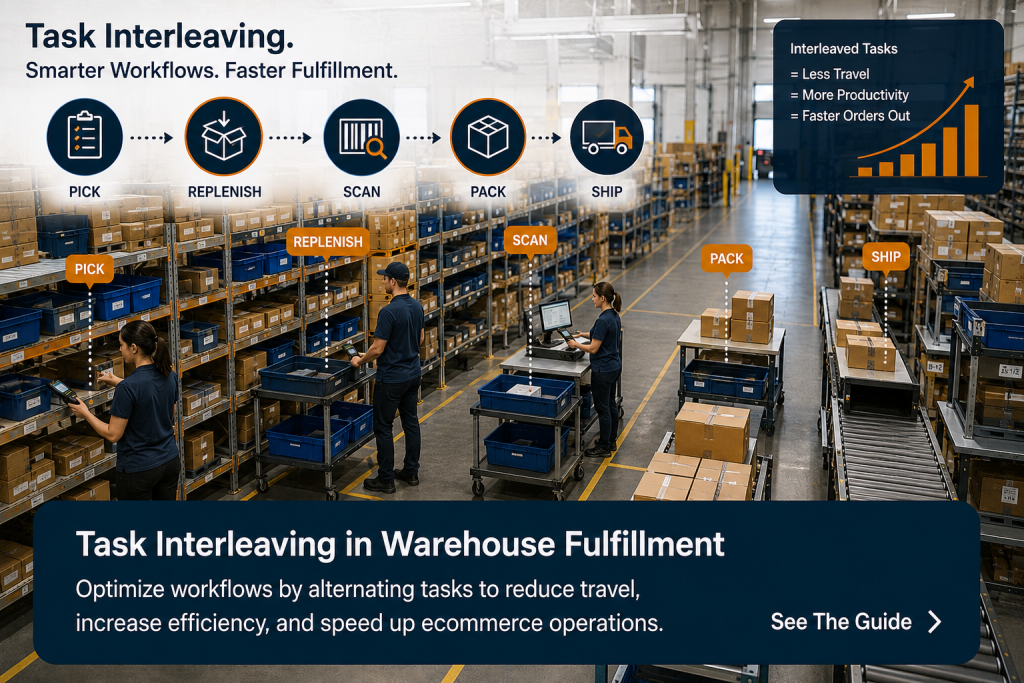
Task interleaving is a warehouse strategy that reduces wasted movement by combining multiple operational tasks into one efficient workflow. Instead of workers completing one task at a time in isolation, systems intelligently sequence related tasks together.
For ecommerce brands, this matters because warehouse labor costs continue to rise while customer delivery expectations continue to tighten. Small inefficiencies inside the warehouse compound quickly during peak order periods.
This article explains how task interleaving works, where ecommerce brands usually lose operational efficiency, and how a structured 3PL environment helps reduce fulfillment bottlenecks without adding unnecessary labor costs.
Brands shipping high-volume parcel orders often discover that fulfillment slowdowns are caused less by staffing shortages and more by operational sequencing problems. Improving movement efficiency inside the warehouse creates measurable gains.
If you already know you need a steadier fulfillment program, you can start the conversation here,
Contact Product Fulfillment Solutions.
Table of contents
- When task interleaving starts to matter
- Story: How Ridgewell Nutrition reduced wasted movement
- What task interleaving actually means
- Where warehouse time gets lost
- How task interleaving improves fulfillment speed
- Technology and system requirements
- How 3PLs support task interleaving
- Task Interleaving FAQs
When task interleaving starts to matter
Task interleaving becomes important once warehouse activity reaches a level where labor movement starts consuming more time than actual order handling.
Many ecommerce brands initially grow with simple workflows. A picker completes one order batch, walks back across the warehouse, then starts another task from scratch. That process works at lower volume but becomes expensive during scaling.
As order counts rise, unnecessary walking, repeated travel paths, and disconnected workflows quietly reduce throughput. Brands often assume they need more labor when the real issue is inefficient movement.
This becomes especially noticeable during seasonal peaks, subscription box releases, product launches, and promotional periods where order spikes place pressure on labor efficiency.
Structured pick and pack services help reduce this operational friction by optimizing how work is assigned throughout the warehouse floor.
Story: How Ridgewell Nutrition reduced wasted movement
Before
Ridgewell Nutrition sold supplements and wellness products through Shopify, Amazon, and recurring subscription orders. Their warehouse team handled increasing daily volume but fulfillment costs kept rising despite hiring additional staff.
Pain points
The warehouse team spent large portions of the day walking between picking zones, replenishment areas, and packing stations. Workers completed tasks separately instead of combining movements efficiently.
Managers noticed congestion around high-demand SKU locations and delays during replenishment windows. Labor utilization looked high on paper, but actual productivity stayed inconsistent.
The shift
After restructuring workflows with a fulfillment partner using stronger warehouse execution systems, the operation began combining replenishment, putaway, and picking tasks into coordinated movement patterns.
Instead of empty return trips across the facility, workers completed multiple related actions during the same movement cycle. Order throughput improved while overtime costs stabilized.
Access to structured real time information also helped leadership identify bottlenecks earlier before they disrupted outbound performance.
What task interleaving actually means
Task interleaving is the process of intelligently sequencing warehouse tasks so employees complete multiple related activities during the same movement cycle.
Instead of assigning isolated tasks independently, warehouse systems combine activities like:
- Picking and replenishment
- Putaway and returns handling
- Inventory movement and cycle counts
- Outbound picking and inbound storage tasks
The goal is simple. Reduce empty travel time and maximize productive movement.
In high-volume ecommerce environments, travel time often becomes one of the largest hidden operational costs. Workers can spend significant portions of the shift walking without handling inventory productively.
Task interleaving minimizes these inefficiencies while improving warehouse flow consistency.
Where warehouse time gets lost
Most warehouse inefficiency comes from fragmented operational design rather than employee effort.
Common problem areas include:
- Long walking distances between zones
- Disconnected replenishment scheduling
- Congested pick locations
- Frequent partial inventory movements
- Poor task prioritization during peaks
- Manual coordination between departments
As ecommerce brands scale SKU counts and order volume, these inefficiencies multiply quickly.
Facilities without organized warehousing and storage solutions often struggle to maintain productivity consistency during growth periods.
Operational fatigue also increases when workers constantly retrace the same inefficient travel patterns throughout the day.
Talk to an Expert
How task interleaving improves fulfillment speed
Task interleaving improves warehouse performance by reducing idle movement and smoothing workflow transitions.
Higher labor efficiency
Workers spend more time handling inventory and less time walking empty paths through the warehouse.
Better replenishment timing
Inventory replenishment happens naturally alongside active picking rather than requiring separate labor allocation.
Reduced congestion
Better task coordination prevents multiple employees from competing for the same pick zones simultaneously.
Improved order throughput
Orders move through the warehouse more consistently during peak periods because workflows remain balanced.
Brands operating through a centralized Cincinnati, Ohio fulfillment center often gain additional efficiency by reducing geographic shipping fragmentation alongside warehouse optimization.
Technology and system requirements
Task interleaving depends heavily on warehouse management system visibility.
Without accurate inventory positioning and real-time task awareness, interleaving becomes difficult to coordinate consistently.
Effective warehouse systems support:
- Dynamic task prioritization
- Live inventory visibility
- Travel path optimization
- Labor balancing
- Automated replenishment triggers
- Operational workload forecasting
Brands that rely on disconnected spreadsheets or manual task assignment often struggle to scale these processes effectively.
Integrated EDI solutions and connections also help synchronize inventory movement between retail, wholesale, and ecommerce channels.
How 3PLs support task interleaving
Experienced 3PL providers already operate within structured warehouse environments designed to optimize movement efficiency.
Instead of rebuilding warehouse logic internally, ecommerce brands can leverage operational systems that already support scalable workflows.
This becomes particularly valuable for brands managing recurring orders, subscription fulfillment, or multi-channel operations.
A structured fulfillment partner can help stabilize:
- Labor utilization
- Inventory movement timing
- Order prioritization
- Peak season scalability
- Replenishment accuracy
- Outbound throughput consistency
Combining optimized workflows with discounted shipping rates also helps brands reduce both warehouse and transportation costs simultaneously.
Talk to an Expert
Task Interleaving FAQs
What is task interleaving in warehouse fulfillment?
Task interleaving is a warehouse strategy that combines multiple operational tasks into coordinated workflows to reduce wasted movement and improve labor efficiency.
Why does task interleaving matter for ecommerce brands?
It helps ecommerce operations reduce labor costs, improve order throughput, and maintain fulfillment consistency during periods of rapid order growth.
What types of warehouse tasks are commonly interleaved?
Warehouses often combine picking, replenishment, putaway, cycle counting, and inventory movement tasks into coordinated workflows.
Does task interleaving require advanced warehouse software?
Most effective task interleaving programs depend on warehouse management systems with real-time inventory visibility and intelligent task assignment capabilities.
Can smaller ecommerce brands benefit from task interleaving?
Yes. Even moderate order volume operations can improve efficiency by reducing unnecessary travel time and organizing warehouse workflows more effectively.
How do 3PL providers support task interleaving?
Experienced 3PLs use structured warehouse systems, operational visibility, and optimized labor workflows to improve movement efficiency across fulfillment operations.