
Reviewed by: Director of Inventory Operations, Product Fulfillment Solutions
Last updated: May 19, 2026
Executive TLDR
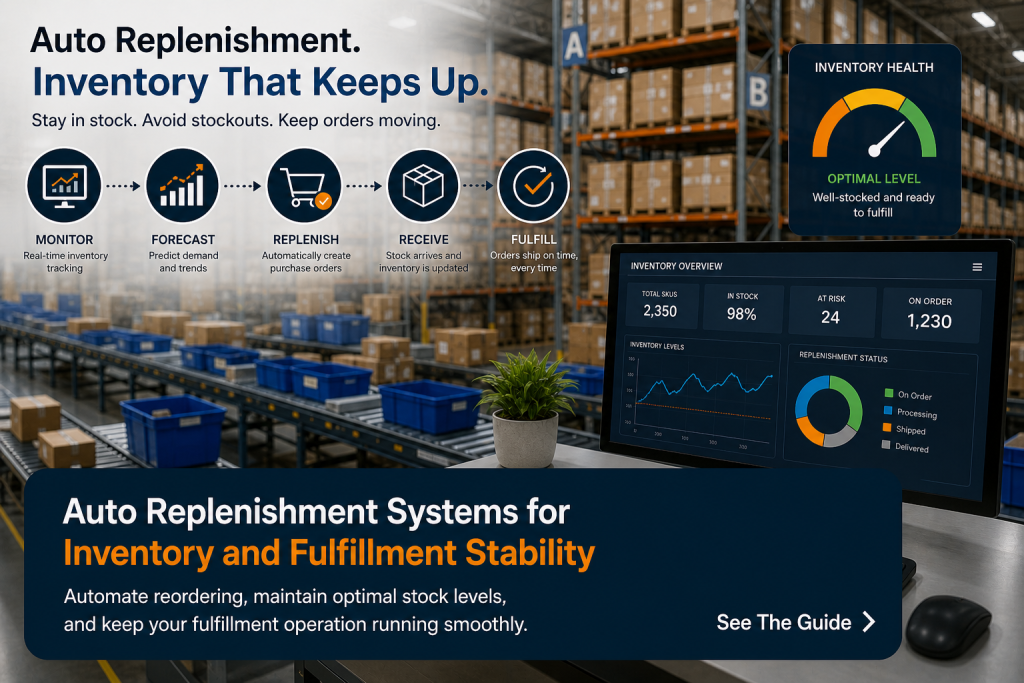
Auto replenishment helps ecommerce brands maintain healthier inventory flow by automatically triggering restocking actions based on sales velocity, inventory thresholds, and forecast demand.
Without replenishment discipline, brands often swing between stockouts and overbuying. Both situations create operational stress, margin pressure, and customer experience problems.
This article explains how auto replenishment works, where inventory planning commonly breaks down, and how fulfillment partners help brands create more stable inventory operations.
For fast-moving ecommerce products, replenishment timing matters just as much as inventory quantity. Small delays in purchasing or inbound coordination can create large downstream fulfillment problems.
If you already know you need a steadier fulfillment program, you can start the conversation here,
Contact Product Fulfillment Solutions.
Table of contents
- When auto replenishment becomes critical
- Story: How VerdeWell stabilized inventory flow
- What auto replenishment actually means
- Inventory problems caused by manual replenishment
- How auto replenishment improves operations
- Forecasting and reorder logic fundamentals
- How 3PLs support replenishment stability
- Auto Replenishment FAQs
When auto replenishment becomes critical
Auto replenishment becomes important when brands can no longer manage inventory manually without creating costly inconsistencies.
At lower order volume, teams often track inventory through spreadsheets or periodic reviews. That process becomes risky once SKU counts increase, sales channels expand, and demand fluctuates more frequently.
Brands selling supplements, cosmetics, snacks, and recurring subscription products often experience volatile order cycles that require faster replenishment decision-making.
Without structured replenishment systems, inventory teams spend too much time reacting to shortages instead of proactively managing inventory flow.
Strong real time information helps brands detect inventory movement patterns earlier before stockouts disrupt fulfillment performance.
Story: How VerdeWell stabilized inventory flow
Before
VerdeWell sold wellness powders, hydration mixes, and subscription-based health products through Shopify and Amazon. Demand patterns shifted constantly during promotions and influencer campaigns.
Pain points
The operations team relied on manual reorder reviews once per week. Fast-moving SKUs frequently sold out before replenishment orders arrived, while slower products accumulated excess storage costs.
Warehouse staff struggled to manage inbound timing because purchase orders arrived inconsistently and inventory priorities changed constantly.
The shift
After implementing replenishment thresholds tied to sales velocity and forecast demand, the company stabilized purchasing cycles and improved inventory availability.
Using structured warehousing and storage solutions, the brand gained clearer visibility into inventory positioning and inbound planning requirements.
What auto replenishment actually means
Auto replenishment is a system-driven inventory process that automatically triggers replenishment actions when stock levels reach predefined thresholds.
Instead of relying entirely on manual monitoring, the system uses inventory rules based on:
- Historical sales velocity
- Forecast demand patterns
- Lead times from suppliers
- Safety stock requirements
- Seasonal demand fluctuations
- Inventory turnover rates
The goal is not simply ordering more inventory. The goal is maintaining healthier inventory flow with fewer disruptions.
Effective replenishment systems reduce both stockout risk and excess inventory accumulation.
Inventory problems caused by manual replenishment
Manual replenishment systems often create instability because inventory reviews happen too slowly for modern ecommerce demand patterns.
Common problems include:
- Delayed reorder decisions
- Inconsistent safety stock planning
- Poor demand forecasting
- Overreacting to temporary sales spikes
- Inventory aging issues
- Emergency expedited purchasing costs
These issues become more expensive when brands operate across multiple sales channels with varying demand behavior.
Strong ecommerce fulfillment services help synchronize inventory flow with outbound fulfillment activity more consistently.
Talk to an Expert
How auto replenishment improves operations
Auto replenishment creates operational consistency by reducing decision lag and improving inventory predictability.
Fewer stockouts
Inventory thresholds trigger replenishment earlier before products reach critical shortage levels.
Lower excess inventory
Brands avoid unnecessary over-ordering because replenishment follows structured inventory logic instead of guesswork.
Better purchasing stability
Procurement teams gain more predictable purchasing cycles and supplier coordination.
Improved fulfillment continuity
Warehouses experience fewer disruptions caused by sudden inventory shortages or inbound surges.
Combining replenishment systems with organized pick and pack services improves overall fulfillment consistency during scaling periods.
Forecasting and reorder logic fundamentals
Auto replenishment systems depend heavily on accurate inventory data and realistic forecasting assumptions.
Brands should evaluate:
- Average daily sales volume
- Supplier lead times
- Seasonal demand variability
- Promotional activity
- Inventory carrying costs
- Safety stock targets
Replenishment logic should also account for operational realities like supplier delays, transportation disruptions, and demand volatility.
Brands operating through a centralized Cincinnati, Ohio fulfillment center can often improve replenishment timing by reducing geographic fragmentation.
How 3PLs support replenishment stability
Experienced 3PL providers help brands create more stable inventory flow through operational visibility and warehouse coordination.
This includes:
- Inventory reporting visibility
- Inbound receiving coordination
- Demand planning support
- SKU movement tracking
- Warehouse replenishment workflows
- Operational forecasting insights
As brands scale order volume, fulfillment systems become tightly connected to replenishment performance. Inventory instability eventually impacts shipping speed, customer satisfaction, and labor efficiency.
Operational support from structured fulfillment environments helps reduce those disruptions before they compound.
Talk to an Expert
Auto Replenishment FAQs
What is auto replenishment?
Auto replenishment is an inventory system that automatically triggers restocking actions based on predefined inventory thresholds and demand patterns.
Why is auto replenishment important for ecommerce brands?
It helps reduce stockouts, improve inventory consistency, and stabilize fulfillment operations during changing demand conditions.
How do replenishment systems calculate reorder timing?
Most systems use sales velocity, supplier lead times, safety stock targets, and demand forecasting data to determine reorder timing.
Can small ecommerce brands benefit from auto replenishment?
Yes. Even moderate-volume brands can improve inventory control and reduce manual planning errors with structured replenishment logic.
What causes replenishment systems to fail?
Common issues include inaccurate inventory data, unrealistic forecasting assumptions, inconsistent supplier lead times, and poor operational visibility.
How do 3PLs support replenishment planning?
3PLs provide inventory visibility, inbound coordination, warehouse reporting, and operational forecasting support that improves replenishment consistency.