
Reviewed by: Chief Operations Officer, Product Fulfillment Solutions
Last updated: June 02, 2026
Executive TLDR
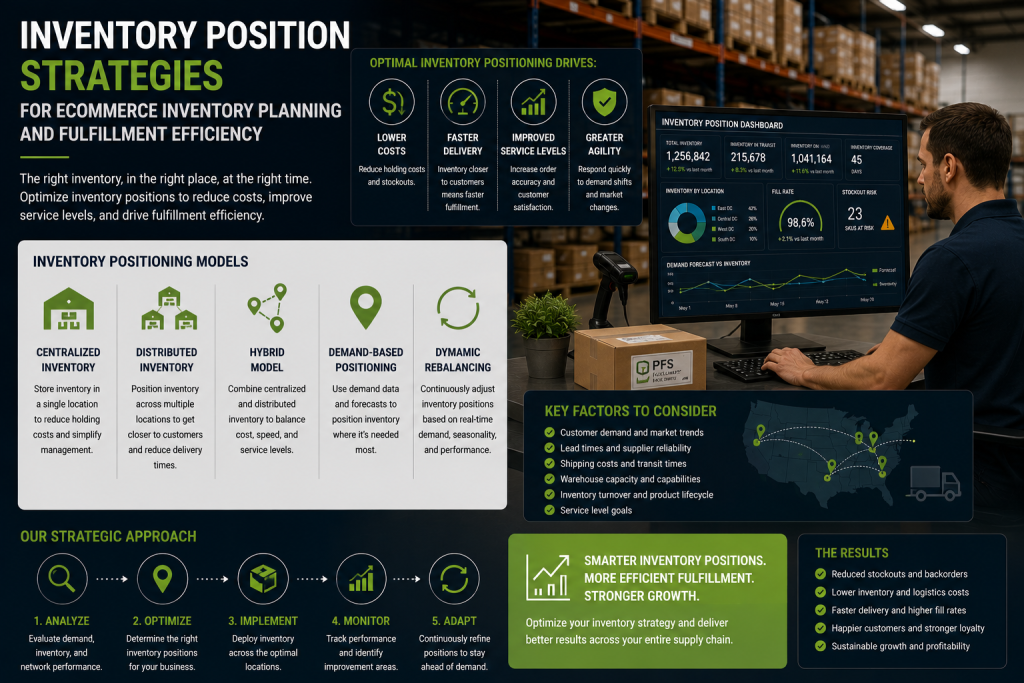
Many ecommerce brands spend significant time managing inventory levels but pay far less attention to inventory position. While inventory quantity tells you how much stock you have, inventory position tells you where inventory is located, how quickly it can be deployed, and whether it can support customer demand efficiently.
Poor inventory positioning often leads to higher shipping costs, slower delivery speeds, stockouts in critical regions, excess inventory in the wrong locations, and increased operational complexity.
For brands selling supplements, cosmetics, wellness products, snacks, subscription boxes, and small consumer goods, inventory position directly impacts customer experience, fulfillment costs, and scalability.
This guide explains what inventory position means, why it matters for growing ecommerce brands, and how better inventory placement strategies can improve fulfillment performance.
- Improve inventory visibility
- Reduce shipping costs
- Support faster delivery times
- Improve replenishment planning
- Strengthen fulfillment efficiency
If you already know you need a steadier fulfillment program, you can start the conversation here,
Contact Product Fulfillment Solutions.
Table of contents
- When inventory position starts impacting growth
- Story: How NatureCore Wellness improved inventory efficiency
- What inventory position actually means
- Common inventory positioning mistakes
- How inventory position affects fulfillment performance
- Inventory Position FAQs
When inventory position starts impacting growth
Inventory management discussions often focus on quantity. Teams ask whether there is enough inventory available to support demand. While quantity matters, location matters just as much.
A brand may technically have sufficient inventory available, but if products are positioned inefficiently, customers can still experience delayed shipments and inconsistent delivery experiences.
As ecommerce companies grow, inventory position becomes increasingly important because:
- Shipping costs increase
- Customer delivery expectations rise
- SKU counts expand
- Order volume grows
- Inventory complexity increases
- Forecasting becomes more challenging
Inventory that is physically available but poorly positioned often creates many of the same operational problems as inventory shortages.
Many growing brands rely on professional ecommerce fulfillment services to help optimize inventory placement while supporting scalable fulfillment operations.
Story: How NatureCore Wellness improved inventory efficiency
Before
NatureCore Wellness sold vitamins, hydration supplements, and subscription wellness products through multiple ecommerce channels.
The company maintained healthy inventory levels and rarely experienced stockouts. Leadership believed inventory management was performing well.
Pain points
Despite strong inventory availability, shipping costs continued increasing. Customers on the West Coast regularly experienced longer delivery times than expected.
The operations team discovered inventory was frequently stored in locations that increased shipping zones and transit times.
Inventory was available, but it was not positioned efficiently.
The company also struggled with replenishment planning because inventory visibility was fragmented across multiple systems.
The shift
NatureCore began analyzing inventory position alongside inventory quantity.
Warehouse workflows were redesigned. Replenishment planning improved. Inventory visibility increased.
The company leveraged structured warehousing and storage solutions to improve operational efficiency and simplify inventory management.
Within months, shipping costs stabilized, fulfillment speed improved, and customer satisfaction scores increased.
What inventory position actually means
Inventory position refers to the location, availability, and accessibility of inventory throughout the supply chain.
It answers questions such as:
- Where is inventory physically located?
- How much inventory is available?
- How quickly can products be fulfilled?
- Which products require replenishment?
- Are inventory levels aligned with customer demand?
Inventory position is not simply a warehouse metric. It influences transportation costs, customer experience, fulfillment speed, inventory turnover, and cash flow management.
Strong inventory positioning requires balancing customer demand patterns with operational realities.
Companies that understand inventory position can often make better decisions regarding purchasing, forecasting, storage, and fulfillment.
Common inventory positioning mistakes
Many ecommerce brands encounter inventory challenges not because inventory levels are wrong, but because inventory is positioned inefficiently.
Common mistakes include:
- Storing slow-moving inventory in premium locations
- Overlooking regional demand patterns
- Poor inventory visibility
- Inaccurate replenishment planning
- Excess safety stock
- Delayed inventory transfers
- Disconnected reporting systems
These issues can increase carrying costs while reducing overall fulfillment efficiency.
Brands should routinely evaluate inventory position alongside demand forecasts and fulfillment performance metrics.
Access to real time information helps operations teams make faster inventory decisions while improving planning accuracy.
Talk to an Expert
How inventory position affects fulfillment performance
Inventory position directly influences how efficiently orders move through the fulfillment process.
Well-positioned inventory can improve:
- Order processing speed
- Inventory accuracy
- Warehouse productivity
- Shipping efficiency
- Customer satisfaction
- Transportation costs
For example, inventory stored closer to primary customer demand regions often reduces shipping zones and transit times. This can improve both delivery performance and transportation cost control.
Inventory positioning also affects labor productivity. Products that are placed strategically within warehouse workflows can reduce travel time, improve picking efficiency, and increase throughput.
As ecommerce operations become more complex, inventory position becomes an increasingly important lever for operational improvement.
“`