
Reviewed by: Director of Transportation Operations, Product Fulfillment Solutions
Last updated: May 20, 2026
Executive TLDR
Parcel management is the process of controlling how ecommerce shipments move through carriers, fulfillment systems, tracking workflows, and shipping cost structures. As brands scale, parcel shipping quickly becomes one of the largest operational expenses.
Many ecommerce companies focus heavily on product growth but underestimate how shipping inefficiencies slowly erode margins. Small issues like address corrections, dimensional weight charges, and inconsistent carrier selection create major long-term cost pressure.
This article explains how parcel management works, where ecommerce shipping operations usually break down, and how structured fulfillment systems help brands maintain better delivery consistency while controlling transportation costs.
Brands shipping high parcel volume need more than discounted labels. They need operational visibility, carrier flexibility, and fulfillment workflows that support reliable outbound execution.
If you already know you need a steadier fulfillment program, you can start the conversation here,
Contact Product Fulfillment Solutions.
Table of contents
- When parcel management becomes important
- Story: How Riverbend Home stabilized shipping costs
- What parcel management actually means
- Common parcel shipping problems for ecommerce brands
- How carrier strategy impacts shipping costs
- Why visibility and reporting matter
- How 3PLs support parcel management
- Parcel Management FAQs
When parcel management becomes important
Parcel management becomes a serious operational priority once shipping volume grows beyond a manageable manual process.
At lower order volume, teams can often absorb occasional delivery delays, carrier mistakes, or shipping cost fluctuations. As order counts increase, those issues compound rapidly.
Ecommerce brands shipping supplements, cosmetics, wellness products, subscription boxes, and small consumer goods often depend heavily on parcel carriers for customer delivery performance.
That means even small inefficiencies in packaging, carrier routing, or address handling can create major downstream costs.
Without structured parcel oversight, brands often experience:
- Unexpected carrier surcharges
- Higher dimensional weight charges
- Late delivery complaints
- Rising reshipment costs
- Poor tracking visibility
- Inconsistent carrier performance
Operational visibility through real time information becomes critical once shipping activity scales across multiple channels and customer regions.
Story: How Riverbend Home stabilized shipping costs
Before
Riverbend Home sold wellness accessories, home organizers, and recurring subscription products through Shopify and retail marketplaces. The company experienced rapid growth after expanding paid advertising campaigns.
Pain points
Shipping costs started increasing faster than revenue growth. Customer support tickets related to tracking delays and damaged shipments also climbed.
The operations team discovered they were using inconsistent packaging sizes, default carrier settings, and manual shipment routing decisions that created unnecessary transportation expenses.
Address corrections and residential surcharges quietly reduced margins across thousands of monthly shipments.
The shift
After restructuring fulfillment workflows and improving parcel oversight through a centralized 3PL operation, the company stabilized shipping performance.
Optimized packaging selection, carrier diversification, and structured outbound workflows reduced shipping variability while improving customer delivery consistency.
Using organized ecommerce fulfillment services, the brand gained better control over parcel execution across all sales channels.
What parcel management actually means
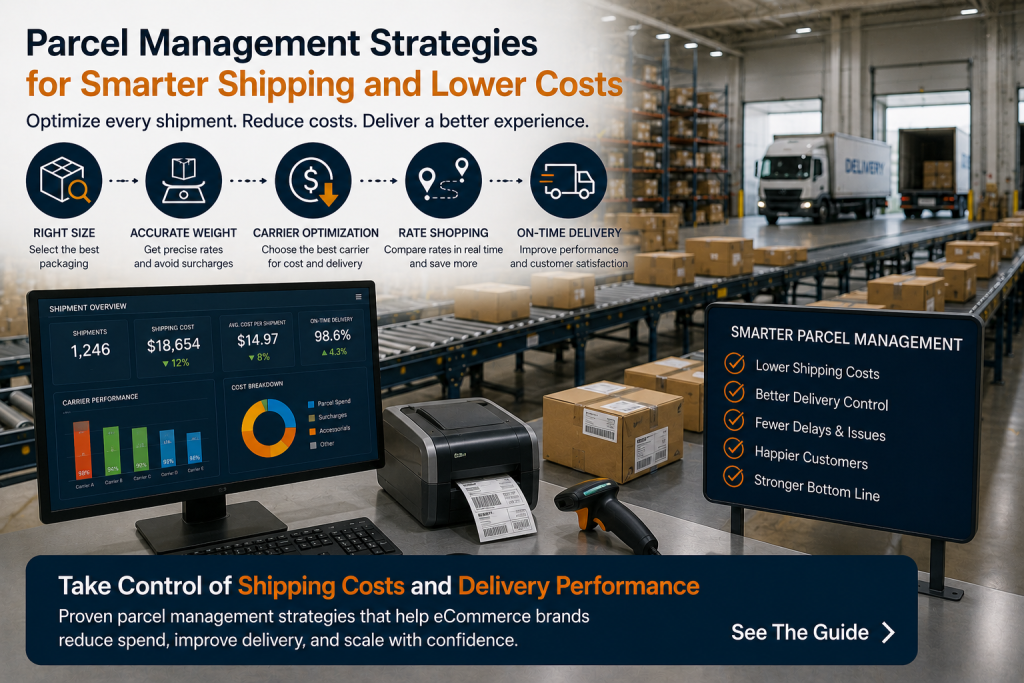
Parcel management refers to the systems, workflows, and operational controls used to manage outbound shipping performance.
This includes:
- Carrier selection strategy
- Shipping cost management
- Packaging optimization
- Tracking visibility
- Address validation
- Delivery exception management
- Rate shopping logic
- Transit performance monitoring
The goal is not simply lowering postage costs.
Strong parcel management creates a balance between cost control, delivery speed, operational consistency, and customer satisfaction.
For ecommerce brands, parcel performance directly affects customer retention and profitability.
Common parcel shipping problems for ecommerce brands
Many parcel shipping problems are operational rather than carrier-related.
Brands often lose margin through avoidable process inefficiencies.
Common issues include:
- Incorrect packaging dimensions
- Poor carton selection
- Manual shipping decisions
- Lack of carrier diversification
- Inconsistent address verification
- Limited visibility into surcharge activity
As order volume grows, these inefficiencies scale quickly.
Warehouse workflow structure also impacts parcel performance. Delays during picking and packing create later carrier cutoff risks and slower outbound movement.
Structured pick and pack services help reduce fulfillment variability before shipments even enter carrier networks.
Talk to an Expert
How carrier strategy impacts shipping costs
Carrier strategy affects both transportation costs and customer experience.
Many ecommerce brands initially rely too heavily on a single carrier because setup is simple. Over time, that creates limited flexibility during capacity constraints, rate increases, or regional service disruptions.
Strong parcel management typically includes:
- Multi-carrier shipping flexibility
- Zone optimization
- Dimensional weight management
- Packaging standardization
- Residential delivery optimization
- Automated carrier selection logic
Brands using centralized Cincinnati, Ohio fulfillment center operations can often reduce transit zones and improve delivery consistency across large portions of the United States.
Why visibility and reporting matter
Parcel management becomes difficult without operational reporting visibility.
Brands need access to accurate data around:
- Carrier performance trends
- Delivery exceptions
- Surcharge activity
- Transit times
- Packaging utilization
- Shipping cost per order
Without reporting visibility, shipping problems often remain hidden until margins deteriorate or customer complaints increase significantly.
Integrated reporting systems help leadership identify operational weaknesses before they become expensive long-term issues.
Combining reporting visibility with discounted shipping rates helps brands improve transportation efficiency while maintaining delivery performance.
How 3PLs support parcel management
Experienced 3PL providers support parcel management through transportation systems, operational visibility, and fulfillment coordination.
This includes:
- Carrier relationship management
- Packaging optimization support
- Shipping rate negotiation
- Address validation systems
- Outbound workflow consistency
- Delivery tracking visibility
For scaling ecommerce brands, parcel shipping eventually becomes too operationally complex to manage effectively through disconnected systems.
A structured fulfillment environment helps stabilize outbound execution while improving cost control across growing shipment volume.
Integrated EDI solutions and connections also help synchronize order data between ecommerce platforms, retail systems, and shipping workflows.
Talk to an Expert
Parcel Management FAQs
What is parcel management?
Parcel management is the process of controlling shipping workflows, carrier performance, packaging strategy, and transportation costs for outbound ecommerce shipments.
Why is parcel management important for ecommerce brands?
It helps reduce shipping costs, improve delivery consistency, manage carrier relationships, and maintain stronger customer experiences.
What causes parcel shipping costs to increase?
Common causes include dimensional weight charges, address corrections, inefficient packaging, poor carrier routing, and lack of shipping visibility.
How can brands improve parcel shipping efficiency?
Brands can improve efficiency through packaging optimization, multi-carrier strategies, operational reporting visibility, and structured fulfillment workflows.
What role does a 3PL play in parcel management?
3PL providers help coordinate shipping systems, carrier relationships, packaging workflows, and transportation visibility across fulfillment operations.
Does parcel management affect customer satisfaction?
Yes. Delivery speed, tracking visibility, shipping accuracy, and carrier reliability directly influence the customer delivery experience.