
Reviewed by: Director of Fulfillment Operations, Product Fulfillment Solutions
Last updated: April 29, 2026
Executive TLDR
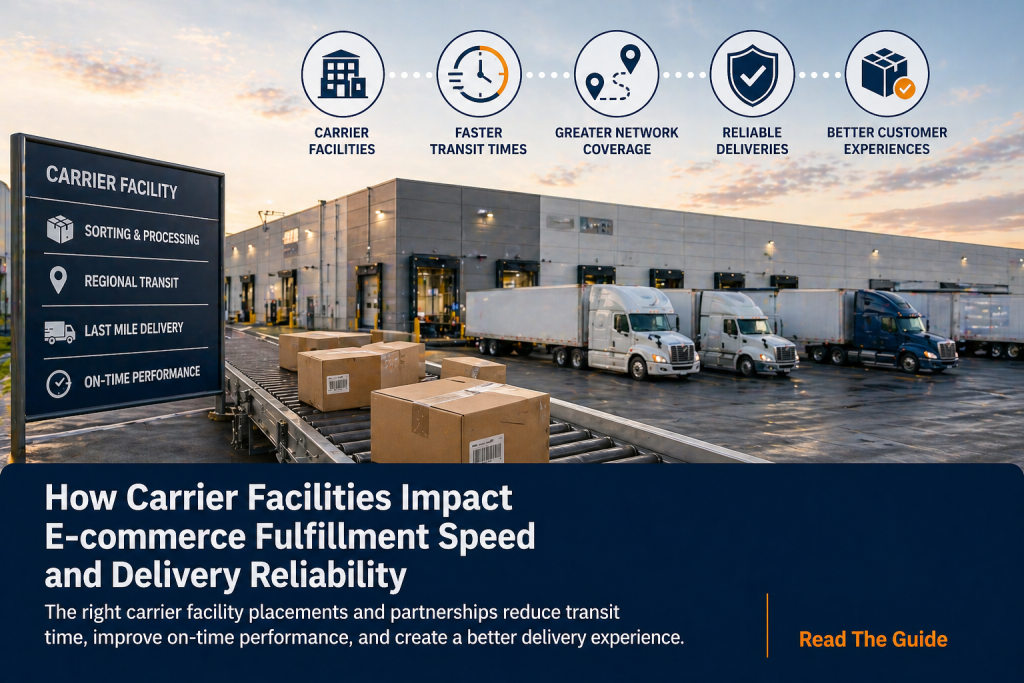
Carrier facilities are one of the most overlooked parts of ecommerce fulfillment. Most brands focus on warehouses and last mile delivery, but the real bottleneck often sits between them inside carrier sorting and distribution hubs. That middle layer determines how fast packages move and how predictable delivery actually is.
This guide breaks down what carrier facilities do, how they affect delivery speed, and where ecommerce brands lose control without realizing it. You will also see how fulfillment design choices upstream directly influence carrier performance downstream.
At PFS, we help brands reduce carrier variability by tightening how orders are prepared before they ever reach a carrier facility.
If you already know you need a steadier fulfillment program, you can start the conversation here,
Contact Product Fulfillment Solutions.
Table of contents
- When carrier facilities start affecting delivery speed
- Story: a brand caught in carrier facility delays
- What carrier facilities actually do in the supply chain
- Why packaging and handoff timing matter
- How fulfillment centers influence carrier performance
- Reducing delays through better order flow
- When to rethink your fulfillment partner
- Final takeaway on control vs dependence
When carrier facilities start affecting delivery speed
Carrier facilities matter most when order volume increases and delivery expectations tighten. At low volume, delays feel random. At scale, they become patterns tied to sorting capacity, scan timing, and hub congestion.
Most ecommerce brands assume delays are caused by the warehouse or the last mile driver. In reality, packages often spend the most unpredictable time inside carrier sorting facilities.
This becomes critical during peak seasons when facility throughput limits are tested daily.
Story: a brand caught in carrier facility delays
Before
A growing wellness brand expanded nationally and began seeing inconsistent delivery times despite stable warehouse operations. Orders were leaving the fulfillment center on time but arriving late.
Pain points
Customer complaints increased, but internal metrics showed no warehouse delays. The issue was inconsistent processing time inside carrier facilities during regional congestion periods.
The shift
Once the brand adjusted its fulfillment batching and shipping cutoffs, packages entered carrier networks earlier in the day, reducing time spent in congested facility queues.
The change was not in the carrier. It was in the timing and structure of fulfillment handoff.
Talk to an Expert
What carrier facilities actually do in the supply chain
Carrier facilities are sorting and redistribution hubs. Once a package leaves a warehouse, it is scanned, sorted, and routed through a network of regional and national hubs before reaching its destination.
The key functions include:
- Sorting packages by destination zones
- Consolidating shipments for linehaul transport
- Managing scan events that trigger tracking updates
Delays often happen when volume exceeds sorting capacity or when scan timing falls outside optimal processing windows.
Why packaging and handoff timing matter
Carrier performance is heavily influenced by what happens before the package arrives at the facility. Poor labeling, inconsistent packaging, or late-day handoffs can push shipments into slower processing cycles.
Key pressure points
- Late cutoff shipping increases facility backlog exposure
- Inconsistent packaging slows automated sorting systems
- Label issues delay scan acceptance at intake points
This is where structured ecommerce fulfillment services reduce variability before carrier entry.
How fulfillment centers influence carrier performance
Fulfillment centers act as the first control point in carrier performance. The way orders are staged, batched, and released directly impacts how efficiently they move through downstream carrier facilities.
A centralized system like the Cincinnati, Ohio fulfillment center improves consistency by controlling shipping waves and reducing chaotic carrier handoffs.
Better structure at the warehouse level reduces variability at the carrier level.
Reducing delays through better order flow
Order flow design matters more than most brands realize. Small adjustments in batching and release timing can reduce exposure to carrier facility congestion.
- Batch orders by carrier cutoff windows
- Align pick completion with shipping waves
- Avoid end-of-day bulk releases when possible
This is where structured pick and pack services improve timing precision and reduce downstream variability.
Talk to an Expert
When to rethink your fulfillment partner
If delivery performance is inconsistent despite stable carrier contracts, the issue is often upstream in fulfillment design. Carrier facilities amplify upstream inefficiencies rather than create them.
Signs it is time to reassess include unpredictable delivery times across similar zones, rising customer complaints, and inconsistent scan timing patterns.
Strong fulfillment systems reduce dependency on carrier variability by controlling how shipments enter the network.
Final takeaway on control vs dependence
You cannot control carrier facility performance, but you can control how your shipments interact with it. The more structured your fulfillment operation is, the less exposed you are to carrier variability.
Brands that scale successfully do not eliminate carrier risk. They reduce how often they depend on perfect carrier behavior.
Carrier Facility FAQs
What is a carrier facility in ecommerce shipping?
A carrier facility is a sorting hub where packages are processed, grouped, and routed between origin and destination points in the delivery network.
Why do packages get delayed at carrier facilities?
Delays usually occur due to high volume, limited sorting capacity, or timing issues when packages enter the facility during peak congestion periods.
Can fulfillment centers reduce carrier delays?
Yes, by improving batching, labeling, and shipping timing, fulfillment centers can reduce how often packages enter congested carrier windows.
Do all carriers use similar facility systems?
Most major carriers use hub and spoke networks, but capacity, automation, and regional congestion levels vary significantly.
What is the biggest mistake brands make with carrier performance?
They focus only on carrier selection instead of improving upstream fulfillment processes that determine how packages enter carrier systems.
How does shipping timing affect carrier facility speed?
Packages shipped earlier in the day typically move through facilities faster because they enter processing queues before peak volume builds.
Talk to an Expert