
Reviewed by: Chief Operations Officer, Product Fulfillment Solutions
Last updated: May 13, 2026
Executive TLDR
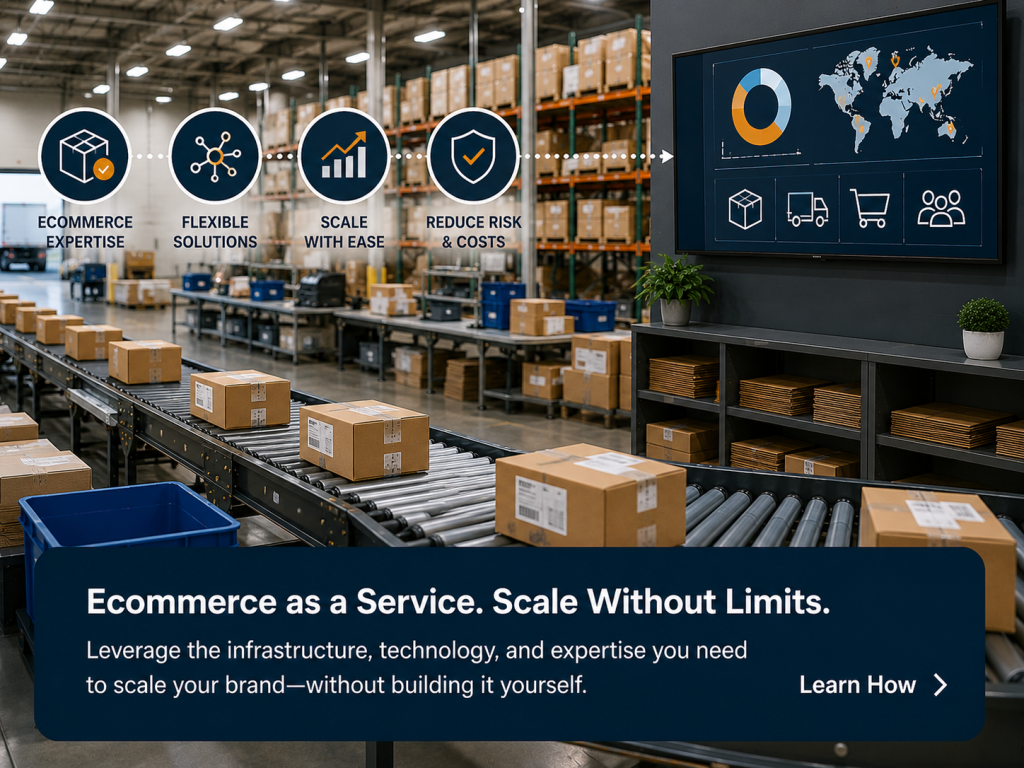
Ecommerce as a Service is a model where brands outsource core operational layers like fulfillment, warehousing, and logistics instead of building them internally. It allows companies to scale faster without investing heavily in infrastructure, staff, or systems.
The challenge is that many brands adopt this model without understanding how tightly operations, inventory, and customer experience are connected. When execution breaks, customers feel it immediately through delays, stock issues, and inconsistent delivery.
This article breaks down how Ecommerce as a Service actually works in real operations, where brands get exposed as they scale, and how structured fulfillment partnerships like PFS stabilize growth.
If you already know you need a steadier fulfillment program, you can start the conversation here,
Contact Product Fulfillment Solutions.
Table of contents
- When Ecommerce as a Service becomes necessary
- Story: Lumen Supplements scaling reality
- What Ecommerce as a Service actually is
- Core components behind the model
- Benefits and hidden operational risks
- Role of 3PL in Ecommerce as a Service
- How to implement without breaking operations
- Ecommerce as a Service FAQs
When Ecommerce as a Service becomes necessary
This model becomes necessary when ecommerce brands outgrow their ability to manage operations internally without slowing down growth.
It usually happens during rapid channel expansion, rising order volume, or when operational complexity exceeds what a small internal team can handle.
At this point, the business is no longer limited by demand. It is limited by execution capacity.
Story: Lumen Supplements scaling pressure
Before
Lumen Supplements started as a direct-to-consumer Shopify brand fulfilling orders in-house with a small warehouse setup and manual processes.
Pain points
As sales grew, shipping delays increased, inventory tracking became unreliable, and customer support volume spiked due to fulfillment errors.
The shift
They moved fulfillment and inventory operations into an outsourced model aligned with Ecommerce as a Service principles, allowing them to focus on growth while execution was centralized.
What Ecommerce as a Service actually is
Ecommerce as a Service is a structured outsourcing model where operational functions like fulfillment, inventory storage, and shipping are handled by specialized partners.
Instead of building warehouses and logistics systems, brands plug into an existing infrastructure designed to scale.
This is where ecommerce fulfillment services become the operational backbone of the model.
Core components behind the model
The model is not just outsourcing. It is a connected system of operational layers working together in real time.
- Inventory storage and management
- Order routing and fulfillment execution
- Shipping carrier coordination
- Real time inventory visibility
Without reliable warehousing and storage solutions, the system becomes unstable during demand spikes.
Benefits and hidden operational risks
The biggest advantage is speed to scale without infrastructure investment. Brands can expand channels without building physical operations.
However, the risk is over-reliance on systems they do not fully control. If visibility or communication breaks, customer experience degrades quickly.
Strong execution depends on structured workflows like pick and pack services that reduce variability.
Talk to an Expert
Role of 3PL in Ecommerce as a Service
A 3PL acts as the physical and operational execution layer of Ecommerce as a Service. It connects digital orders to real-world fulfillment actions.
A centralized Cincinnati, Ohio fulfillment center helps brands stabilize shipping zones, reduce transit variability, and improve delivery predictability.
With strong visibility tools like real time information, brands gain operational control without owning infrastructure.
How to implement without breaking operations
Implementing Ecommerce as a Service requires careful transition planning, especially around inventory migration and channel integration.
Step 1: Map fulfillment dependencies
Identify all systems tied to order flow, including marketplaces, ERP tools, and shipping logic.
Step 2: Centralize inventory visibility
Ensure all SKUs are standardized and synchronized across systems before migration.
Step 3: Transition fulfillment execution
Move order fulfillment into a structured environment using a partner built for scale.
Talk to an Expert
Ecommerce as a Service FAQs
What is Ecommerce as a Service?
It is a model where ecommerce operations like fulfillment and logistics are outsourced to specialized providers instead of being built in-house.
Why do brands use this model?
Brands use it to scale faster without investing in warehouses, staffing, and operational systems.
What are the biggest risks?
The main risks are loss of visibility, dependency on external systems, and inconsistent execution if processes are not standardized.
How does a 3PL support this model?
A 3PL provides the physical fulfillment infrastructure and execution layer needed to turn online orders into delivered shipments.
Is this model suitable for small brands?
Yes, especially if they are experiencing rapid growth or multi-channel expansion that exceeds internal operational capacity.