
Reviewed by: Chief Operations Officer, Product Fulfillment Solutions
Last updated: March 30, 2026
Executive TLDR
Pick and pack operations sit at the center of ecommerce fulfillment performance. When they work well, orders move quickly, customers receive accurate shipments, and costs stay predictable. When they break down, brands experience delays, rising labor costs, and growing customer service issues almost overnight.
Many ecommerce companies outgrow early fulfillment setups without realizing it. What worked at 50 orders per day often fails at 500. The problem is rarely effort. It is usually process design, warehouse layout, and lack of operational visibility.
In this guide, you will learn how modern pick and pack warehouses actually function, what separates efficient fulfillment operations from chaotic ones, and how a centralized 3PL partner helps brands scale without constantly rebuilding workflows.
If you already know you need a steadier fulfillment program, you can start the conversation here,
Contact Product Fulfillment Solutions.
Table of contents
- When pick and pack operations become mission critical
- Story: How Lumora Beauty stabilized fulfillment growth
- What pick and pack really means inside a warehouse
- Core components of efficient pick and pack systems
- Common pick and pack failures growing brands face
- How technology and warehouse layout work together
- Why centralized 3PL fulfillment changes performance
- Building a scalable pick and pack strategy
- Pick and pack warehouse FAQs
When pick and pack operations become mission critical
Pick and pack processes rarely feel urgent in the early stages of an ecommerce business. Founders often ship orders themselves, store inventory wherever space exists, and rely on manual processes that seem manageable at low volume.
Problems appear when order consistency increases. A brand moves from occasional spikes to predictable daily volume, and suddenly small inefficiencies compound across hundreds or thousands of orders.
Typical warning signs include:
- Order accuracy starts slipping as SKU counts grow
- Packing takes longer despite hiring more staff
- Shipping cutoffs become difficult to meet
- Customer complaints increase during promotions
- Warehouse organization breaks down after peak seasons
At this stage, fulfillment stops being a back-office function and becomes a primary driver of customer experience and margin control. Structured pick and pack services become essential rather than optional.
Story: How Lumora Beauty stabilized fulfillment growth
Before
Lumora Beauty, a fast-growing cosmetics brand, began fulfilling orders from a small leased warehouse. Early success created rapid order growth, but processes never evolved beyond basic shelf storage and manual picking lists.
Pain points
Within months, operational friction appeared:
- Pickers walked excessive distances across the warehouse
- Best-selling SKUs frequently stocked out on shelves
- Packing stations became bottlenecks during promotions
- Returns increased due to incorrect item selection
- Labor costs rose faster than revenue
The team worked harder but performance worsened because the system itself could not scale.
The shift
After transitioning fulfillment to a structured environment supported by real-time processes and optimized workflows, Lumora centralized operations through a professionally managed fulfillment partner. Inventory placement improved, picking paths shortened, and accuracy stabilized.
Instead of reacting to daily fires, the operations team gained visibility and predictability through integrated real time information and standardized workflows.
What pick and pack really means inside a warehouse
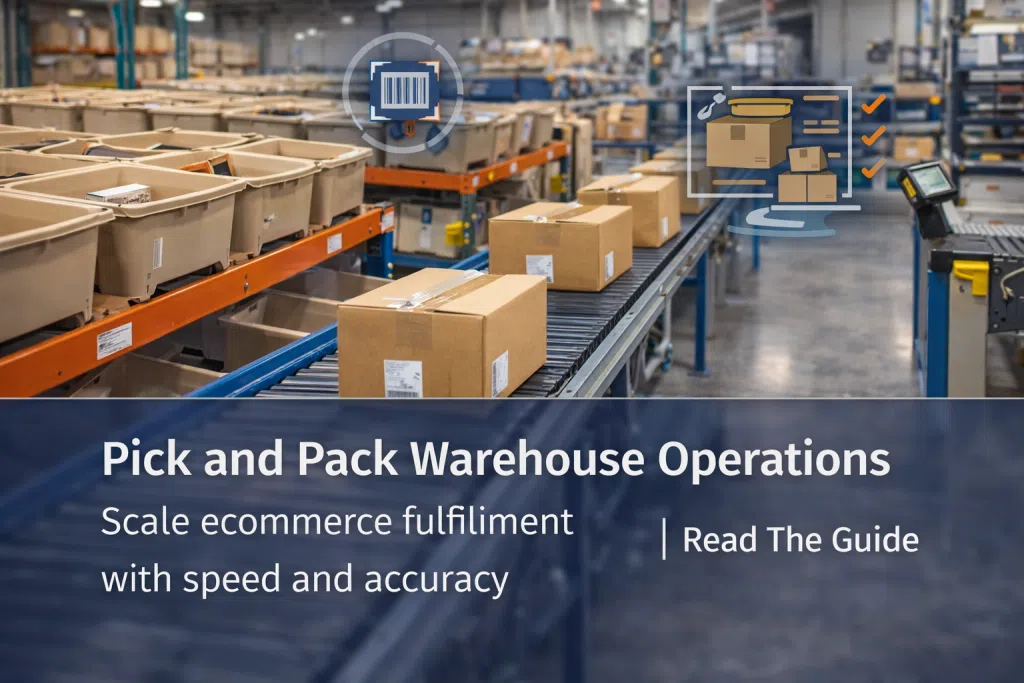
Pick and pack refers to the sequence of steps required to retrieve ordered products from storage and prepare them for shipment. While the concept sounds simple, execution determines fulfillment speed, cost, and accuracy.
Picking
Picking involves locating and retrieving items listed in an order. Efficient warehouses minimize travel distance and decision-making time for workers through structured storage logic and guided workflows.
Packing
Packing ensures products are protected, correctly labeled, and shipped using appropriate materials and carriers. Proper packing balances cost efficiency with damage prevention and customer presentation.
Quality control
Modern operations include verification steps that reduce mis-picks and shipping errors before packages leave the building.
When these steps operate as a unified system rather than isolated tasks, fulfillment performance becomes consistent and scalable.
Core components of efficient pick and pack systems
High-performing warehouses rely on a combination of physical layout, standardized workflows, and operational discipline.
Optimized inventory placement
- Fast-moving SKUs positioned near packing stations
- Seasonal inventory relocated based on demand cycles
- Logical zoning reduces picker travel time
Standardized workflows
- Defined picking paths prevent congestion
- Consistent packing procedures reduce variability
- Clear labeling prevents confusion across teams
Integrated systems
Technology connects orders, inventory data, and shipping decisions. Brands benefit from centralized dashboards that enable better forecasting and operational planning through ecommerce fulfillment services.
Talk to an Expert
Common pick and pack failures growing brands face
Most fulfillment breakdowns are predictable. They happen when operational complexity grows faster than warehouse design.
Static storage layouts
Assigning permanent shelf locations works early but becomes inefficient as SKU velocity changes. Workers spend more time walking than picking.
Manual decision making
Without system guidance, staff rely on memory or printed lists, increasing training time and error rates.
Disconnected shipping strategy
Carrier selection without operational alignment leads to missed cutoffs and inconsistent delivery performance. Access to negotiated discounted shipping rates helps align speed with cost control.
How technology and warehouse layout work together
Technology alone does not fix fulfillment problems. Warehouse design must support system logic.
Guided picking workflows
Warehouse management systems assign optimized routes that reduce walking time and increase throughput.
Real-time inventory visibility
Accurate inventory counts prevent overselling and reduce emergency replenishment tasks.
Cartonization and packing logic
Smart packing decisions select box sizes and shipping methods automatically, improving efficiency and reducing dimensional weight costs.
Facilities designed around structured warehousing and storage solutions enable these systems to work effectively.
Why centralized 3PL fulfillment changes performance
Location and operational expertise influence fulfillment outcomes more than many brands realize. A centrally located warehouse reduces transit times across the United States while simplifying inventory management.
Operating through a dedicated Cincinnati, Ohio fulfillment center allows brands to:
- Reach large portions of the US population within shorter transit windows
- Maintain fewer inventory nodes
- Reduce shipping costs without sacrificing delivery speed
- Scale staffing without internal hiring challenges
Instead of constantly rebuilding operations, brands leverage established infrastructure built specifically for ecommerce fulfillment.
Building a scalable pick and pack strategy
Brands preparing for growth should evaluate fulfillment through an operational lens rather than a staffing lens.
Focus on process before volume
- Document workflows before hiring additional labor
- Measure pick time per order regularly
- Track accuracy as a leading performance indicator
Design for peaks, not averages
- Promotions and seasonal spikes expose weak systems
- Flexible workflows prevent backlog accumulation
- Pre-kitting improves efficiency for bundles and subscriptions using kitting and assembly solutions
Scalable fulfillment is not about working faster. It is about removing friction from every step between order placement and shipment.
Talk to an Expert
Pick and pack warehouse FAQs
What is a pick and pack warehouse in ecommerce fulfillment?
A pick and pack warehouse stores inventory and fulfills orders by selecting products from storage locations and packing them for shipment. The efficiency of this process directly impacts delivery speed, order accuracy, and fulfillment costs.
When should an ecommerce brand outsource pick and pack operations?
Brands typically benefit from outsourcing when order volume becomes consistent, SKU counts increase, or internal teams struggle to maintain accuracy and shipping timelines during growth or seasonal peaks.
How does pick and pack efficiency reduce fulfillment costs?
Efficient picking paths, optimized inventory placement, and standardized packing procedures reduce labor time per order. Lower handling time translates directly into reduced cost per shipment.
What causes picking errors in warehouses?
Common causes include poor inventory organization, manual workflows, unclear labeling, and lack of system guidance. Structured processes and verification steps significantly reduce error rates.
Why does warehouse location affect pick and pack performance?
A central warehouse location shortens transit distances and simplifies inventory management. Faster delivery zones reduce shipping costs while improving customer experience consistency.
How can brands prepare fulfillment operations for rapid growth?
Brands should invest early in scalable workflows, real-time inventory visibility, and fulfillment partners designed for ecommerce operations rather than retrofitted storage facilities.