
Reviewed by: Chief Operations Officer, Product Fulfillment Solutions
Last updated: March 9, 2026
Executive TLDR
Warehouse mapping is one of the most overlooked drivers of fulfillment efficiency. When inventory locations are poorly planned, teams walk farther, picking errors increase, and order processing slows down. For ecommerce brands shipping hundreds or thousands of orders per day, layout decisions can quietly drive up cost per order.
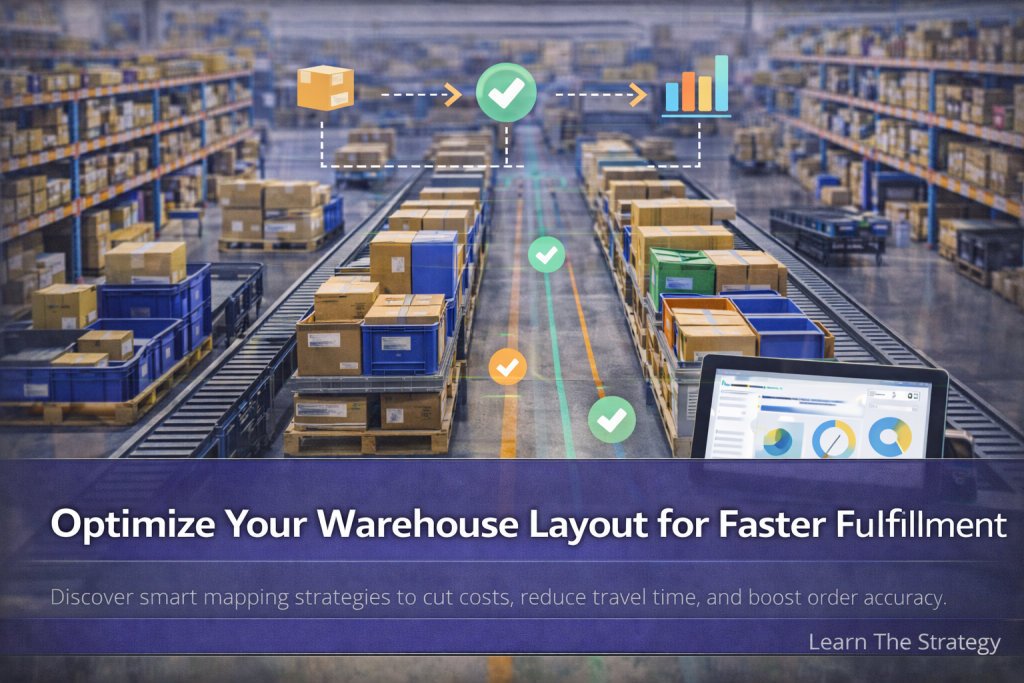
A well designed warehouse map organizes products by velocity, size, and picking patterns. Fast moving SKUs sit near packing stations. Kitted products stay close to assembly areas. Seasonal inventory is separated to avoid disrupting daily operations. These small decisions compound into faster fulfillment and fewer mistakes.
For growing ecommerce brands, warehouse mapping becomes critical once order volume increases, SKU counts grow, or new sales channels are added. At that point, a structured system supported by technology becomes necessary to maintain accuracy and speed.
Product Fulfillment Solutions helps brands simplify these operational challenges through structured warehouse layouts, real time inventory tracking, and disciplined pick workflows inside our Cincinnati, Ohio fulfillment center.
If you already know you need a steadier fulfillment program, you can start the conversation here,
Contact Product Fulfillment Solutions.
Table of contents
- When warehouse mapping becomes critical for ecommerce brands
- Story: how Radiant Skincare fixed warehouse chaos
- What warehouse mapping actually means in modern fulfillment
- How SKU velocity should shape warehouse layout
- Zone design for efficient ecommerce picking
- Technology that keeps warehouse maps accurate
- How a 3PL simplifies warehouse layout decisions
- Building a warehouse map that scales with growth
- Warehouse mapping FAQs
When warehouse mapping becomes critical for ecommerce brands
Warehouse mapping is easy to ignore when order volume is small. Early stage brands often store products wherever space is available, and teams rely on memory instead of structured inventory locations. That approach works temporarily, but it breaks down quickly as complexity increases.
Once daily orders rise, inefficient layouts create real operational friction. Pickers spend more time walking between locations, packing stations become congested, and inventory accuracy declines. Small inefficiencies multiply across hundreds of orders.
Warehouse mapping becomes especially important when brands experience:
- Rapid SKU growth across product lines
- High order volume with recurring customers
- Bundles or subscription box programs
- Multiple sales channels like DTC, Amazon, and retail
- Seasonal spikes that strain fulfillment capacity
Structured warehouse mapping allows fulfillment teams to maintain speed and accuracy while handling growth. Brands relying on experienced providers offering ecommerce fulfillment services benefit from layouts already optimized for high volume order flow.
Story: how Radiant Skincare fixed warehouse chaos
Before
Radiant Skincare launched with a simple product lineup of serums and moisturizers. Orders were manageable, and inventory was stored wherever space was available. A small team could pick orders quickly by memory.
Pain points
As the brand grew, inventory expanded to dozens of SKUs including bundles and seasonal kits. The warehouse layout never evolved with that growth. Pickers began walking long distances between locations, and incorrect picks started appearing more frequently.
Peak promotions made the situation worse. Orders stacked up, packing stations backed up, and returns increased due to picking errors.
The shift
After redesigning the warehouse layout, high velocity SKUs moved closer to packing stations while slower products shifted to secondary zones. Kitting areas were placed near bundle components, and standardized bin locations replaced ad hoc shelving.
Combined with improved pick and pack services, the new layout dramatically reduced walking time and stabilized order throughput.
What warehouse mapping actually means in modern fulfillment
Warehouse mapping is the process of defining structured locations for every product inside a fulfillment center. Each storage area receives a unique identifier, allowing inventory systems to track exactly where items live and how they move through the building.
A typical warehouse map includes several layers:
- Storage zones for different product categories
- Bin level identifiers for precise item locations
- Receiving and inbound inspection areas
- Kitting and assembly workstations
- Packing stations and outbound staging zones
Without these structures, inventory quickly becomes disorganized. With them, fulfillment teams can scale operations while maintaining accuracy.
Many brands also rely on providers that combine mapping with warehousing and storage solutions designed specifically for small parcel ecommerce products.
How SKU velocity should shape warehouse layout
One of the most important principles in warehouse mapping is SKU velocity. Fast moving products should always be placed closer to packing stations to minimize walking time during picking.
High velocity SKUs
- Placed near primary pick aisles
- Stored in easily accessible bins
- Frequently replenished from reserve inventory
Moderate velocity SKUs
- Located slightly farther from packing stations
- Stored in standard shelving zones
- Picked less frequently but still accessible
Low velocity SKUs
- Stored in secondary or reserve storage areas
- Retrieved only when needed
- Kept separate from high traffic picking paths
This velocity based approach reduces picker travel time and improves overall throughput. Combined with discounted shipping rates, brands can significantly reduce total fulfillment cost per order.
Talk to an Expert
Zone design for efficient ecommerce picking
Warehouse zones organize products into logical groups that simplify picking workflows. Instead of wandering the entire facility, pickers work inside specific zones assigned to their tasks.
Common ecommerce zones include:
- Fast moving product pick zones
- Kitting and bundle assembly areas
- Returns inspection areas
- Reserve pallet storage
- Outbound packing and shipping stations
For subscription programs or promotional bundles, proximity to assembly areas matters even more. Brands running regular kit programs benefit from specialized kitting and assembly solutions that integrate with warehouse layouts.
Technology that keeps warehouse maps accurate
Even the best warehouse layout fails without accurate inventory tracking. Modern fulfillment operations rely on warehouse management systems that maintain precise location records.
These systems help teams:
- Track every SKU location down to the bin level
- Direct pickers along optimized routes
- Prevent inventory from being stored incorrectly
- Maintain real time stock visibility
Reliable real time information helps brands maintain inventory accuracy while keeping ecommerce platforms synced with warehouse activity.
How a 3PL simplifies warehouse layout decisions
Designing a warehouse layout requires experience with real fulfillment patterns. Ecommerce brands often underestimate how quickly operational complexity increases when order volume grows.
A specialized 3PL removes much of that complexity by operating facilities already optimized for ecommerce order flow.
Inside a professionally managed fulfillment center, brands benefit from:
- Structured inventory location systems
- Dedicated receiving and replenishment workflows
- Experienced pick and pack teams
- Shipping carrier integrations
- Technology that synchronizes order and inventory data
By centralizing operations in a strategically located facility such as the Cincinnati, Ohio fulfillment center, ecommerce brands can reduce transit times while maintaining efficient internal workflows.
Building a warehouse map that scales with growth
Warehouse mapping should always anticipate future growth. Layouts designed only for current order volume will quickly become outdated as brands expand.
Smart fulfillment strategies include:
- Designating expansion zones for future SKUs
- Separating reserve inventory from pick faces
- Creating dedicated areas for kitting and assembly
- Using flexible shelving systems
- Maintaining accurate location labeling
These decisions make it easier to scale operations without constantly reorganizing inventory. When fulfillment infrastructure is designed correctly from the beginning, brands can grow confidently without operational disruption.
Talk to an Expert
Warehouse mapping FAQs
What is warehouse mapping in ecommerce fulfillment?
Warehouse mapping is the process of defining structured storage locations for inventory inside a fulfillment center. It assigns identifiers to zones, aisles, shelves, and bins so teams and software systems know exactly where each product is stored.
Why does warehouse layout affect fulfillment speed?
The layout determines how far pickers must travel to retrieve products. When high velocity items are located near packing stations and picking routes are organized efficiently, teams process orders faster and reduce labor time per order.
How often should warehouse layouts be updated?
Warehouse maps should be reviewed whenever product catalogs grow, order volume changes significantly, or new sales channels are added. Regular reviews ensure high velocity items remain positioned for efficient picking.
Can small ecommerce brands benefit from warehouse mapping?
Yes. Even smaller brands gain efficiency from structured inventory locations. Clear bin labeling and organized storage reduce picking errors and make it easier to scale operations when order volume increases.
Does warehouse mapping require specialized software?
Most modern fulfillment operations use warehouse management systems to track inventory locations. These systems maintain accurate records, guide pickers through optimized routes, and synchronize inventory levels with ecommerce platforms.
How does a 3PL help with warehouse organization?
Experienced 3PL providers operate facilities already optimized for ecommerce fulfillment. They implement structured layouts, inventory tracking systems, and trained teams so brands can scale without designing warehouse infrastructure themselves.