
Reviewed by: Chief Operations Officer, Product Fulfillment Solutions
Last updated: March 23, 2026
Executive TLDR
Every ecommerce brand makes supply chain decisions every day, often without realizing it. Where inventory lives, how orders ship, when to reorder, and which partners handle fulfillment all determine whether growth feels controlled or chaotic.
Early decisions that work at 50 orders per day often break at 500. Shipping costs spike, inventory becomes fragmented, and operations teams spend more time reacting than planning. The issue is rarely demand, it is decision structure.
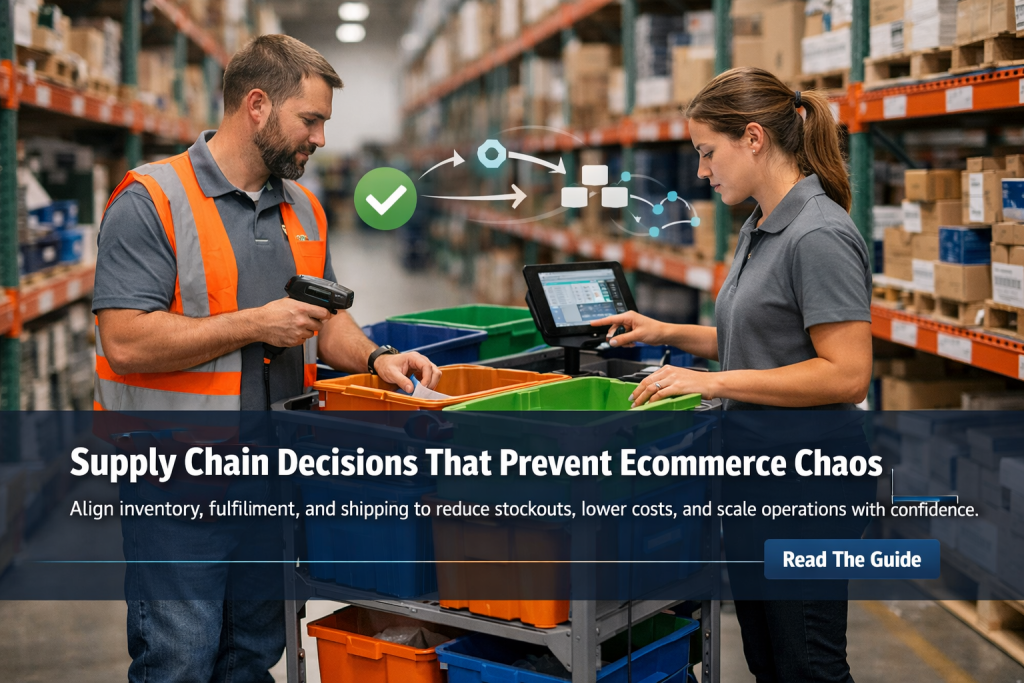
This guide explains the supply chain decisions that matter most for growing ecommerce brands, how to evaluate tradeoffs realistically, and how a centralized fulfillment strategy simplifies operations while improving customer experience.
- Understand which decisions create long-term operational leverage
- Learn how inventory placement impacts cost and delivery speed
- Identify when fulfillment complexity begins hurting growth
- Build a decision framework your operations team can actually use
If you already know your operations need more stability, you can start the conversation here,
Contact Product Fulfillment Solutions.
Table of contents
- When supply chain decisions start to matter
- Story: How Lunera Beauty stabilized rapid growth
- Inventory location decisions that shape fulfillment costs
- Shipping strategy tradeoffs ecommerce brands face
- Technology and visibility decisions operators must make
- Outsourcing versus operating fulfillment in-house
- Building a repeatable supply chain decision framework
- Supply chain decisions FAQs
When supply chain decisions start to matter for ecommerce brands
In early stages, most ecommerce logistics decisions are reactive. Founders ship orders themselves, inventory lives wherever space exists, and shipping methods evolve week by week. This works temporarily because volume is low.
Problems begin once growth introduces operational pressure. More SKUs, higher order volume, and tighter delivery expectations expose weaknesses in earlier decisions.
Common warning signs include:
- Shipping costs rising faster than revenue
- Inventory split across multiple storage locations
- Long receiving times after inbound deliveries
- Customer service tickets related to delivery delays
- Operations teams constantly firefighting
At this stage, supply chain decisions stop being tactical and become strategic. Brands must decide how inventory flows, not just how orders ship.
Story: How Lunera Beauty stabilized rapid growth
Before
Lunera Beauty, a fast-growing skincare subscription brand, experienced explosive demand after influencer campaigns drove monthly order volume beyond expectations.
Pain points
- Inventory stored across two small warehouses and an office space
- Inconsistent picking processes created fulfillment errors
- Expedited shipping became the default solution to delays
- Operations costs climbed each quarter
The team realized their challenges were not fulfillment speed but fragmented decision making.
The shift
By consolidating inventory into a centralized Midwest location and implementing structured fulfillment workflows through Product Fulfillment Solutions, Lunera simplified inbound receiving, improved order accuracy, and reduced shipping variability.
Growth continued, but operations finally felt predictable.
Inventory location decisions that shape fulfillment costs
One of the most important supply chain decisions involves where inventory should live. Many brands assume more warehouse locations automatically improve delivery speed, but distribution complexity often increases faster than benefits.
A centralized strategy built around a Cincinnati, Ohio fulfillment center allows brands to reach a large percentage of US customers efficiently while maintaining inventory control.
Key tradeoffs to evaluate
- Transportation cost versus delivery speed expectations
- Inventory duplication across multiple facilities
- Forecasting accuracy requirements
- Operational overhead and staffing complexity
For many small parcel ecommerce brands, fewer locations with better processes outperform distributed networks.
Shipping strategy tradeoffs ecommerce brands face
Shipping decisions impact margins more than most operators expect. Carrier selection, service levels, and packaging standards all influence total fulfillment cost.
Effective supply chain leaders avoid designing shipping around exceptions. Instead, they optimize for predictable volume.
Working with partners that provide discounted shipping rates allows brands to reduce per-order costs without sacrificing service levels.
Questions operators should ask
- Are expedited shipments masking operational inefficiencies?
- Is packaging standardized for efficiency?
- Are carrier decisions data-driven or reactive?
- Does delivery promise match operational capability?
Consistency almost always beats theoretical speed.
Talk to an Expert
Technology and visibility decisions operators must make
Visibility drives confident decision making. Without accurate operational data, teams rely on assumptions that compound risk over time.
Modern ecommerce operations depend on integrated systems that connect orders, inventory, and shipping performance.
Access to real time information enables teams to forecast inventory needs, monitor fulfillment performance, and identify bottlenecks early.
Operational visibility should include
- Inventory levels by SKU and location
- Order processing timelines
- Receiving throughput metrics
- Shipping performance tracking
- Returns and exception reporting
Better data reduces reactive decisions and improves planning confidence.
Outsourcing versus operating fulfillment in-house
Another critical supply chain decision involves whether to operate fulfillment internally or partner with a 3PL.
In-house fulfillment can work early, but operational complexity grows quickly as volume increases.
Partnering with experienced providers offering ecommerce fulfillment services allows brands to access established processes, trained labor, and scalable infrastructure.
Signs outsourcing may make sense
- Warehouse space limits growth
- Hiring and training slow fulfillment speed
- Order accuracy declines during peak seasons
- Leadership spends excessive time managing logistics
The right partnership converts logistics from a constraint into a growth enabler.
Building a repeatable supply chain decision framework
Strong operators avoid one-off logistics decisions. Instead, they build frameworks that guide consistent choices.
A practical framework includes
- Define customer delivery expectations first
- Align inventory placement with demand patterns
- Standardize fulfillment workflows
- Measure cost per order continuously
- Partner with specialists where complexity increases
Reliable fulfillment depends less on perfect forecasting and more on repeatable operational systems supported by structured pick and pack services.
When decisions follow a framework, growth becomes manageable instead of stressful.
Supply chain decisions FAQs
What are supply chain decisions in ecommerce operations?
Supply chain decisions determine how products are sourced, stored, fulfilled, and delivered. These choices influence costs, delivery speed, and operational scalability.
Why do supply chain decisions become harder as brands grow?
Growth increases SKU counts, order volume, and customer expectations. Decisions that once worked manually must become standardized systems to prevent operational bottlenecks.
How does inventory placement affect supply chain performance?
Inventory location impacts shipping cost, delivery time, and forecasting accuracy. Centralized inventory often improves control and reduces duplication for small parcel ecommerce brands.
When should a brand partner with a 3PL?
Brands typically benefit from a 3PL when fulfillment complexity begins consuming leadership time or when operational scaling requires infrastructure beyond internal capabilities.
What is the biggest mistake ecommerce brands make with supply chains?
Many brands optimize individual steps instead of the full workflow. Successful operators design systems that improve end-to-end flow rather than solving isolated problems.
How can PFS help improve supply chain decision making?
Product Fulfillment Solutions provides structured fulfillment processes, centralized operations, and operational visibility that help brands make confident logistics decisions as they scale.
Talk to an Expert