
Reviewed by: Chief Operations Officer, Product Fulfillment Solutions
Last updated: March 25, 2026
Executive TLDR
Vendor Managed Inventory (VMI) shifts inventory responsibility upstream, allowing suppliers to monitor stock levels and replenish products automatically. For ecommerce brands experiencing rapid growth, VMI reduces stockouts, stabilizes purchasing cycles, and improves fulfillment consistency.
Many brands struggle with inventory because forecasting, purchasing, and fulfillment operate in silos. Vendor managed inventory connects suppliers directly to real demand signals, ensuring products arrive before shortages impact customers.
- What vendor managed inventory actually means in ecommerce operations
- How VMI reduces stockouts and excess inventory simultaneously
- When brands should consider vendor collaboration
- How fulfillment partners make VMI scalable
If inventory planning is starting to limit growth, you can begin the conversation here,
Contact Product Fulfillment Solutions.
Table of contents
- Why inventory management breaks as brands scale
- Story: How Aurelia Skin Co. stabilized stock levels
- What vendor managed inventory means
- How VMI works in ecommerce fulfillment
- Benefits of VMI for growing brands
- Requirements for successful VMI
- How a 3PL enables VMI at scale
- Vendor managed inventory FAQs
Why inventory management breaks as brands scale
Early ecommerce brands typically manage inventory manually. Founders place purchase orders based on intuition, spreadsheets track stock levels, and suppliers ship products when requested. This approach works at low volume but becomes unstable as order velocity increases.
Growth introduces complexity:
- Demand fluctuates across sales channels
- Lead times vary between suppliers
- Forecasting becomes less predictable
- Stockouts damage customer trust
- Overordering ties up cash flow
Without connected systems, brands spend more time reacting to inventory problems than preventing them. Structured ecommerce fulfillment services help centralize inventory visibility, which is the foundation required for vendor managed inventory to succeed.
Story: How Aurelia Skin Co. stabilized stock levels
Before
Aurelia Skin Co., a fast-growing skincare brand, relied on quarterly purchasing cycles. Demand spikes regularly caused stockouts, while slower months left excess inventory sitting in storage.
Pain points
- Manual reorder decisions created inconsistent supply
- Supplier communication delays extended lead times
- Warehouse inventory fluctuated dramatically
- Customer backorders increased during promotions
The shift
After implementing vendor managed inventory supported by centralized fulfillment data, suppliers gained visibility into real-time stock levels. Replenishment orders became proactive instead of reactive.
Within one quarter:
- Stockouts dropped significantly
- Inventory carrying costs stabilized
- Purchase planning required less internal oversight
- Customer fulfillment timelines improved
The change was not simply automation. It was alignment between suppliers, inventory data, and fulfillment execution.
What vendor managed inventory means
Vendor Managed Inventory is a supply chain model where suppliers monitor inventory levels and take responsibility for replenishment decisions based on agreed thresholds.
Instead of brands constantly placing purchase orders, vendors receive inventory data and restock products automatically according to predefined rules.
Core components include:
- Shared inventory visibility
- Defined reorder points
- Demand-based replenishment triggers
- Collaborative forecasting
- Performance monitoring
Accurate inventory data powered by real time information ensures suppliers act on current demand rather than outdated reports.
How VMI works in ecommerce fulfillment
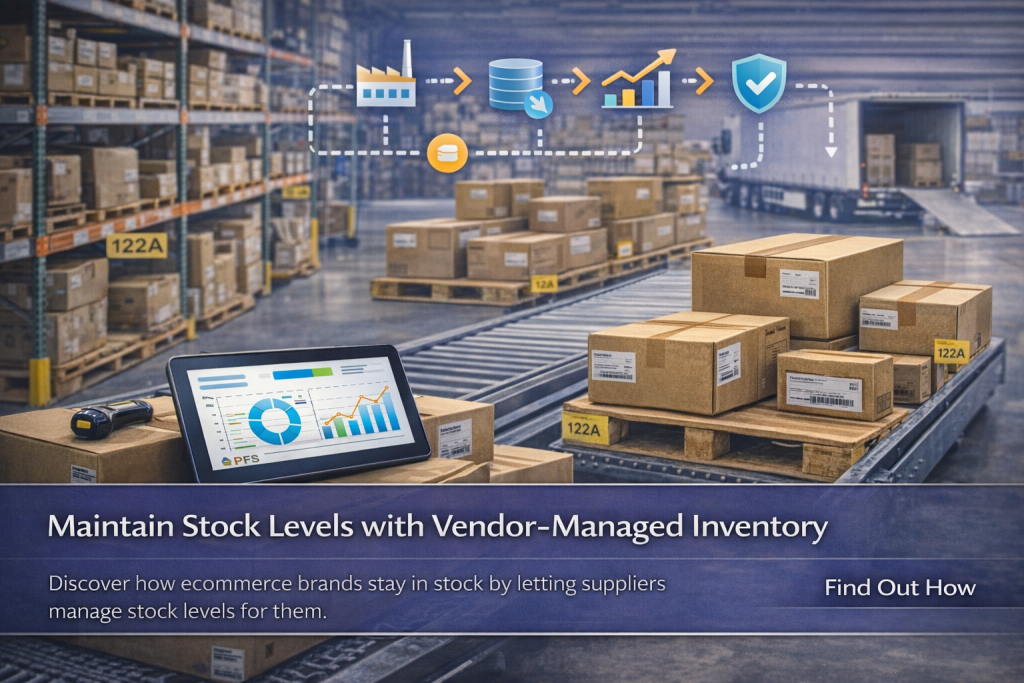
In a modern fulfillment environment, VMI connects suppliers, warehouses, and ecommerce platforms through shared operational data.
A simplified workflow looks like this:
- Orders flow into fulfillment systems daily
- Inventory levels update automatically
- Suppliers monitor predefined thresholds
- Replenishment shipments are triggered
- Inventory arrives before shortages occur
When combined with organized warehousing and storage solutions, inbound inventory integrates smoothly without disrupting daily operations.
Benefits of VMI for growing brands
Vendor managed inventory improves both operational stability and financial efficiency.
1. Reduced stockouts
Suppliers respond directly to consumption data instead of waiting for purchase orders.
2. Lower administrative workload
Procurement teams spend less time managing reorder cycles.
3. Better supplier relationships
Vendors gain predictable demand visibility, improving production planning.
4. Improved cash flow management
Inventory levels align more closely with actual demand.
5. Faster fulfillment performance
Consistent inventory availability supports reliable shipping timelines.
Pairing VMI with optimized shipping programs like discounted shipping rates ensures downstream logistics remain equally efficient.
Requirements for successful VMI
Vendor managed inventory works best when operational foundations are already strong.
Brands should establish:
- Accurate inventory tracking
- Reliable fulfillment workflows
- Clear supplier agreements
- Defined service level expectations
- Consistent reporting standards
Products requiring bundled assembly or subscription configurations benefit from structured kitting and assembly solutions to maintain predictable inventory consumption patterns.
Talk to an Expert
How a 3PL enables VMI at scale
Many ecommerce brands struggle to implement vendor managed inventory internally because data visibility and operational consistency are difficult to maintain. A specialized 3PL provides the infrastructure needed for supplier collaboration.
Fulfillment partners enable VMI through:
- Centralized inventory reporting
- Consistent receiving processes
- Standardized replenishment workflows
- Integrated order and inventory systems
Operating from a strategically located hub such as a Cincinnati, Ohio fulfillment center also reduces transit variability, helping suppliers plan inbound shipments more accurately.
The result is a supply chain that anticipates demand instead of reacting to shortages.
Vendor managed inventory FAQs
What is vendor managed inventory?
Vendor managed inventory is a system where suppliers monitor stock levels and replenish products automatically based on agreed inventory thresholds and demand data.
How does VMI help ecommerce brands?
VMI reduces stockouts, improves forecasting accuracy, and lowers the administrative burden of managing purchase orders while maintaining consistent product availability.
Is vendor managed inventory only for large companies?
No. Growing ecommerce brands benefit significantly from VMI once order volume becomes predictable enough to support data-driven replenishment.
What data do suppliers need for VMI?
Suppliers typically require real-time inventory levels, sales velocity data, reorder thresholds, and agreed service level targets.
Does VMI replace inventory forecasting?
No. Forecasting still exists but becomes collaborative, combining supplier production insight with fulfillment demand data.
Can a 3PL manage vendor coordination?
Yes. Many fulfillment providers facilitate supplier integration, inventory reporting, and inbound logistics coordination required for effective VMI programs.
Talk to an Expert