
Reviewed by: Chief Operations Officer, Product Fulfillment Solutions
Last updated: April 28, 2026
Executive TLDR
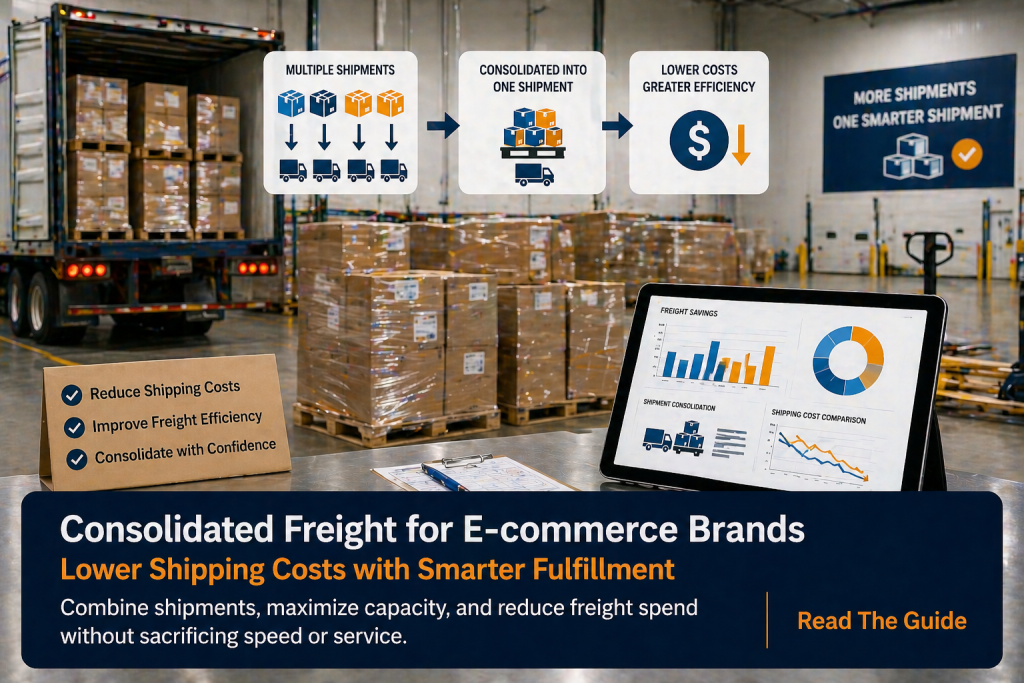
Freight costs often rise quietly. Brands notice parcel invoices climbing, inbound shipments arriving inconsistently, and margin pressure building long before they identify the root cause. One common issue is shipping too many partial loads, too often, with poor coordination between vendors, warehouses, and carriers.
Consolidated freight solves this by combining multiple smaller shipments into fuller, more efficient loads. That can lower transportation cost, improve dock scheduling, and create steadier inventory flow into your fulfillment operation.
For ecommerce brands shipping supplements, cosmetics, snacks, and other small consumer goods, consolidation works best when paired with disciplined receiving, inventory visibility, and a centrally located 3PL partner.
In this guide, you will learn when consolidated freight makes sense, how to avoid common mistakes, and how PFS helps brands turn freight savings into stronger fulfillment performance.
If you already know you need a steadier fulfillment program, you can start the conversation here,
Contact Product Fulfillment Solutions.
Table of contents
- When consolidated freight starts to help growing brands
- Story, how PureVita cut freight costs and chaos
- What consolidated freight actually means
- Biggest benefits for ecommerce brands
- Mistakes that erase freight savings
- How PFS makes consolidation work
- Quarterly freight improvement checklist
- Consolidated freight FAQs
When consolidated freight starts to help growing brands
Consolidated freight becomes valuable when inbound shipping volume grows but shipments remain fragmented. Instead of receiving several small shipments from vendors across the week, brands combine freight into more efficient movements.
This usually matters when teams are dealing with rising landed cost, inconsistent replenishment timing, dock congestion, or inventory gaps caused by scattered arrivals.
It is especially useful for brands that reorder often and move lightweight products in cartons or pallets. Supplements, beauty products, dry snacks, and subscription box components are common examples.
If your receiving team spends more time reacting than planning, freight structure deserves attention.
Story, how PureVita cut freight costs and chaos
Before
PureVita, a fictional wellness brand, sourced packaging from one vendor, labels from another, and finished goods from two contract manufacturers. Each supplier shipped independently whenever orders were ready.
Pain points
The warehouse received trucks almost daily, but many arrived partially full. Some pallets showed up without matching components, delaying kitting. Receiving labor became unpredictable, and freight cost per unit kept rising.
Customer demand was healthy, yet margins tightened because operations lacked coordination.
The shift
PureVita moved fulfillment to PFS and redesigned inbound planning. Vendors shipped on scheduled windows, loads were consolidated where practical, and receipts were matched to production priorities.
With stronger inbound rhythm, the brand lowered freight waste, improved receiving flow, and reduced stockouts during promotions.
What consolidated freight actually means
Consolidated freight is the practice of combining multiple smaller shipments into one more efficient transportation move. That may involve multiple suppliers, multiple purchase orders, or several destinations planned together.
The goal is simple, use capacity better.
Instead of paying premium rates for repeated underfilled shipments, brands create fuller truckloads or coordinated LTL moves with better economics.
Strong consolidation also requires accurate data. Purchase orders, vendor readiness dates, pallet counts, and receiving capacity must align. That is where many brands struggle without experienced logistics support.
Once inbound freight reaches the warehouse, dependable warehousing and storage solutions help convert those savings into usable inventory quickly.
Biggest benefits for ecommerce brands
When managed well, consolidated freight improves more than transportation rates.
- Lower cost per pallet or carton moved
- Fewer dock appointments and less receiving disruption
- More predictable replenishment timing
- Better inventory availability for promotions
- Less admin work chasing scattered shipments
- Improved planning between purchasing and fulfillment
- Stronger margin control as volume grows
Brands often overlook the labor savings. Fewer, better-planned arrivals reduce constant interruptions inside the warehouse.
That matters when speed and order accuracy are priorities.
Talk to an Expert
Mistakes that erase freight savings
Some brands hear the term consolidated freight and assume any combined shipment is efficient. That is not true.
Poor timing
Waiting too long to build a load can delay inventory and create stockouts that cost more than the freight savings.
Weak communication
If vendors miss ready dates or ship partial quantities without notice, planning breaks quickly.
No warehouse readiness
Receiving a larger consolidated shipment without labor planning can create bottlenecks at the dock.
Tracking gaps
Without clear visibility, finance and operations lose confidence in what is in transit.
Strong real time information helps prevent these issues.
How PFS makes consolidation work
Freight savings only matter if inventory becomes sellable quickly. PFS helps brands connect transportation efficiency with fulfillment execution.
From our centrally positioned Cincinnati, Ohio fulfillment center, brands can simplify national parcel reach while improving inbound control.
PFS supports clients with:
- Scheduled receiving windows and cleaner dock flow
- Fast putaway and inventory readiness
- Accurate order processing through pick and pack services
- Multi-component builds using kitting and assembly solutions
- Parcel savings through discounted shipping rates
- Scalable ecommerce fulfillment services
That combination helps brands capture savings upstream and protect customer experience downstream.
Quarterly freight improvement checklist
- Review inbound shipments under target utilization
- Identify vendors shipping too frequently
- Match reorder timing to demand cycles
- Confirm receiving capacity by weekday
- Track cost per pallet, order, and unit
- Reduce avoidable rush shipments
- Align freight planning with promotions calendar
Small changes repeated every quarter often outperform one large reactive overhaul.
Talk to an Expert
Consolidated freight FAQs
What is consolidated freight in simple terms?
It means combining smaller shipments into fuller, more efficient transportation moves to reduce waste and improve shipping economics.
Is consolidated freight only for large companies?
No. Mid-sized ecommerce brands often benefit because they ship frequent smaller replenishment orders that can be coordinated better.
Can consolidation delay inventory arrivals?
It can if planned poorly. Good scheduling balances freight savings with the need to keep stock available.
How do I know if my brand should use consolidated freight?
If you receive many partial shipments, rising inbound costs, or unpredictable receiving volume, it is worth reviewing.
Does warehouse location matter for freight planning?
Yes. A central location can support efficient inbound routing and balanced outbound parcel transit times.
How does PFS support freight efficiency?
PFS helps brands connect inbound planning, receiving discipline, inventory readiness, and fast fulfillment execution.