
Reviewed by: Chief Operations Officer, Product Fulfillment Solutions
Last updated: May 21, 2026
Executive TLDR
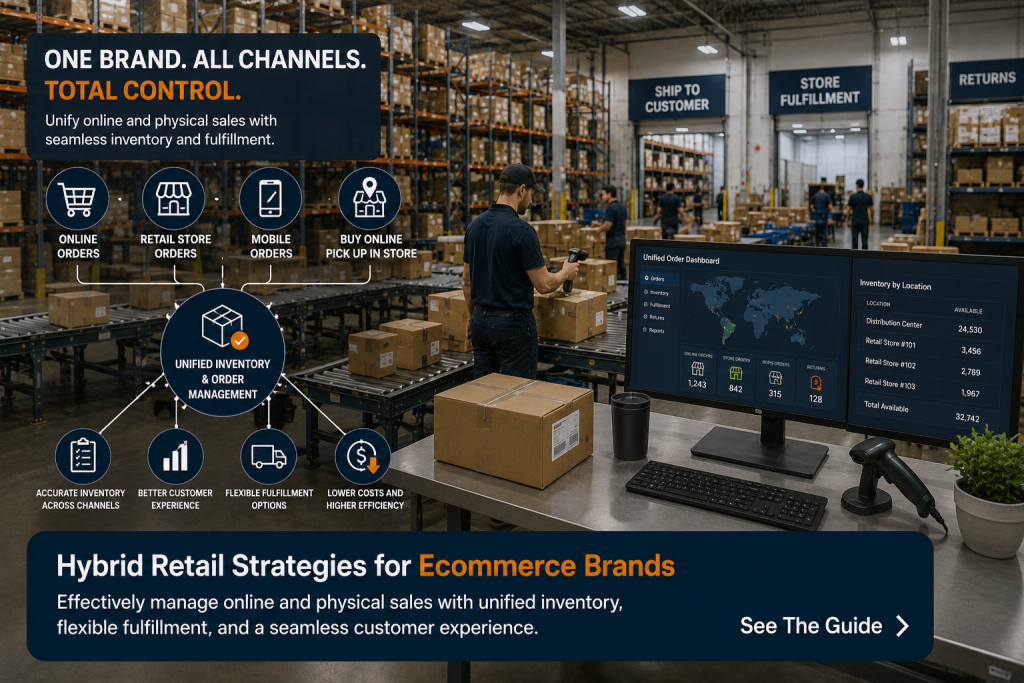
Hybrid retail combines ecommerce, retail stores, marketplaces, wholesale channels, and direct fulfillment into one connected customer experience. Many growing brands now operate across multiple sales channels instead of relying on a single ecommerce storefront.
While hybrid retail creates revenue opportunities, it also increases operational complexity. Inventory allocation, fulfillment timing, packaging standards, and customer expectations become harder to manage when orders are flowing from different systems simultaneously.
This article explains how hybrid retail operations work, where ecommerce brands commonly struggle, and how fulfillment infrastructure supports scalable multi-channel growth without creating warehouse instability.
Strong hybrid retail operations depend on inventory visibility, organized fulfillment workflows, and centralized shipping coordination that supports both ecommerce and retail requirements.
If you already know you need a steadier fulfillment program, you can start the conversation here,
Contact Product Fulfillment Solutions.
Table of contents
- When hybrid retail becomes complex
- Story: How Lakeshore Living stabilized multi-channel growth
- What hybrid retail actually means
- Inventory challenges in hybrid retail
- Fulfillment workflows for multi-channel orders
- Why centralized fulfillment matters
- How 3PLs support hybrid retail operations
- Hybrid Retail FAQs
When hybrid retail becomes complex
Hybrid retail becomes operationally difficult once brands begin balancing ecommerce orders alongside retail, wholesale, subscription, and marketplace fulfillment requirements.
Each sales channel introduces different timing expectations, packaging standards, inventory rules, and customer service pressures.
Many brands initially treat every order source separately. Over time, disconnected systems create inventory confusion, fulfillment bottlenecks, and rising operational costs.
Hybrid retail operations often become unstable when:
- Inventory visibility is inconsistent
- Orders flow from multiple disconnected platforms
- Retail compliance requirements increase
- Warehouse workflows become reactive
- Manual allocation decisions slow fulfillment
- Shipping priorities conflict between channels
Brands scaling across multiple channels benefit from structured ecommerce fulfillment services that support operational consistency across changing demand patterns.
Story: How Lakeshore Living stabilized multi-channel growth
Before
Lakeshore Living sold wellness accessories and home products through Shopify before expanding into regional retail stores and online marketplaces.
Pain points
As new channels launched, the operations team struggled to maintain inventory accuracy. Retail replenishment orders interrupted direct-to-consumer workflows, while marketplace sales created sudden inventory swings.
Warehouse staff frequently shifted priorities throughout the day, creating picking delays and shipping inconsistencies.
Customer service tickets increased because inventory availability across channels no longer matched actual stock levels.
The shift
The company centralized fulfillment operations through a structured 3PL environment that improved inventory visibility and order prioritization.
Retail, wholesale, and ecommerce workflows became more coordinated through standardized warehouse processes and integrated reporting systems.
Using scalable warehousing and storage solutions, the brand improved operational stability while supporting continued multi-channel expansion.
What hybrid retail actually means
Hybrid retail refers to brands selling products across multiple connected channels while maintaining a unified operational system.
Common hybrid retail channels include:
- Direct ecommerce websites
- Retail store distribution
- Marketplace fulfillment
- Subscription programs
- Wholesale accounts
- Social commerce platforms
The challenge is not simply accepting orders from different places. The challenge is coordinating inventory, shipping, packaging, reporting, and customer expectations across every channel simultaneously.
Strong hybrid retail systems create operational flexibility without introducing fulfillment chaos.
Inventory challenges in hybrid retail
Inventory management becomes significantly harder in hybrid retail environments.
Different channels consume inventory at different speeds. Retail replenishment orders can suddenly deplete stock reserved for ecommerce promotions. Subscription launches can create temporary demand spikes that disrupt marketplace availability.
Without centralized inventory visibility, brands often experience:
- Overselling
- Stock allocation conflicts
- Delayed replenishment
- Inventory discrepancies
- Backorder increases
- Poor forecasting accuracy
Integrated real time information systems help brands maintain better visibility into inventory movement across all sales channels.
Talk to an Expert
Fulfillment workflows for multi-channel orders
Hybrid retail fulfillment requires structured workflows that adapt to different order requirements without slowing warehouse efficiency.
Retail orders often require pallet preparation, routing compliance, and scheduled delivery windows. Ecommerce orders typically prioritize speed, parcel optimization, and customer tracking visibility.
Warehouse operations must support both environments simultaneously.
Strong fulfillment systems usually include:
- Order prioritization logic
- Batch picking workflows
- Channel-specific packaging rules
- Inventory allocation controls
- Carrier routing coordination
- Integrated order reporting
Structured pick and pack services help maintain fulfillment consistency across multiple order types.
Why centralized fulfillment matters
Centralized fulfillment improves coordination between inventory, shipping, and operational reporting.
Many hybrid retail brands initially spread inventory across disconnected storage locations or temporary overflow facilities. Over time, this creates inventory fragmentation and inconsistent fulfillment execution.
A centralized operation helps simplify:
- Inventory tracking
- Carrier coordination
- Safety stock planning
- Warehouse labor management
- Outbound shipping workflows
- Retail replenishment scheduling
Operating through a centrally located Cincinnati, Ohio fulfillment center can also improve transit efficiency across major US shipping regions.
How 3PLs support hybrid retail operations
Experienced 3PL providers help brands manage operational complexity as sales channels expand.
Hybrid retail support often includes:
- Inventory synchronization
- Retail compliance workflows
- Marketplace fulfillment coordination
- Subscription order management
- Carrier optimization
- Operational reporting visibility
As brands scale, fulfillment flexibility becomes increasingly important. Operations must support changing customer expectations without creating warehouse instability.
Integrated EDI solutions and connections help synchronize data between retail systems, marketplaces, and fulfillment platforms.
Talk to an Expert
Hybrid Retail FAQs
What is hybrid retail?
Hybrid retail is a business model where brands sell products across multiple connected channels such as ecommerce, retail stores, marketplaces, and wholesale accounts.
Why is hybrid retail difficult to manage?
Hybrid retail increases inventory complexity, fulfillment coordination, and operational reporting requirements across multiple sales channels.
How does fulfillment impact hybrid retail success?
Fulfillment systems help coordinate inventory, shipping, packaging, and order prioritization across different channel requirements.
What inventory problems happen in hybrid retail?
Common issues include overselling, inventory discrepancies, stock allocation conflicts, and inaccurate forecasting across sales channels.
Can a 3PL support hybrid retail operations?
Yes. Experienced 3PL providers help coordinate fulfillment workflows, retail compliance requirements, and inventory visibility across multi-channel operations.
Why does centralized fulfillment help hybrid retail brands?
Centralized fulfillment improves inventory visibility, shipping coordination, and operational consistency while reducing warehouse fragmentation.