
Reviewed by: Director of Fulfillment Technology, Product Fulfillment Solutions
Last updated: May 29, 2026
Executive TLDR
As Shopify brands grow, disconnected warehouse systems often create inventory inaccuracies, delayed shipments, and operational bottlenecks that slow scaling efforts. Many ecommerce companies reach a point where manual workflows can no longer support rising order volume.
Shopify WMS integration helps ecommerce brands connect storefront activity directly with warehouse operations, improving inventory visibility, order processing speed, and fulfillment consistency.
This article explains how Shopify WMS integrations work, common operational mistakes brands make during implementation, and how better system coordination supports long term ecommerce growth.
Brands selling supplements, cosmetics, wellness products, snacks, subscription boxes, and small consumer goods often benefit most from fulfillment environments built around high-volume parcel shipping and real time inventory synchronization.
If you already know you need a steadier fulfillment program, you can start the conversation here,
Contact Product Fulfillment Solutions.
Table of contents
- When Shopify operations start breaking down
- Story: How EverWell Labs improved order accuracy
- What Shopify WMS integration actually does
- Common Shopify WMS integration mistakes
- Why inventory visibility matters
- How centralized fulfillment supports Shopify growth
- How 3PLs help manage Shopify fulfillment
- Shopify WMS Integration FAQs
When Shopify operations start breaking down
Many Shopify brands begin with lightweight operational systems that work reasonably well during early growth stages. Over time, however, rising SKU counts and higher daily order volume expose weaknesses in warehouse coordination.
Operational pressure often appears through:
- Inventory mismatches between systems
- Delayed order processing
- Backorder confusion
- Manual picking bottlenecks
- Shipping delays during promotions
- Higher customer support volume
Disconnected software environments force warehouse teams to spend more time correcting operational issues instead of improving fulfillment efficiency.
Structured ecommerce fulfillment services help growing Shopify brands create more stable operational workflows before fulfillment problems begin affecting customer retention.
Story: How EverWell Labs improved order accuracy
Before
EverWell Labs operated a fast-growing Shopify storefront selling wellness supplements, hydration powders, and subscription products.
The company initially managed warehouse operations using spreadsheets and disconnected inventory tools while processing a few hundred orders per week.
Pain points
As order volume increased, inventory synchronization became unreliable. Customer service teams frequently responded to oversold products, delayed shipments, and missing inventory updates.
The warehouse team also struggled during product launches because picking workflows changed constantly depending on inventory availability.
Operational reporting lacked consistency, making forecasting and replenishment planning increasingly difficult.
The shift
EverWell Labs improved fulfillment coordination by implementing a structured warehouse management environment integrated directly with Shopify operations.
More organized pick and pack services and inventory workflows helped stabilize order accuracy while improving shipping consistency.
What Shopify WMS integration actually does
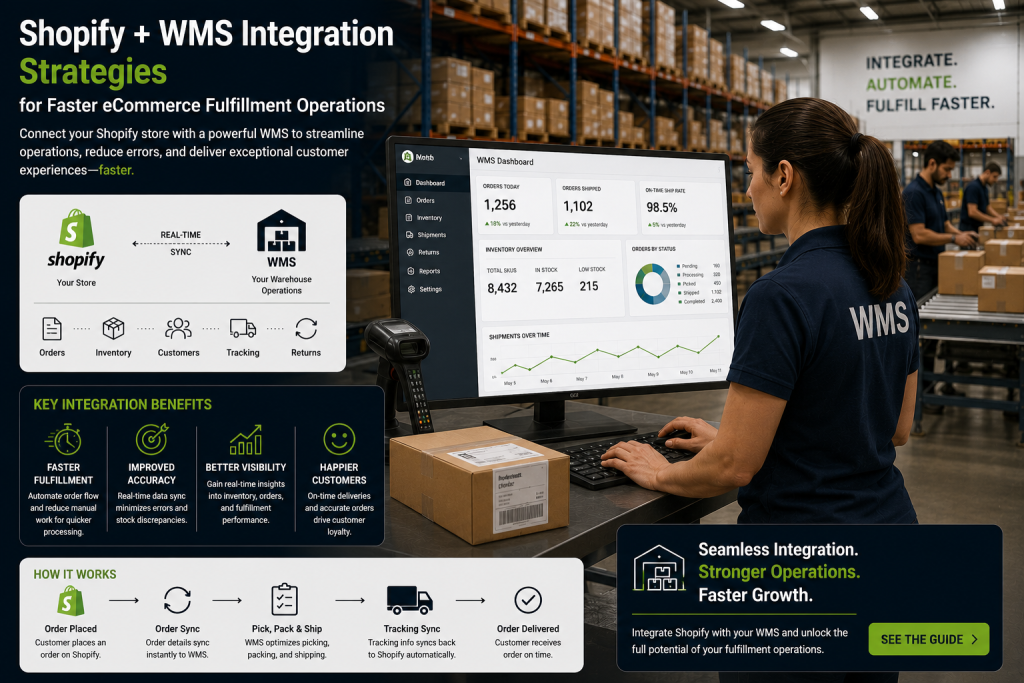
Shopify WMS integration connects ecommerce storefront activity directly with warehouse operations.
Integrated systems help warehouse teams process orders faster while maintaining stronger inventory accuracy and fulfillment visibility.
Strong integrations typically support:
- Inventory synchronization
- Real time order updates
- Warehouse picking coordination
- Shipment tracking visibility
- Receiving workflows
- Order status reporting
Integrated warehouse systems reduce manual data entry while improving operational consistency across fulfillment workflows.
Brands managing subscription kits and bundled products may also benefit from organized kitting and assembly solutions integrated into warehouse workflows.
Common Shopify WMS integration mistakes
Many ecommerce brands underestimate how much operational preparation is required before integration projects begin.
Common mistakes include:
- Poor SKU organization
- Inconsistent inventory procedures
- Weak warehouse workflows
- Incomplete testing environments
- Rushed implementation timelines
- Disconnected operational ownership
Software integrations cannot fix operational instability by themselves. Warehouse discipline and inventory consistency still matter heavily.
Structured warehousing and storage solutions help create a more stable fulfillment foundation before system complexity increases.
Talk to an Expert
Why inventory visibility matters
Inventory visibility becomes increasingly important as ecommerce brands scale across more SKUs, sales channels, and promotional cycles.
Without accurate reporting systems, warehouse teams often react too slowly to inventory shortages and operational bottlenecks.
Strong reporting visibility helps brands monitor:
- Inventory movement
- Order processing status
- Receiving delays
- Warehouse productivity
- Backorder exposure
- Shipping performance
Integrated real time information systems help ecommerce brands make faster operational decisions while improving customer communication.
How centralized fulfillment supports Shopify growth
Centralized fulfillment operations help Shopify brands simplify inventory management while improving national shipping consistency.
Operating through a strategically positioned warehouse environment often reduces operational fragmentation and improves fulfillment scalability.
Centralized fulfillment can improve:
- Inventory coordination
- Order routing consistency
- Shipping speed
- Warehouse productivity
- Carrier management
- Operational visibility
Many ecommerce brands benefit from operating through a centrally located Cincinnati, Ohio fulfillment center that supports efficient parcel delivery across major US regions.
How 3PLs help manage Shopify fulfillment
Experienced 3PL providers help ecommerce brands improve operational consistency through more structured warehouse coordination and integrated fulfillment workflows.
Operational support often includes:
- Inventory synchronization
- Order processing coordination
- Warehouse workflow optimization
- Carrier management
- Shipping visibility systems
- Fulfillment reporting support
As Shopify brands scale, operational flexibility becomes critical for maintaining customer experience and fulfillment reliability.
Structured discounted shipping rates also help brands manage rising transportation expenses more efficiently.
Talk to an Expert
Shopify WMS Integration FAQs
What is Shopify WMS integration?
Shopify WMS integration connects ecommerce storefront activity directly with warehouse operations and inventory management systems.
Why do Shopify brands need warehouse integrations?
Integrated systems improve inventory visibility, reduce manual workflows, and support faster, more accurate fulfillment operations.
What problems can Shopify WMS integrations help solve?
Integrations often reduce inventory discrepancies, shipping delays, manual data entry, and fulfillment bottlenecks.
How does inventory visibility improve ecommerce operations?
Better inventory visibility helps ecommerce brands manage stock levels, avoid overselling, and improve operational decision making.
Can a 3PL integrate warehouse systems with Shopify?
Yes. Many 3PL providers support Shopify integrations that improve order visibility, inventory synchronization, and fulfillment coordination.
Why does centralized fulfillment help Shopify brands scale?
Centralized fulfillment improves inventory management, shipping consistency, warehouse efficiency, and operational scalability.