
Reviewed by: Chief Operations Officer, Product Fulfillment Solutions
Last updated: May 14, 2026
Executive TLDR
Omnichannel order management is the system that lets ecommerce brands control orders across multiple sales channels like Shopify, Amazon, retail, and wholesale from one coordinated workflow. When it works, customers get consistent delivery experiences no matter where they buy.
The problem is that most brands adopt multiple channels faster than their backend systems can handle. That creates inventory conflicts, overselling risks, delayed fulfillment, and constant firefighting between platforms.
This article breaks down how omnichannel order management actually works in real operations, where brands typically lose control, and how a structured fulfillment setup like PFS stabilizes multi-channel complexity.
If you already know you need a steadier fulfillment program, you can start the conversation here,
Contact Product Fulfillment Solutions.
Table of contents
- When omnichannel operations start breaking
- Story: NorthPeak Supplements expansion chaos
- What omnichannel order management actually means
- Core systems behind omnichannel control
- Where inventory and fulfillment go wrong
- How 3PLs stabilize omnichannel operations
- Implementation approach for scaling brands
- Omnichannel Order Management FAQs
When omnichannel operations start breaking
Omnichannel complexity shows up when a brand adds sales channels faster than its inventory and fulfillment systems can synchronize.
This usually happens when Shopify stores expand into Amazon, wholesale accounts, or retail partnerships without centralized order logic.
At that point, inventory stops being a shared asset and becomes a source of constant conflict between channels.
Story: NorthPeak Supplements expansion chaos
Before
NorthPeak Supplements started as a direct-to-consumer brand fulfilling orders through a single Shopify store with simple inventory tracking.
Pain points
After launching Amazon and wholesale distribution, inventory updates lagged across systems, leading to overselling and delayed shipments. Customer support tickets increased sharply.
The shift
They moved toward a centralized fulfillment model supported by structured ecommerce fulfillment services, which unified order flow and stabilized inventory accuracy across all channels.
What omnichannel order management actually means
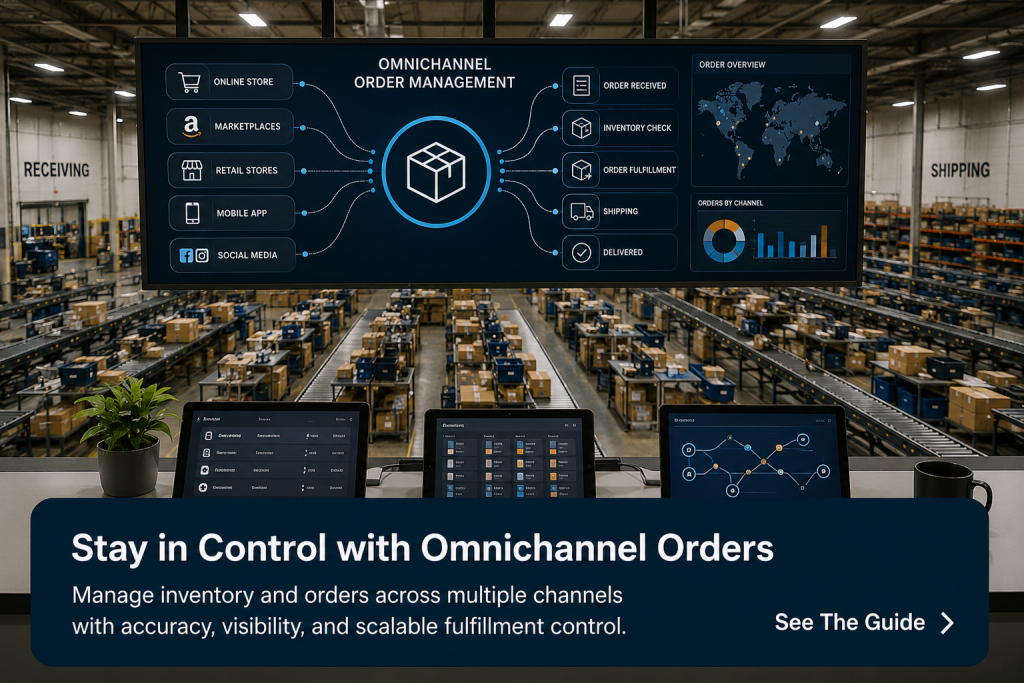
Omnichannel order management is the coordination layer that ensures every order, regardless of source, is processed through a single operational system.
Instead of separate workflows for Shopify, Amazon, or wholesale, everything flows into a unified fulfillment pipeline.
This is where real time information becomes critical for preventing overselling and misaligned inventory signals.
Core systems behind omnichannel control
Effective omnichannel systems rely on tightly connected operational components that communicate continuously.
- Centralized inventory management system
- Order routing and prioritization logic
- Warehouse execution workflows
- Carrier integration and shipping logic
Without structured warehousing and storage solutions, inventory accuracy breaks under multi-channel demand.
Talk to an Expert
Where inventory and fulfillment go wrong
The most common failure point is inventory sync delay between sales channels and the warehouse system.
This leads to overselling, stockouts, and order cancellations that damage customer trust quickly.
Another failure point is inconsistent picking and packing workflows across different order types, especially when volume spikes unexpectedly.
Structured pick and pack services reduce this variability by standardizing execution.
How 3PLs stabilize omnichannel operations
A 3PL acts as the operational backbone that connects all channels into one execution environment.
With a centralized Cincinnati, Ohio fulfillment center, brands reduce fragmentation and gain more predictable shipping outcomes across regions.
Advanced systems also support EDI solutions and connections for retail and wholesale integrations that require structured data flow.
Implementation approach for scaling brands
Implementing omnichannel order management requires aligning systems before adding more sales channels.
Step 1: Consolidate inventory logic
Unify all SKU data into a single source of truth before expanding channels.
Step 2: Standardize fulfillment workflows
Ensure all orders follow the same picking and packing structure regardless of channel origin.
Step 3: Align shipping logic
Use consistent shipping rules to prevent fragmented delivery performance across channels.
Talk to an Expert
Omnichannel Order Management FAQs
What is omnichannel order management?
It is the process of managing all customer orders from multiple sales channels through one unified system.
Why is omnichannel hard to scale?
It becomes difficult when inventory and fulfillment systems are not synchronized across channels in real time.
What causes overselling in omnichannel systems?
Overselling typically happens when inventory updates lag between sales channels and warehouse systems.
How does a 3PL support omnichannel operations?
A 3PL centralizes fulfillment execution and ensures consistent order processing across all channels.
What is the biggest risk of poor omnichannel setup?
The biggest risk is customer experience breakdown due to stock errors, delays, and inconsistent fulfillment performance.