
Reviewed by: Chief Operations Officer, Product Fulfillment Solutions
Last updated: May 7, 2026
Executive TLDR
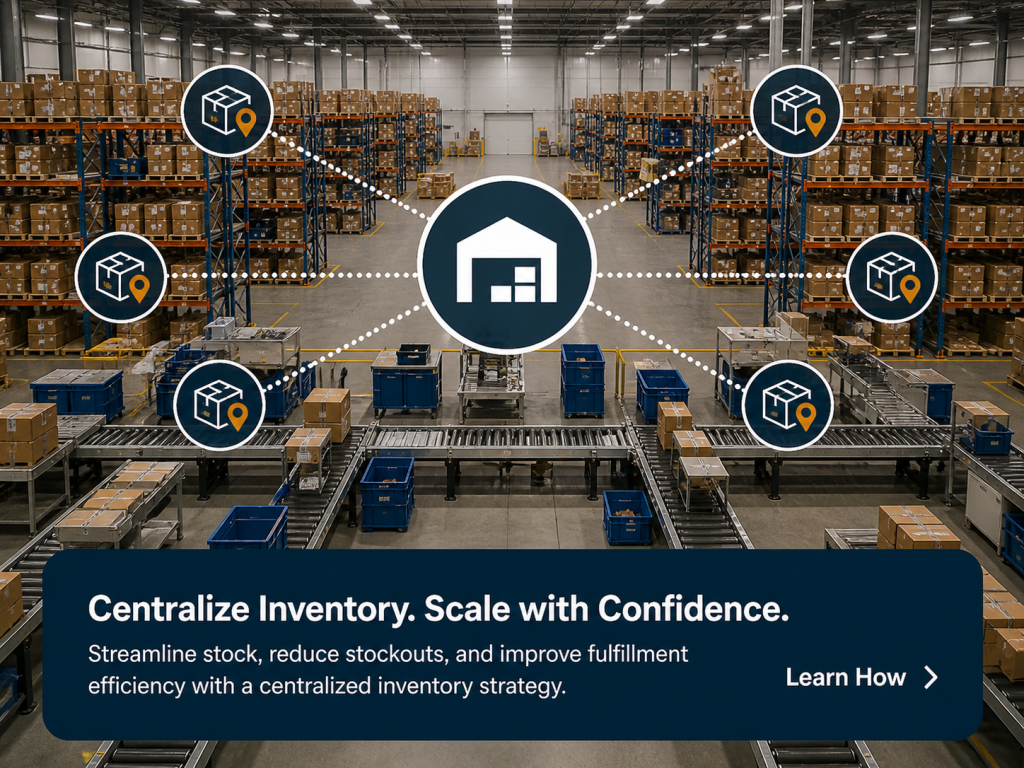
Centralized inventory is one of the most effective ways ecommerce brands reduce chaos, improve fulfillment speed, and control costs as order volume grows. When inventory is scattered across multiple storage points without clear control, fulfillment errors, delays, and unnecessary shipping costs tend to increase quickly.
In this article, you will learn when centralized inventory becomes necessary, how it improves operational control, and what steps brands can take to transition without disrupting customer delivery performance.
For growing brands working with a structured 3PL model like Product Fulfillment Solutions, centralized inventory at a single fulfillment hub such as a Cincinnati-based operation can simplify forecasting, reduce handling time, and improve SLAs without adding complexity.
If you already know you need a steadier fulfillment program, you can start the conversation here,
Contact Product Fulfillment Solutions.
Table of contents
- When centralized inventory starts to matter
- Story, how a brand stopped fulfillment chaos
- Why centralized inventory improves control
- Cost impacts of fragmented inventory
- How to transition to centralized inventory
- Role of a 3PL in centralization
- Avoiding common centralization mistakes
- When centralization might not fit
- Operational playbook summary
When centralized inventory starts to matter in ecommerce growth
Centralized inventory becomes critical when order volume increases faster than your ability to manually track stock across multiple locations, spreadsheets, or disconnected systems. Early stage brands can often manage scattered storage, but the cracks show quickly once SKU count and order velocity rise.
Common signs include inconsistent stock counts, delayed replenishment decisions, and rising fulfillment errors between channels. At this stage, inventory stops being a passive asset and becomes an operational risk.
This is where structured warehousing and storage solutions paired with centralized control help restore visibility and consistency across the entire supply chain.
Story, how a brand stopped fulfillment chaos
Before
A mid-sized wellness brand was storing inventory across a small warehouse, a prep center, and partial storage at a retail partner. Each channel had partial visibility, but no single source of truth.
Pain points
Overselling became frequent. Customer service tickets increased. And fulfillment teams were constantly reconciling inventory mismatches instead of shipping orders.
The shift
The brand moved to centralized inventory at a single fulfillment hub supported by a structured 3PL system. With standardized receiving, real-time inventory visibility, and unified order routing, fulfillment errors dropped significantly within weeks.
This shift also enabled more consistent ecommerce fulfillment services performance because every order now flowed through a single controlled system instead of fragmented storage points.
Why centralized inventory improves operational control
Centralization is not just about physical location, it is about decision control. When inventory is centralized, forecasting, replenishment, and order allocation all operate from a single data environment.
Key operational benefits
- Single source of truth for SKU availability
- Reduced reconciliation between systems and locations
- Faster cycle counting and inventory audits
- Improved picking accuracy and reduced substitutions
Brands also gain stronger alignment with pick and pack services because fulfillment teams are working from consistent inventory data instead of fragmented stock pools.
CTA:
Talk to an Expert
Cost impacts of fragmented inventory systems
When inventory is spread across multiple locations without centralized control, costs rise in less obvious ways. It is not just storage fees, but inefficiencies in labor, shipping, and rework.
Where costs typically increase
- Duplicate safety stock across multiple sites
- Higher labor time for reconciliation and transfers
- Increased shipping costs from suboptimal routing
- More frequent expedited replenishment orders
Centralizing inventory in a single system supported by a Cincinnati-based fulfillment operation helps reduce these inefficiencies by eliminating unnecessary movement and duplication across the supply chain.
How to transition to centralized inventory without disruption
Transitioning to centralized inventory should be done in phases to avoid service disruptions. The goal is not just consolidation, but stability during the shift.
Step-by-step approach
- Audit all SKU locations and actual on-hand accuracy
- Identify slow-moving vs high-velocity inventory
- Consolidate top-performing SKUs first
- Standardize receiving and labeling rules
- Sync inventory systems before physical consolidation
Many brands pair this transition with improved real time information tools so they can monitor inventory movement as it consolidates.
Talk to an Expert
Role of a 3PL in centralizing inventory effectively
A strong 3PL does more than store inventory, it enforces structure. Centralization only works when receiving, storage, picking, and reporting follow consistent rules.
A centralized fulfillment model at a facility like the Cincinnati, Ohio fulfillment center ensures inventory is processed under one operational framework. This reduces variation and improves predictability across every order channel.
It also integrates naturally with kitting and assembly solutions, allowing bundled SKUs to be managed without creating secondary inventory fragmentation.
Avoiding common centralized inventory mistakes
Centralization is not automatic improvement. Poor execution can create bottlenecks if not managed correctly.
Common mistakes
- Consolidating too quickly without validation
- Ignoring SKU-level velocity differences
- Lack of system synchronization during migration
- Overlooking peak season constraints
The most successful transitions treat centralization as a controlled operational redesign, not just a warehouse move.
When centralized inventory may not be the right move
Not every brand should centralize immediately. If you have highly regional demand patterns or strict delivery time requirements across multiple geographies, partial decentralization may still be needed.
However, even in hybrid models, most brands benefit from a primary centralized hub that anchors inventory accuracy and forecasting before distributing selectively.
Operational playbook summary for centralizing inventory
Centralized inventory is ultimately about control, clarity, and predictability. When done correctly, it reduces operational noise and gives teams more confidence in every fulfillment decision.
Brands that move toward centralized systems supported by structured 3PL operations typically see fewer stock discrepancies, faster fulfillment cycles, and better cost control over time.
For growing ecommerce operations, the goal is not just storing inventory in one place, but building a system where every unit is visible, accountable, and ready to ship without friction.