
Reviewed by: Chief Operations Officer, Product Fulfillment Solutions
Last updated: May 6, 2026
Executive TLDR
Most ecommerce brands hit a ceiling where the warehouse simply cannot move faster without adding chaos. Picking becomes slower, errors increase, and peak seasons expose every inefficiency.
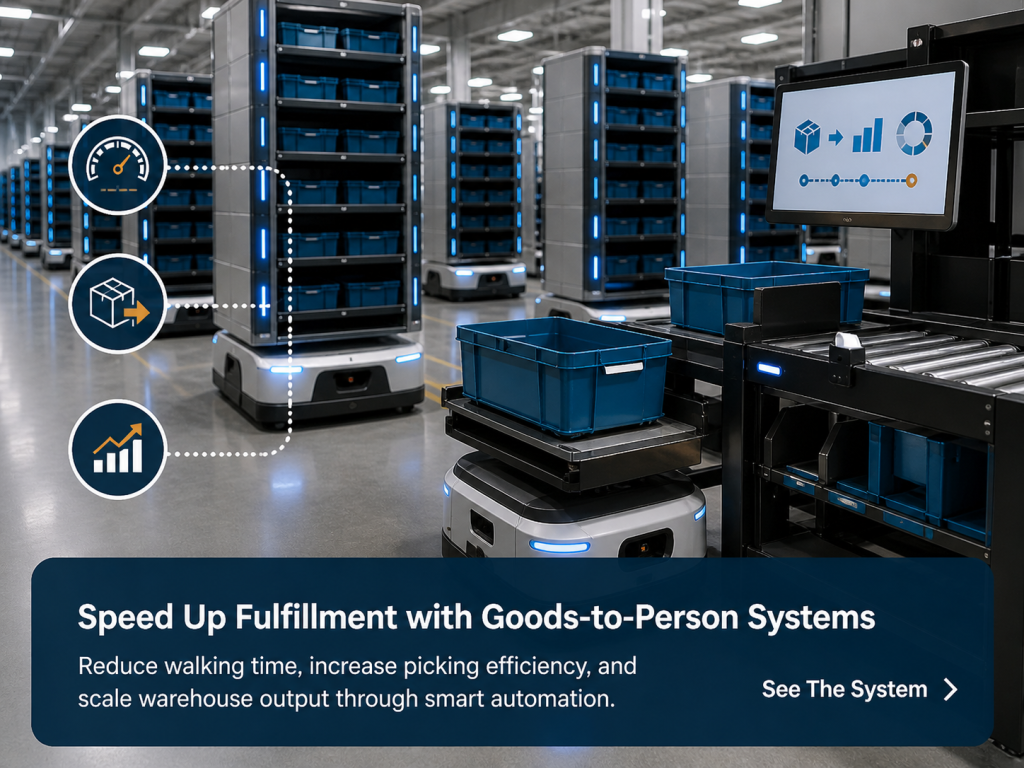
This is where goods to person fulfillment thinking becomes relevant. Instead of workers walking long distances to pick items, inventory is brought to the picker. The result is faster order cycles and fewer mistakes.
PFS applies the same principle in practical ways inside its Cincinnati, Ohio fulfillment center, combining smart layout design, pick logic, and pick and pack services that reduce wasted movement and improve throughput.
If you already know you need a steadier fulfillment program, you can start the conversation here, Contact Product Fulfillment Solutions.
Table of contents
- When goods to person starts to matter
- Story, how VitalBox scaled without chaos
- What goods to person actually solves
- Layout design and picking efficiency
- Reducing walking time in fulfillment
- How PFS builds faster fulfillment systems
- When to rethink your warehouse model
When goods to person starts to matter in fulfillment
Goods to person concepts become important when order volume grows faster than warehouse layout can handle. Walking distance becomes the hidden cost nobody tracks at first.
Brands usually notice it during peak seasons. Pickers are busy all day but output barely increases. More staff does not solve the bottleneck because the problem is movement, not labor.
This is when structured systems inside a warehousing and storage solutions strategy start to matter more than headcount.
Story, how VitalBox scaled without warehouse chaos
Before
VitalBox, a subscription snack brand, started with a simple warehouse setup. Workers walked every aisle for every order. It worked at 300 orders per day.
Pain points
At 2,000 orders per day, pick times doubled. Errors increased. The team added more workers but output stayed flat because travel time dominated the process.
The shift
They restructured pick zones and introduced a goods-to-person style layout where fast-moving SKUs were positioned closer to packing stations. Combined with ecommerce fulfillment services, throughput stabilized without increasing headcount.
What goods to person actually solves in real operations
Goods to person is not just automation. It is a design principle that reduces wasted motion inside the warehouse.
Core problems it fixes
- Long walking distances per order
- Picker fatigue during peak periods
- Inconsistent picking speeds across shifts
- High error rates in dense SKU environments
Even without robotics, simple layout adjustments inside a Cincinnati, Ohio fulfillment center model can replicate much of the benefit.
Talk to an Expert
Layout design and picking efficiency improvements
Most inefficiency comes from poor SKU placement rather than technology gaps. Slow movers should not block fast movers, and high-frequency SKUs should never sit deep in the warehouse.
Practical improvements
- Zone fast-moving SKUs near packing stations
- Group items by order frequency, not category
- Use bin sizing that reduces handling time
- Re-slot inventory monthly based on demand shifts
These adjustments align closely with structured real time information systems that keep inventory logic current.
Reducing walking time in fulfillment operations
Walking is silent waste. It rarely appears in dashboards but directly impacts cost per order.
Key strategies
- Batch pick similar orders together
- Use wave picking for peak periods
- Eliminate unnecessary aisle crossings
- Position packing stations closer to high velocity zones
When walking time drops, labor efficiency improves without changing staffing levels.
How PFS builds faster fulfillment systems
PFS applies goods to person principles without overengineering. The focus is simple: reduce steps between pick and pack.
This is supported by optimized pick and pack services, smart SKU placement, and operational feedback loops that adjust layouts based on real demand patterns.
Combined with centralized operations in Cincinnati, it reduces variability and improves consistency across brands with different order profiles.
Talk to an Expert
When to rethink your warehouse model
If adding labor no longer improves output, your system is the constraint. That is the clearest signal to rethink layout, flow, and picking logic.
Goods to person thinking is not about automation investment. It is about removing unnecessary motion so your existing team can do more with less friction.
Goods to Person FAQs
What is goods to person in warehouse operations?
It is a fulfillment approach where inventory is brought to workers instead of workers walking to pick items, reducing travel time and improving efficiency.
Do you need robotics to implement goods to person?
No. Many improvements come from layout changes, slotting strategy, and better picking logic rather than automation systems.
What types of products benefit most from this system?
High SKU, small parcel businesses like supplements, cosmetics, and subscription boxes benefit most due to frequent picking patterns.
How does it reduce fulfillment costs?
It reduces walking time, which increases picks per hour per worker and lowers cost per order without increasing headcount.
Is it scalable for growing ecommerce brands?
Yes. It is often used to extend warehouse capacity before needing major infrastructure expansion.
How does PFS apply this approach?
PFS uses layout optimization, smart SKU placement, and structured picking workflows inside its fulfillment network to improve throughput and accuracy.